Iftar Ki Dua & Roza Ki Niyat: Arabic, Meaning in Urdu & Hindi
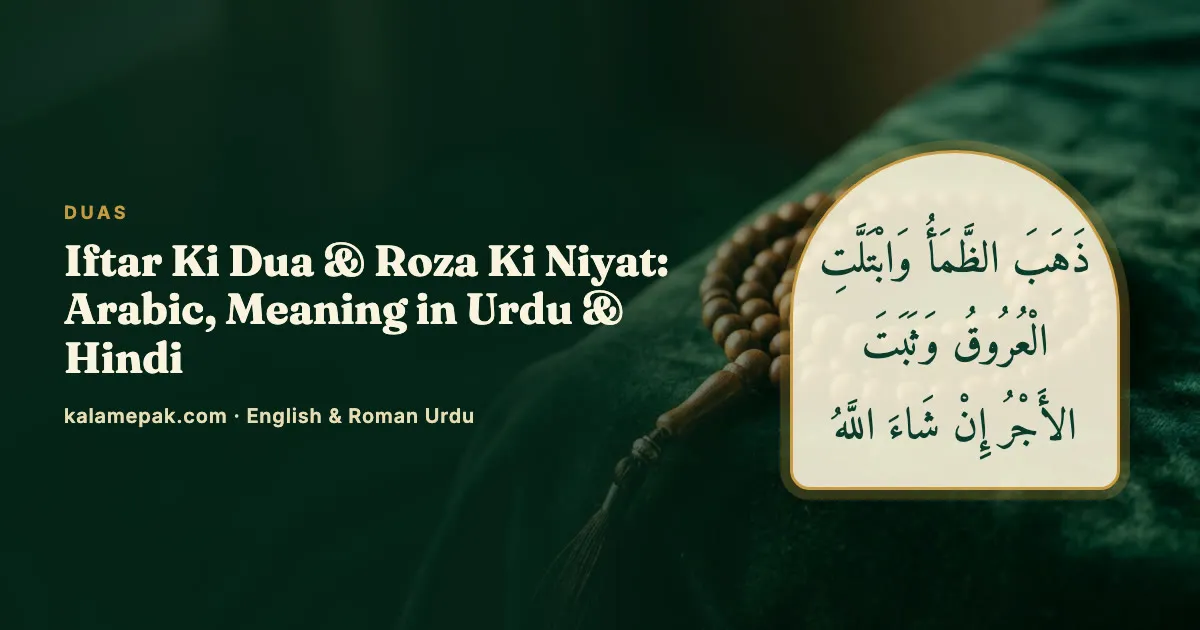
Iftar ki dua is the one dua in Ramadan that everyone says and almost no one has checked. The words most of us were taught, Allāhumma innī laka ṣumtu wa bika āmantu wa ʿalayka tawakkaltu wa ʿalā rizqika afṭartu, are a beautiful dua but a weak hadith. The dua the Prophet ﷺ is actually reported to have said at iftar is shorter and stranger: Dhahaba ẓ-ẓamaʾu wa-btallati l-ʿurūqu wa thabata l-ajru in shāʾallāh, "the thirst has gone, the veins are moist, and the reward is sure, if Allah wills" (Sunan Abi Dawud 2357). Here are both, with the sehri side of it, roza ki niyat, and what the hadith actually says about intention; each in Arabic and Roman English with meaning in English, Urdu, Roman Urdu and Hindi, and every word.
Iftar ki dua from the hadith (Dhahabaz zama'u)
The thirst has gone, the veins are moist, and the reward is sure, if Allah wills.
Pyaas chali gayi, ragein tar ho gayin, aur ajr saabit ho gaya, in sha Allah.
Sunan Abi Dawud 2357 · narrated by Ibn Umar · hasan (al-Albani)
پیاس چلی گئی، رگیں تر ہو گئیں، اور اجر ثابت ہو گیا، ان شاء اللہ
प्यास चली गई, रगें तर हो गईं, और अज्र साबित हो गया, इन शा अल्लाह।
Roman English: Dhahaba ẓ-ẓamaʾu wa-btallati l-ʿurūqu wa thabata l-ajru in shāʾallāh.
Marwan ibn Salim says he saw Ibn Umar, and Ibn Umar said: when the Messenger of Allah ﷺ broke his fast he would say these words. Notice what the dua does not do: it does not ask for anything. It states three facts, two about the body and one about the hereafter, and ends with in shāʾallāh on the one that matters. The English on this page is a plain rendering of sunnah.com's translation; the Urdu, Roman Urdu and Hindi are our own plain rendering of the Arabic.
The popular dua (Allahumma inni laka sumtu)
O Allah, for You I have fasted, and with Your provision I have broken my fast.
Aey Allah! Tere liye maine roza rakha, aur Tere rizq se maine iftar kiya.
Sunan Abi Dawud 2358 · Mu'adh ibn Zuhrah · da'if (al-Albani)
اے اللہ! تیرے لیے میں نے روزہ رکھا، اور تیرے رزق سے میں نے افطار کیا
ऐ अल्लाह! तेरे लिए मैंने रोज़ा रखा, और तेरे रिज़्क़ से मैंने इफ़्तार किया।
Roman English: Allāhumma laka ṣumtu wa ʿalā rizqika afṭartu.
This is the hadith behind the dua on most Ramadan calendars. Its chain stops at Mu'adh ibn Zuhrah, a Tabi'i who says "it reached him" that the Prophet ﷺ used to say it; he names no Companion, so al-Albani grades it da'if. The fuller version printed in India, with wa bika āmantu wa ʿalayka tawakkaltu ("and in You I believed, and on You I relied") added in the middle, is not in Abu Dawud, Tirmidhi, Nasa'i, Ibn Majah, Bukhari or Muslim at all. The meaning is good, and there is no harm in saying it as your own words, but if you want to say what the Prophet ﷺ said, say the Dhahaba ẓ-ẓamaʾ dua above, and then whatever you like in your own language: the moment of iftar is a time when dua is accepted (Jami at-Tirmidhi 3598).
Roza ki niyat (sehri ki dua)
The words on the calendar, wa bi-ṣawmi ghadin nawaytu min shahri Ramaḍān, "and I intend to fast tomorrow in the month of Ramadan", are not a hadith. No book of hadith has them. What the Prophet ﷺ did teach is this:
He who does not resolve to fast before dawn has no fast.
Jis ne fajr se pehle roze ka pakka iraada na kiya, us ka roza nahin.
Sunan Abi Dawud 2454 · narrated by Hafsa · sahih (al-Albani)
जिसने फ़ज्र से पहले रोज़े का पक्का इरादा न किया, उसका रोज़ा नहीं।
So the niyat is the resolve itself: when you get up for sehri knowing you are fasting tomorrow, that is the niyat, done. Saying nawaytu in Arabic is a habit of the subcontinent, not a condition; if it helps you remember, say it, and know that the real niyat happened in your heart before the words. At sehri there is one more thing with a sound chain: the Prophet ﷺ said tasaḥḥarū fa-inna fi s-saḥūri barakah, "take sehri, for there is blessing in sehri" (Sahih al-Bukhari 1923). And before you eat, the ordinary khane ki dua: Bismillāh.
Word by word
The number in the last column is the word's place in 600 Words of the Quran.
| Arabic | Say it | Meaning | In the book |
|---|---|---|---|
| ذَهَبَ | dhahaba | has gone | dhahaba #271 |
| الظَّمَأُ | aẓ-ẓamaʾ | the thirst | |
| وَابْتَلَّتِ | wa-btallat | and have become wet | |
| الْعُرُوقُ | al-ʿurūq | the veins | |
| وَثَبَتَ | wa thabata | and is established, sure | |
| الأَجْرُ | al-ajr | the reward | ajr #206 |
| إِنْ شَاءَ اللَّهُ | in shāʾallāh | if Allah wills | shāʾa #105 · Allāh #2 |
| اللَّهُمَّ | Allāhumma | O Allah | Allāh #2 |
| لَكَ صُمْتُ | laka ṣumtu | for You I fasted | |
| وَعَلَى رِزْقِكَ | wa ʿalā rizqika | and with Your provision | ʿalā #9 · rizq #100 |
| أَفْطَرْتُ | afṭartu | I broke the fast | |
| الصِّيَامَ | aṣ-ṣiyām | the fasting | |
| قَبْلَ الْفَجْرِ | qabla l-fajr | before dawn | qabl #51 |
Ajr (#206) is the wage, the reward, and thabata l-ajr means the wage is fixed and cannot be taken back. Rizq (#100) is provision, the word the Quran uses for everything Allah gives you to live on, and the dates and water on the iftar table are rizq in the most literal sense. Ṣawm and ṣiyām are the fast; afṭara is to break it, the root of iftar and of Eid al-Fitr.
Three hadith about iftar itself
- Hasten it. The Prophet ﷺ said: people remain upon good as long as they hasten the iftar (Sahih al-Bukhari 1957). The dua comes after the first date, not before it.
- Feed someone. Whoever gives a fasting person food to break his fast with has a reward like his, without the fasting person's reward being reduced at all (Jami at-Tirmidhi 807, sahih).
- Eat sehri. There is blessing in sehri (Sahih al-Bukhari 1923). Ramadan is not thirty days of skipping breakfast; it has its own breakfast, and the Prophet ﷺ told us to eat it.
How to make it a habit
Ramadan 2027 is expected to begin around 8 February. Learn the five words of Dhahaba ẓ-ẓamaʾ now, a month before, so they are ready at the first iftar. At sehri: decide, eat, say Bismillāh. At iftar: date, water, then the dua, then your own dua for whatever you need: the Prophet ﷺ said three duas are not rejected, and the first is the fasting person's until he breaks his fast (Jami at-Tirmidhi 3598, hasan). The month's other short texts, Surah Qadr for the last ten nights and the ordinary khane ki dua for every meal, are on this site too.
Sources: Quran text from the Quranic Arabic Corpus and Tanzil · verse meanings in English from Marmaduke Pickthall and in Urdu from Maulana Muhammad Junagarhi · meanings of duas and phrases in Roman Urdu, Urdu and Hindi are our own plain renderings · hadith with collection and number, linked to sunnah.com. How we check every article →
Frequently asked questions
What is iftar ki dua?
The dua with the best chain is Dhahabaz zama'u wabtallatil 'uruqu wa thabatal ajru in sha Allah: the thirst has gone, the veins are moist, and the reward is sure, if Allah wills. Ibn Umar narrates that the Prophet ﷺ said it when he broke his fast (Sunan Abi Dawud 2357, graded hasan by al-Albani).
Is 'Allahumma inni laka sumtu wa bika amantu wa alayka tawakkaltu wa ala rizqika aftartu' authentic?
The core of it, Allahumma laka sumtu wa ala rizqika aftartu (O Allah, for You I fasted and with Your provision I break my fast), is Sunan Abi Dawud 2358, graded da'if (weak) by al-Albani because the narrator Mu'adh ibn Zuhrah did not hear it from the Prophet ﷺ directly. The longer version with wa bika amantu wa alayka tawakkaltu is not in the six main collections at all. Its meaning is sound, so saying it as your own dua is fine; just do not call it a hadith of the Prophet ﷺ.
What is roza ki niyat (sehri ki dua)?
The words most of us learnt, Wa bisawmi ghadin nawaitu min shahri Ramadan (I intend to fast tomorrow in the month of Ramadan), are not from any hadith. The sunnah is the intention itself: the Prophet ﷺ said that whoever does not decide to fast before dawn has no fast (Sunan Abi Dawud 2454, sahih). Deciding in your heart at sehri is the niyat; saying the Arabic is optional.
Iftar ki dua in Hindi?
प्यास चली गई, रगें तर हो गईं, और अज्र साबित हो गया, इन शा अल्लाह। Read the Arabic; this is its meaning.
When exactly is iftar ki dua said?
The hadith says idha aftara, when he broke his fast: so take the first date or sip of water at the azan, then say the dua. The Prophet ﷺ also said that people remain upon good as long as they hasten the iftar (Sahih al-Bukhari 1957), so do not delay the first bite for the dua.