Bismillah Meaning in English, Hindi & Urdu (Word by Word)
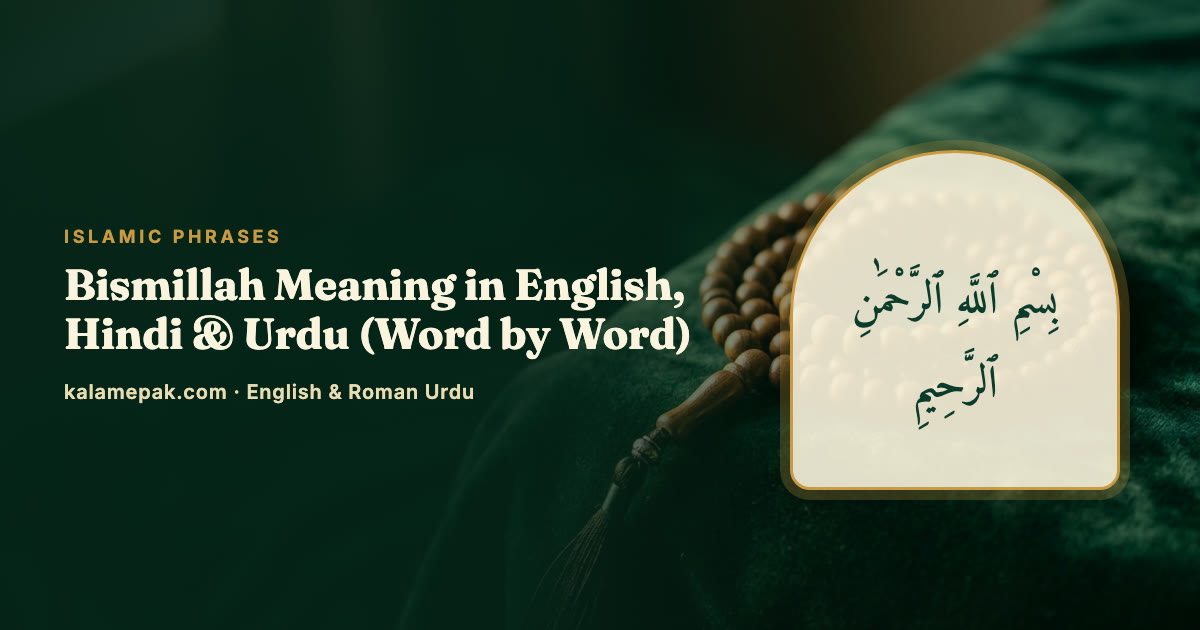
Bismillah means "In the name of Allah" (in Urdu and Hindi: Allah ke naam se). The full phrase, Bismillahir Rahmanir Raheem, means "In the name of Allah, the Beneficent, the Merciful." It is the first verse of the Quran, and for many of us, the first Arabic we ever learned.
We say it so often, before food, before a journey, before opening a book, that it can turn into a sound rather than a sentence. This article gives you the four words it is made of, where it appears in the Quran, and a few ways to say it with meaning again.
Short and full forms
In the name of Allah
Allah ke naam se
Bismillāh · the short form used in daily life
In the name of Allah, the Beneficent, the Merciful.
Shuru karta hoon Allah Ta'ala ke naam se jo bada meherbaan nihaayat bahut zyada rahm wala hai
Surah Al-Fatiha · 1:1
Bismillah meaning in Urdu (Maulana Junagarhi's translation of 1:1):
شروع کرتا ہوں اللہ تعالیٰ کے نام سے جو بڑا مہربان نہایت رحم واﻻ ہے
Bismillah meaning in Hindi: the Roman Urdu line above is how most Hindi speakers would say it too: "Shuru karta hoon Allah ke naam se, jo bada meherbaan, nihaayat rahm wala hai."
Notice that the Urdu begins with "Shuru karta hoon", "I begin". The Arabic has no separate word for "I begin", but Bismillah is said at the start of something, so the translator makes that clear. In English you can hear it the same way: "(I begin) in the name of Allah…"
Bismillah word by word
| Arabic | Say it | Meaning | In the book |
|---|---|---|---|
| بِسْمِ | bismi | in the name (of) | #295 ism "name" · 39× |
| ٱللَّهِ | Allāhi | Allah | #2 · 2,699× |
| ٱلرَّحْمَٰنِ | ar-Raḥmāni | the Most Gracious (Pickthall: the Beneficent) | #289 raḥmān · 57× |
| ٱلرَّحِيمِ | ar-Raḥīm | the Most Merciful | #284 raḥīm · 116× |
"In the book" is the word's number in 600 Words of the Quran and how often it appears in the whole Quran. The first word is really two: bi ("in, with, by") joined to ism ("name"). In the Quran's script the alif of ism is dropped in this phrase, so you see بِسْمِ and not bi-ism.
Ism: name
Urdu borrowed this word too: ism, ism-e-sharif. It appears 39 times in the Quran. One of the most famous is in the first verse revealed to the Prophet Muhammad ﷺ:
Read: In the name of thy Lord Who createth,
Padh apne Rabb ke naam se jis ne paida kiya
Surah Al-Alaq · 96:1
Same bi + ism, "in the name of", and here you can even see the alif written. This time it is followed by "your Lord".
Allah
The name of God, and the most frequent noun in the Quran: 2,699 times as a main word. It is word #2 in the book, right after min ("from").
Ar-Rahman and ar-Raheem: two kinds of mercy
Both names come from the root r-ḥ-m, mercy. The same root gives raḥma (mercy, word #285, 114 times) and raḥima ("he had mercy", word #298). In Urdu you already know it: rahm, rehmat, raheem.
Why two names from the same root, one after the other? Scholars have explained it in a few ways. A common explanation is that ar-Raḥmān stresses how vast Allah's mercy is, covering all creation, and ar-Raḥīm how constant it is. Pickthall catches the difference with "the Beneficent, the Merciful", Junagarhi with "bada meherbaan, nihaayat rahm wala".
Either way, the point is clear: of all Allah's names, the two He chose to put in the sentence we say before everything are both about mercy.
Where Bismillah appears in the Quran
- At the start of every surah except one. Surah At-Tawbah (Surah 9) is the only surah that does not begin with it.
- As verse 1 of Surah Al-Fatiha, in the numbering used in most Indian and Pakistani copies. (Scholars differ on whether it counts as a verse of the Fatiha and of the other surahs. See our Surah Fatiha meaning for the full surah.)
- Inside a verse, in the letter the Prophet Sulaiman (peace be upon him) sent to the Queen of Sheba:
Lo! it is from Solomon, and lo! it is: In the name of Allah, the Beneficent, the Merciful;
Jo Sulaiman ki taraf se hai aur jo bakhshish karne wale meherbaan Allah ke naam se shuru hai
Surah An-Naml · 27:30
- On a boat. When the Prophet Nuh (peace be upon him) told the believers to board the ark, he said: "Embark therein! In the name of Allah be its course and its mooring" (11:41). Many people remember this when they start a journey.
When do Muslims say Bismillah?
It is said at the start of almost any good action. Common moments:
- before eating and drinking
- before reciting the Quran (after aʿūdhu billāh), and in namaz before the Fatiha. Whether it is said aloud or quietly in namaz differs between schools
- before wudu
- when leaving or entering the home
- when starting a journey or getting into a vehicle
- before starting work, study, or writing something important
The idea behind all of them is the same: "I am not starting this on my own strength. I start in the name of Allah, the Most Gracious, the Most Merciful."
Three ways to say it with meaning again
- Pause after "Bismillah". Before you continue with ar-Raḥmān ar-Raḥīm, take half a second to remember whose name you just used.
- Hear the Urdu in your head. Allah ke naam se is short enough to think in the same breath.
- Connect it to the next thing. Before food: "in His name I eat what He gave". Before a drive: remember Nuh's "bismi llāh" on the ark.
Keep going
The next verse of the Fatiha begins with another phrase we say every day. See Alhamdulillah meaning. To see which of Allah's names are among the most common words of the Quran, read Allah's names in the Quran's common words, and if you are just starting with Arabic, Quran vocabulary for beginners lists the first 25 words to learn.
Every word of Bismillah (ism, Allah, raḥmān, raḥīm) is in 600 Words of the Quran, a book that teaches the most common Quranic words in 30 short lessons, each with a real verse and its meaning in English and Roman Urdu.
Frequently asked questions
What does Bismillah mean?
Bismillah means 'In the name of Allah'. In Urdu and Hindi: 'Allah ke naam se'.
What is the full meaning of Bismillahir Rahmanir Raheem?
In the name of Allah, the Beneficent, the Merciful (Pickthall). In Roman Urdu: Shuru karta hoon Allah Ta'ala ke naam se jo bada meherbaan nihaayat rahm wala hai.
What is the difference between Rahman and Raheem?
Both come from the root r-h-m, mercy. Pickthall translates them 'the Beneficent, the Merciful' and Junagarhi 'bada meherbaan, nihaayat rahm wala'. A common explanation is that Rahman stresses how vast Allah's mercy is and Raheem how constant it is.
Which surah does not begin with Bismillah?
Surah At-Tawbah (Surah 9). Every other surah begins with it, and it also appears inside Surah An-Naml (27:30), in the letter of Prophet Sulaiman.
Is Bismillah a verse of Surah Fatiha?
In the numbering used in most Indian and Pakistani copies of the Quran, it is verse 1 of the Fatiha. Scholars differ on whether it is a verse of the Fatiha and of other surahs, and on whether it is recited aloud in namaz.