Astaghfirullah Meaning in Hindi, Urdu & English (Word by Word)
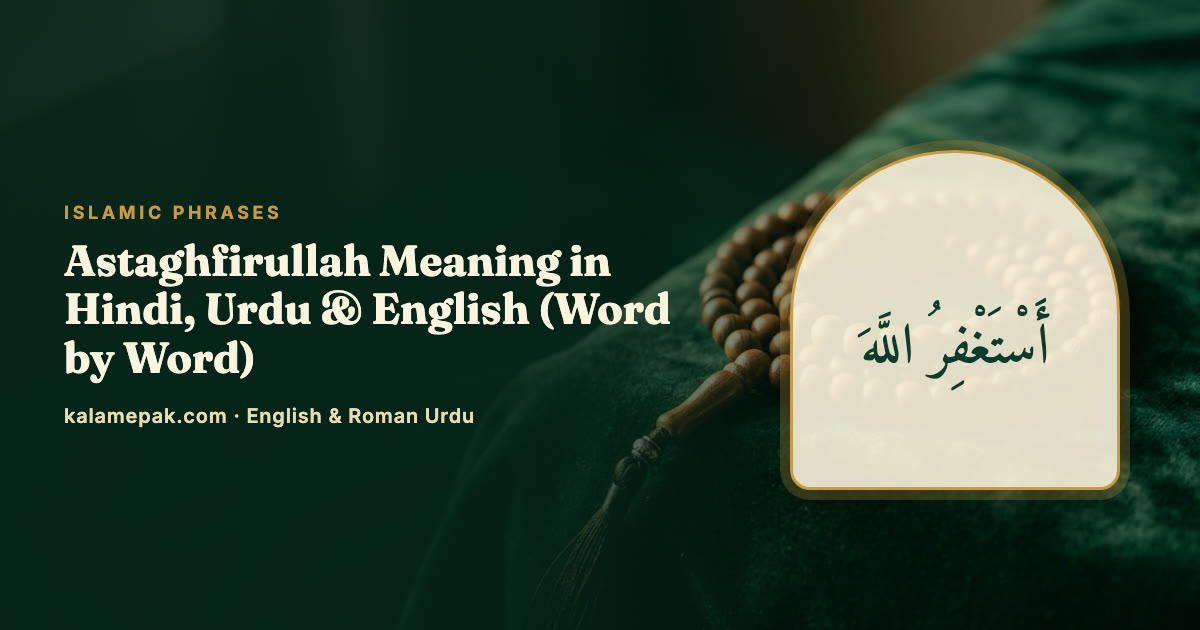
Astaghfirullah means "I ask Allah for forgiveness." In Hindi and Urdu: "Main Allah se maafi maangta hoon."
I ask Allah for forgiveness
Main Allah se maafi maangta hoon
Astaghfiru llāh
In South Asia you'll hear it in two very different ways. Sometimes it's a quiet, sincere dua after a mistake. Sometimes it's a shocked "Astaghfirullah!" when someone hears something bad. The first is its real meaning — you are asking, not just reacting. Once you see how the word is built, that difference becomes obvious.
Astaghfirullah word by word
| Arabic | Say it | Meaning | In the book |
|---|---|---|---|
| أَسْتَغْفِرُ | astaghfiru | I ask for forgiveness | istaghfara, word #399 · 40 times |
| اللَّهَ | Allāha | Allah | word #2 · 2,699 times |
That's all — two words. But the first one is packed:
- a- = "I" (the speaker)
- -sta- = here it adds the sense of "asking for"
- ghfir = forgiveness (root gh-f-r)
So astaghfiru is literally "I ask for forgiveness". You've already met this "asking" pattern in every rakʿah: in Al-Fatiha, nastaʿīn means "we ask for help".
Thee (alone) we worship; Thee (alone) we ask for help.
Hum sirf teri hi ibaadat karte hain aur sirf tujh hi se madad chaahte hain
Surah Al-Fatiha · 1:5
Nasta-ʿīn (we ask for help) and asta-ghfir (I ask for forgiveness) — once you spot the pattern, you'll see it all over the Quran.
Astaghfirullah meaning in Hindi and Urdu
"Astaghfirullah ka matlab kya hai?"
Astaghfirullah = Main Allah se maafi maangta hoon (मैं अल्लाह से माफ़ी माँगता हूँ). A woman would say maangti hoon — the Arabic word is the same for both.
The act of saying it is called istighfar (Urdu: istighfaar) — the same root again.
The gh-f-r family: four forgiveness words in the book
This is one of the richest root families in the Quran. All four of these words are among the 600 most common Quran words:
| Arabic | Say it | Meaning | In the book |
|---|---|---|---|
| غَفَرَ | ghafara | he forgave | word #130 · 65 times |
| غَفُور | ghafūr | Most Forgiving (a name of Allah) | word #287 · 91 times |
| اسْتَغْفَرَ | istaghfara | he sought forgiveness | word #399 · 40 times |
| مَغْفِرَة | maghfirah | forgiveness (Urdu: maghfirat) | word #418 · 28 times |
Put the counts together: this family appears well over 200 times in the Quran just through these four words. The name Ghafūr — Most Forgiving — alone appears 91 times. That tells you how much the Quran wants us to ask.
Astaghfirullah in the Quran
The Quran doesn't just allow istighfar — it commands it, again and again.
And seek forgiveness of Allah. Lo! Allah is ever Forgiving, Merciful.
Aur Allah Ta'ala se bakhshish maafi maango! Beshak Allah Ta'ala bakhshish karne wala, meharbaani karne wala hai
Surah An-Nisa · 4:106
Notice wa-staghfiri llāh — "and seek forgiveness of Allah". That's almost our exact phrase, as a command. And the verse closes with ghafūr, word #287, from the same root.
Prophet Nuh (Noah) told his people:
And I have said: Seek pardon of your Lord. Lo! He was ever Forgiving.
Aur main ne kaha ke apne Rabb se apne gunaah bakhshwao (aur maafi maango), woh yaqeenan bada bakhshne wala hai
Surah Nuh · 71:10
And in Surah An-Nasr — a surah many of us recite in namaz — even at the moment of victory, the instruction is to glorify and seek forgiveness:
Then hymn the praises of thy Lord, and seek forgiveness of Him. Lo! He is ever ready to show mercy.
To apne Rabb ki tasbeeh paaki bayaan karne lag hamd taareef ke saath aur us se maghfirat maafi ki dua maang, beshak woh bada hi tauba qubool karne wala hai
Surah An-Nasr · 110:3
Success is not a reason to stop asking for forgiveness — it's a reason to ask more. (More in Surah Nasr meaning.)
Istighfar and tauba — what's the difference?
People often use them as if they're the same, but the Quran puts them side by side:
Ask pardon of your Lord and then turn unto Him (repentant). Lo! my Lord is Merciful, Loving.
Tum apne Rabb se istighfaar maafi maangna karo aur us ki taraf tauba karo, yaqeen maano ke mera Rabb badi meharbaani wala aur bahut mohabbat karne wala hai
Surah Hud · 11:90
- Istighfar (istaghfirū) — asking Allah to forgive.
- Tauba (tūbū, from tāba, word #131, "he repented, turned") — turning back to Him, leaving the wrong.
Asking with the tongue, turning with the life. Both together.
You already ask for forgiveness in namaz
Many people recite this dua after Durood, before salaam — look how many gh-f-r words are in it:
O Allah, I have wronged myself greatly, and no one forgives sins except You. So forgive me with forgiveness from You, and have mercy on me. You are the Forgiving, the Merciful.
Aey Allah! Main ne apni jaan par bahut zulm kiya, aur gunaahon ko Tere siwa koi maaf nahin karta. Bas apni taraf se mujhe maaf farma de aur mujh par rahm farma. Beshak Tu hi bahut maaf karne wala, nihaayat rahm wala hai.
Sahih al-Bukhari 834, Sahih Muslim 2705
Yaghfiru (forgives), fa-ghfir (so forgive), maghfiratan (forgiveness), al-ghafūr (the Forgiving) — four times in one dua. Once you know the root, this dua suddenly makes sense. We explain it word by word in dua after Durood in namaz.
When do Muslims say Astaghfirullah?
- After a mistake — a harsh word, a lie, a missed duty. Say it and mean it.
- As daily dhikr — many people make it a habit to say it many times a day.
- After namaz — many people say astaghfirullah a few times right after salaam.
- When hearing something wrong — the common South Asian use. It's fine, but remember the phrase is a request to Allah, so say it as one.
Spelling variants: Astaghfirullah, Astagfirullah, Astaghfirullah hal azeem
- Astaghfirullah, Astagfirullah, Astaghferullah, Astaghfir Allah — all the same phrase. The "gh" is the throaty sound like the French "r"; writing "g" is a common simplification.
- Astaghfirullah hal azeem — a longer form people say: astaghfiru llāha l-ʿaẓīm, "I ask forgiveness of Allah, the Mighty". ʿAẓīm (great, tremendous) is word #244 in the book — the same word you say in ruku: subḥāna rabbiya l-ʿaẓīm.
A 1-minute practice
Tonight, before sleeping, say astaghfirullah slowly three times. On the first, think of one wrong from today. On the second, think of Ghafūr, the Most Forgiving — a word that appears 91 times in the Quran. On the third, decide one thing you'll do differently tomorrow. That's istighfar and tauba together.
Learning roots like gh-f-r is one of the fastest ways to understand the Quran — one root can unlock four or five words at once. The book 600 Words of the Quran teaches the most common words with a real verse for each, in English and Roman Urdu. Also see SubhanAllah meaning.
Frequently asked questions
What does Astaghfirullah mean?
Astaghfirullah (astaghfiru llāh) means 'I ask Allah for forgiveness'. In Hindi and Urdu: 'Main Allah se maafi maangta hoon'.
What is the root of Astaghfirullah?
The root is gh-f-r, which is about forgiving and covering. From it come ghafara (he forgave), ghafūr (Most Forgiving), maghfirah (forgiveness) and istaghfara (he sought forgiveness) — all four are in the 600 most common Quran words.
When should you say Astaghfirullah?
Whenever you realise you've made a mistake, when you remember past sins, as regular dhikr, and many people also say it after finishing namaz. The Quran repeatedly tells believers to seek Allah's forgiveness.
What is the difference between istighfar and tauba?
Istighfar is asking Allah for forgiveness. Tauba means turning back to Allah — leaving the wrong. Verse 11:90 mentions both together: 'Ask pardon of your Lord and then turn unto Him'.