Surah Nasr Meaning in English & Urdu (Word by Word)
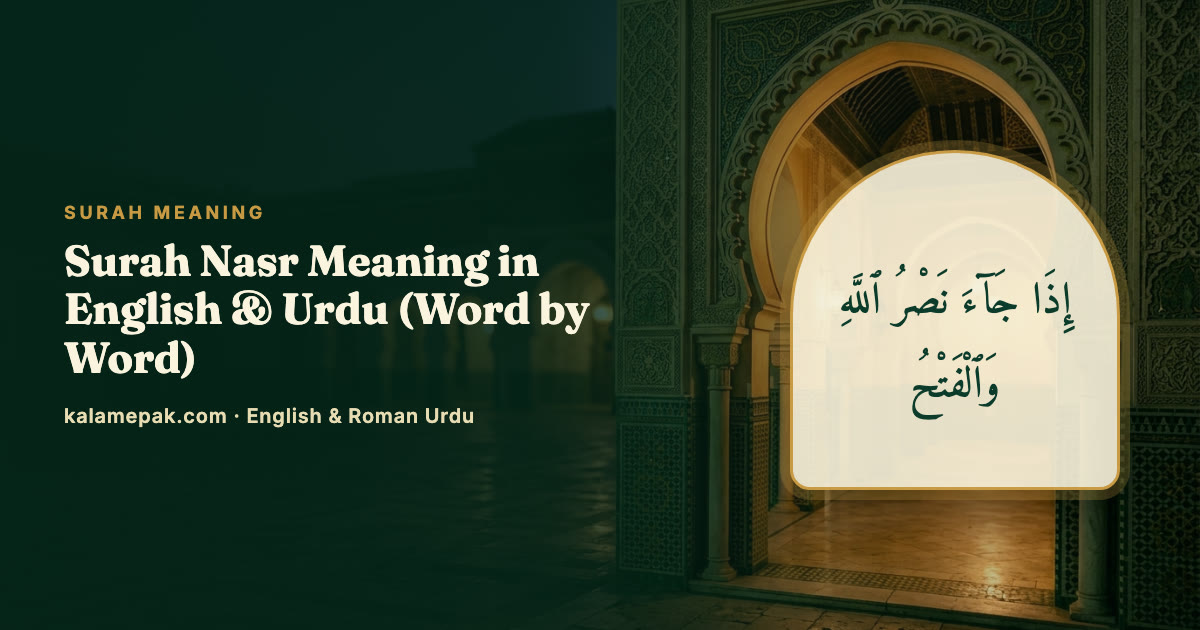
What should a believer do when things finally go right? Surah Nasr answers in three verses. Its meaning: "When Allah's succour and the triumph cometh and thou seest mankind entering the religion of Allah in troops, then hymn the praises of thy Lord, and seek forgiveness of Him. Lo! He is ever ready to show mercy."
In Urdu (Roman): Jab Allah ki madad aur fateh aa jaaye, aur tu logon ko Allah ke deen mein jauq dar jauq aata dekh le, to apne Rabb ki tasbeeh karne lag hamd ke saath aur us se maghfirat ki dua maang — beshak woh bada hi tauba qubool karne wala hai.
Victory, and then — not celebration, not pride — but tasbeeh, hamd and istighfar. Those three are words you already say in every namaz. That is the focus of this page.
Surah Nasr meaning in English and Urdu
When Allah's succour and the triumph cometh
Jab Allah ki madad aur fateh aa jaaye
Surah An-Nasr · 110:1
And thou seest mankind entering the religion of Allah in troops,
Aur tu logon ko Allah ke deen mein jauq dar jauq jhund ke jhund aata dekh le
Surah An-Nasr · 110:2
Then hymn the praises of thy Lord, and seek forgiveness of Him. Lo! He is ever ready to show mercy.
To apne Rabb ki tasbeeh paaki bayaan karne lag hamd taareef ke saath aur us se maghfirat maafi ki dua maang, beshak woh bada hi tauba qubool karne wala hai
Surah An-Nasr · 110:3
Surah Nasr word by word
| Arabic | Say it | Meaning | In the book |
|---|---|---|---|
| إِذَا | idhā | when | word #24 — 383 times |
| جَآءَ | jāʾa | comes | word #260 jāʾa (he came) — 278 times |
| نَصْرُ | naṣru | the help (of) | word #350 naṣr — 22 times |
| ٱللَّهِ | Allāhi | Allah | word #2 — 2,699 times |
| وَٱلْفَتْحُ | wal-fatḥ | and the victory (opening) | root shared with #573 fataḥa (he opened) |
| وَرَأَيْتَ | wa raʾayta | and you see | word #104 raʾā (he saw) — 271 times |
| ٱلنَّاسَ | an-nās | the people | word #220 — 241 times |
| يَدْخُلُونَ | yadkhulūna | entering | word #264 dakhala (he entered) — 76 times |
| فِى | fī | into | word #4 — 1,701 times |
| دِينِ | dīni | the religion (of) | word #167 dīn — 92 times |
| أَفْوَاجًا | afwājan | in crowds, troops | — |
| فَسَبِّحْ | fa-sabbiḥ | then glorify | word #397 sabbaḥa — 42 times |
| بِحَمْدِ | bi-ḥamdi | with the praise (of) | word #218 ḥamd — 43 times |
| رَبِّكَ | rabbika | your Lord | word #12 rabb — 975 times |
| وَٱسْتَغْفِرْهُ | wa-staghfirhu | and ask His forgiveness | word #399 istaghfara — 40 times |
| إِنَّهُۥ | innahu | indeed He | word #5 inna + hu |
| كَانَ | kāna | is (ever) | word #10 kāna — 1,358 times |
| تَوَّابًۢا | tawwāban | Accepter of repentance | root shared with #131 tāba (he repented) |
Of the 19 words in this surah, only one — afwājan — has no link to the 600 words in our book. That's how much the short surahs are built from the Quran's most common words.
Look at fatḥ. Its root means "to open" — so a fatḥ is an opening, a breakthrough, a victory. Urdu fateh is the same word. And naṣr (help) is behind the Urdu names Nasir and Nusrat.
Three words you already say in namaz
The last verse gives three instructions. Each one is already part of your prayer.
1. Fa-sabbiḥ — glorify. This is the root of tasbeeh and Subḥān. In ruku you say سُبْحَانَ رَبِّيَ الْعَظِيمِ — Subḥāna rabbiya l-ʿaẓīm, "Glory be to my Lord, the Most Great" (Sahih Muslim 772). In sajdah you say سُبْحَانَ رَبِّيَ الْأَعْلَىٰ — Subḥāna rabbiya l-aʿlā, "Glory be to my Lord, the Most High" (Sahih Muslim 772). Same root as fa-sabbiḥ.
2. Bi-ḥamdi rabbika — with the praise of your Lord. Ḥamd opens Surah Al-Fatiha (al-ḥamdu lillāh), and when you rise from ruku you say رَبَّنَا وَلَكَ الْحَمْدُ — Rabbanā wa laka l-ḥamd, "Our Lord, and to You belongs all praise" (Sahih al-Bukhari 732, 789). The pairing of glory and praise also appears in the well-known dhikr سُبْحَانَ اللَّهِ وَبِحَمْدِهِ — Subḥāna llāhi wa bi-ḥamdih, "Glory be to Allah and praise be to Him" (Sahih al-Bukhari 6405).
3. Wa-staghfirhu — and ask His forgiveness. This is the same verb as أَسْتَغْفِرُ اللَّهَ — astaghfiru llāh, "I ask Allah for forgiveness".
The exact phrase fa-sabbiḥ bi-ḥamdi rabbika is also found elsewhere in the Quran:
But hymn the praise of thy Lord, and be of those who make prostration (unto Him).
Aap apne Parwardigar ki tasbeeh aur hamd bayaan karte rahein aur sajda karne walon mein shaamil ho jaayein
Surah Al-Hijr · 15:98
What Surah Nasr teaches
- Victory is from Allah. Verse 1 doesn't say "your victory"; it says naṣru llāh — Allah's help.
- Success calls for humility. At the moment of greatest success, the instruction is to glorify, praise and ask forgiveness — not to boast.
- The door of forgiveness is always open. The surah ends with tawwāb, a form that means Allah accepts repentance again and again.
It is widely connected with the conquest of Makkah, when people began entering Islam in large groups — the "troops" of verse 2. Many scholars also understood it as a sign that the mission of the Prophet Muhammad ﷺ was nearing its completion.
When is Surah Nasr commonly recited?
Surah An-Nasr is a common short surah in namaz after Surah Al-Fatiha. Because of its message, many people also reflect on it after a success — a result, a new job, a recovery — as a reminder of the right response.
A namaz tip: connect the surah to your ruku
Try this in your next prayer: recite Surah An-Nasr as your surah, and let verse 3 set up what comes next. You say fa-sabbiḥ — "then glorify" — and a moment later you go into ruku and do exactly that: Subḥāna rabbiya l-ʿaẓīm. The surah gives the instruction, and your body follows it.
Read next
The ruku and sajdah words are explained fully in Ruku and sajda tasbeeh meaning. For more on the dhikr in verse 3, see Subhanallah meaning and Astaghfirullah meaning. To compare with another three-verse surah, read Surah Kausar meaning.
Words like naṣr, ḥamd, sabbaḥa and istaghfara each have their own page, with a real verse and Roman Urdu meaning, in 600 Words of the Quran.
Frequently asked questions
What does 'Iza ja'a nasrullahi wal fath' mean?
It means 'When Allah's succour and the triumph cometh' — Roman Urdu: Jab Allah ki madad aur fateh aa jaaye.
What is the main message of Surah Nasr?
When help and victory come from Allah, the right response is not pride but glorifying Allah, praising Him and asking His forgiveness.
What does 'tawwab' mean?
Tawwab describes Allah as the One who accepts repentance again and again. Pickthall writes 'ever ready to show mercy'; the Roman Urdu says 'bada hi tauba qubool karne wala'.
How many verses are in Surah Nasr?
Surah An-Nasr is the 110th surah of the Quran and has 3 verses.