Ayatul Kursi Meaning in English & Roman Urdu (Word by Word)
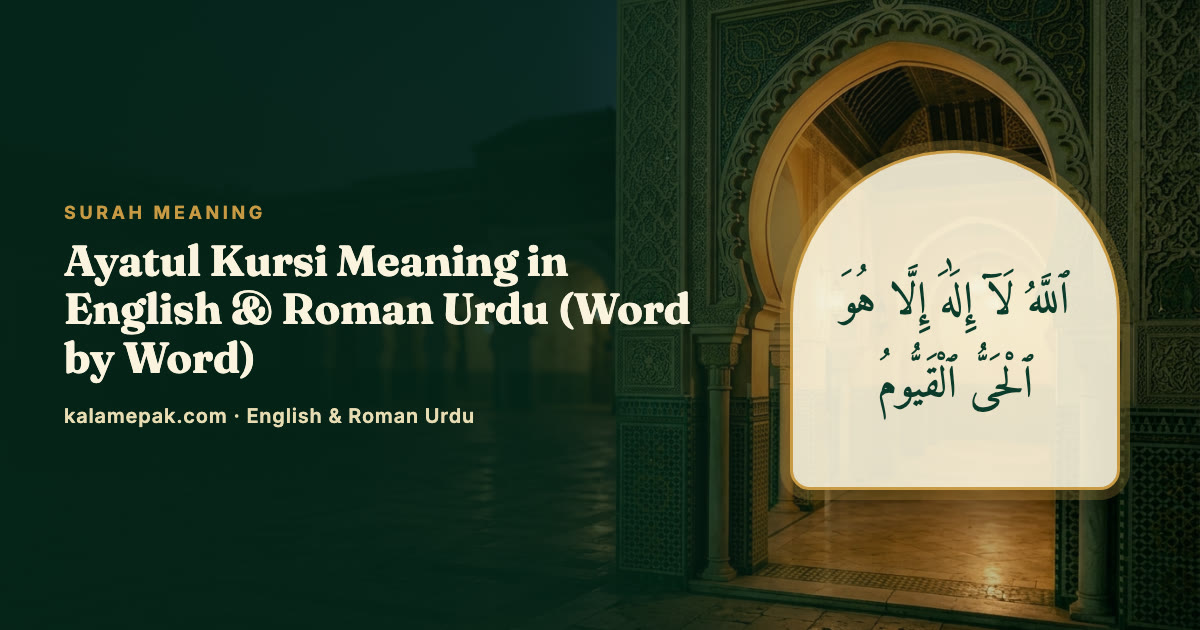
Ayatul Kursi means: "Allah! There is no deity save Him, the Alive, the Eternal. Neither slumber nor sleep overtaketh Him. Unto Him belongeth whatsoever is in the heavens and whatsoever is in the earth. Who is he that intercedeth with Him save by His leave? He knoweth that which is in front of them and that which is behind them, while they encompass nothing of His knowledge save what He will. His throne includeth the heavens and the earth, and He is never weary of preserving them. He is the Sublime, the Tremendous." (Quran 2:255, Pickthall)
Many of us know Ayatul Kursi by heart. We recite it before sleeping, after namaz, when we are afraid. But ask most people what sinatun or yaʾūduhū means, and they are not sure. This guide takes the verse apart in its nine natural phrases, word by word, so that next time you recite it, every line carries its meaning.
Ayatul Kursi in Arabic, English and Roman Urdu
Allah! There is no deity save Him, the Alive, the Eternal. Neither slumber nor sleep overtaketh Him. Unto Him belongeth whatsoever is in the heavens and whatsoever is in the earth. Who is he that intercedeth with Him save by His leave? He knoweth that which is in front of them and that which is behind them, while they encompass nothing of His knowledge save what He will. His throne includeth the heavens and the earth, and He is never weary of preserving them. He is the Sublime, the Tremendous.
Allah Ta'ala hi maabood-e-barhaq hai jis ke siwa koi maabood nahin, jo zinda aur sab ka thaamne wala hai, jise na oongh aaye na neend, us ki milkiyat mein zameen aur aasmaanon ki tamaam cheezein hain. Kaun hai jo us ki ijaazat ke baghair us ke saamne shafaa'at kar sake, woh jaanta hai jo un ke saamne hai aur jo un ke peechhe hai aur woh us ke ilm mein se kisi cheez ka ihaata nahin kar sakte magar jitna woh chaahe, us ki kursi ki wus'at ne zameen o aasmaan ko gher rakha hai aur Allah Ta'ala un ki hifaazat se na thakta aur na uktaata hai, woh to bahut buland aur bahut bada hai
Surah Al-Baqarah · 2:255 (Ayat al-Kursi)
The Roman Urdu is a simple transliteration of Maulana Muhammad Junagarhi's Urdu translation.
Why it is special: The Prophet Muhammad ﷺ once asked Ubayy ibn Ka'b which verse in the Book of Allah is the greatest. Ubayy answered with this verse, and the Prophet ﷺ approved his answer (Sahih Muslim 810). Sahih al-Bukhari (2311) also reports that whoever recites it when going to bed has a guard from Allah through the night.
Ayatul Kursi word by word, phrase by phrase
"In the book" = the word's number in 600 Words of the Quran and how many times it appears in the whole Quran. Attached pieces are shown in the meaning: wa- "and", bi- "by/with", -hū "Him/His", -hum/-him "them".
1. Allahu la ilaha illa huwa, al-Hayyul Qayyum
"Allah! There is no deity save Him, the Alive, the Eternal." · Allah Ta'ala hi maabood-e-barhaq hai jis ke siwa koi maabood nahin, jo zinda aur sab ka thaamne wala hai.
| Arabic | Say it | Meaning | In the book |
|---|---|---|---|
| ٱللَّهُ | Allāhu | Allah | #2 · 2,699× |
| لَآ | lā | (there is) no | #3 · 1,742× |
| إِلَٰهَ | ilāha | god, deity | #283 ilāh · 147× |
| إِلَّا | illā | except | #17 · 659× |
| هُوَ | huwa | He | — |
| ٱلْحَىُّ | al-Ḥayyu | the Ever-Living | #299 ḥayy · 24× |
| ٱلْقَيُّومُ | al-Qayyūm | the Self-Sustaining, who holds everything up | not in the 600 list |
These exact words also open Surah Al-Imran: ٱللَّهُ لَآ إِلَٰهَ إِلَّا هُوَ ٱلْحَىُّ ٱلْقَيُّومُ (3:2). Learn them once, recognise them twice. Junagarhi's "sab ka thaamne wala" ("the one who holds everything") is a lovely way to understand al-Qayyūm: nothing stands on its own; He holds it all up. For the first half of this line, see La ilaha illallah meaning.
2. La ta'khudhuhu sinatun wa la nawm
"Neither slumber nor sleep overtaketh Him." · Jise na oongh aaye na neend.
| Arabic | Say it | Meaning | In the book |
|---|---|---|---|
| لَا | lā | not | #3 |
| تَأْخُذُهُۥ | taʾkhudhuhū | overtakes Him (literally "takes Him") | #84 akhadha · 127× |
| سِنَةٌ | sinatun | slumber, drowsiness (oongh) | not in the 600 list |
| وَلَا | wa lā | and not | #3 |
| نَوْمٌ | nawm | sleep | not in the 600 list |
First the light doze, then deep sleep: neither touches Him. Every human guard eventually nods off. The One guarding the universe never does.
3. Lahu ma fis samawati wa ma fil ard
"Unto Him belongeth whatsoever is in the heavens and whatsoever is in the earth." · Us ki milkiyat mein zameen aur aasmaanon ki tamaam cheezein hain.
| Arabic | Say it | Meaning | In the book |
|---|---|---|---|
| لَّهُۥ | lahū | to Him (belongs): la + -hū | — |
| مَا | mā | whatever | #7 mā "what, that which" · 1,592× |
| فِى | fī | in | #4 · 1,701× |
| ٱلسَّمَٰوَٰتِ | as-samāwāti | the heavens | #142 samāʾ · 310× |
| وَمَا | wa mā | and whatever | #7 |
| ٱلْأَرْضِ | al-arḍ | the earth | #22 arḍ · 461× |
4. Man dhal ladhi yashfa'u 'indahu illa bi-idhnih
"Who is he that intercedeth with Him save by His leave?" · Kaun hai jo us ki ijaazat ke baghair us ke saamne shafaa'at kar sake?
| Arabic | Say it | Meaning | In the book |
|---|---|---|---|
| مَن | man | who | #14 · 871× |
| ذَا | dhā | (is) this, that | #11 · 1,058× |
| ٱلَّذِى | alladhī | who, the one who | #8 · 1,468× |
| يَشْفَعُ | yashfaʿu | intercedes | not in the 600 list |
| عِندَهُۥٓ | ʿindahū | with Him, in His presence | #34 ʿinda · 197× |
| إِلَّا | illā | except | #17 |
| بِإِذْنِهِۦ | bi-idhnihī | by His permission | #412 idhn · 39× |
5. Ya'lamu ma bayna aydihim wa ma khalfahum
"He knoweth that which is in front of them and that which is behind them." · Woh jaanta hai jo un ke saamne hai aur jo un ke peechhe hai.
| Arabic | Say it | Meaning | In the book |
|---|---|---|---|
| يَعْلَمُ | yaʿlamu | He knows | #103 ʿalima · 382× |
| مَا | mā | what | #7 |
| بَيْنَ | bayna | between | #31 bayn · 266× |
| أَيْدِيهِمْ | aydīhim | their hands | #145 yad · 120× |
| وَمَا | wa mā | and what | #7 |
| خَلْفَهُمْ | khalfahum | behind them | #389 khalf · 22× |
Literally "what is between their hands", an Arabic way of saying "what is in front of them". This same phrase appears in 20:110: يَعْلَمُ مَا بَيْنَ أَيْدِيهِمْ وَمَا خَلْفَهُمْ. Once you know it, you will spot it again.
6. Wa la yuhituna bi-shay'in min 'ilmihi illa bima sha'
"While they encompass nothing of His knowledge save what He will." · Aur woh us ke ilm mein se kisi cheez ka ihaata nahin kar sakte magar jitna woh chaahe.
| Arabic | Say it | Meaning | In the book |
|---|---|---|---|
| وَلَا | wa lā | and not | #3 |
| يُحِيطُونَ | yuḥīṭūna | they encompass, grasp fully | #551 aḥāṭa · 17× |
| بِشَىْءٍ | bi-shayʾin | anything | #143 shayʾ · 283× |
| مِّنْ | min | of | #1 · 3,226× |
| عِلْمِهِۦٓ | ʿilmihī | His knowledge | #107 ʿilm · 105× |
| إِلَّا | illā | except | #17 |
| بِمَا | bi-mā | what | #7 |
| شَآءَ | shāʾa | He wills | #105 shāʾa · 236× |
Everything humans have ever discovered is only the part of His knowledge that He willed to give. Shāʾa is the same word you say in in shāʾa llāh.
7. Wasi'a kursiyyuhus samawati wal ard
"His throne includeth the heavens and the earth." · Us ki kursi ki wus'at ne zameen o aasmaan ko gher rakha hai.
| Arabic | Say it | Meaning | In the book |
|---|---|---|---|
| وَسِعَ | wasiʿa | extends over, includes | not in the 600 list |
| كُرْسِيُّهُ | kursiyyuhu | His Kursi | not in the 600 list |
| ٱلسَّمَٰوَٰتِ | as-samāwāti | the heavens | #142 |
| وَٱلْأَرْضَ | wal-arḍa | and the earth | #22 |
This is the phrase that gives the verse its name: Ayat al-Kursi, "the verse of the Kursi". Pickthall translates kursī as "throne"; Junagarhi keeps the word kursi. The Quran's usual word for Allah's Throne is a different one, ʿarsh (word #297 in the book).
8. Wa la ya'uduhu hifzuhuma
"And He is never weary of preserving them." · Aur Allah Ta'ala un ki hifaazat se na thakta aur na uktaata hai.
| Arabic | Say it | Meaning | In the book |
|---|---|---|---|
| وَلَا | wa lā | and not | #3 |
| يَـُٔودُهُۥ | yaʾūduhū | tires Him, burdens Him | not in the 600 list |
| حِفْظُهُمَا | ḥifẓuhumā | guarding the two of them (heavens and earth) | not in the 600 list |
Ḥifẓ (guarding, preserving) is the word behind ḥāfiẓ, someone who "guards" the Quran in memory.
9. Wa huwal 'Aliyyul 'Azeem
"He is the Sublime, the Tremendous." · Woh to bahut buland aur bahut bada hai.
| Arabic | Say it | Meaning | In the book |
|---|---|---|---|
| وَهُوَ | wa huwa | and He (is) | — |
| ٱلْعَلِىُّ | al-ʿAliyyu | the Most High | not in the 600 list |
| ٱلْعَظِيمُ | al-ʿAẓīm | the Most Great | #244 ʿaẓīm · 107× |
You already say this word in every ruku: subḥāna rabbiya l-ʿaẓīm, "Glory be to my Lord, the Most Great." See ruku and sajda tasbeeh meaning.
How much of Ayatul Kursi can you already recognise?
Ayatul Kursi has 50 words. By our count from the tables above:
- 38 are built on a word from the 600 list (Allah, lā, ilāh, illā, ḥayy, mā, fī, samāʾ, arḍ, ʿilm, shāʾa, ʿaẓīm…);
- 3 are simply "He/Him" (huwa, lahū, wa huwa);
- only 9 (qayyūm, sinah, nawm, yashfaʿu, wasiʿa, kursī, yaʾūdu, ḥifẓ, ʿaliyy) are outside the list, and you have just learned them.
That is the same pattern across the Quran: the 600 words in the book are the main word in about 8 out of every 10 words of the Quran (79.8% of its 77,429 words, counting the core word, not small attached letters like wa-, bi- or pronoun endings). See the most common words in the Quran for the top of the list.
Ayatul Kursi meaning in Hindi (easy words)
The Roman Urdu above is everyday Hindustani, readable for Hindi speakers. Harder words:
- maabood-e-barhaq: the true one worthy of worship · thaamne wala: the one who holds up
- oongh: dozing · milkiyat: ownership
- shafaa'at: intercession, speaking on someone's behalf · ijaazat: permission
- ihaata karna: to encompass, grasp fully · wus'at: vastness · hifaazat: guarding
- buland: high, exalted
Memorise it with meaning in 9 days
Take one phrase a day. Read its line of meaning, say the Arabic three times, and use it that night before sleeping. By day 9, you will be reciting the whole verse and understanding every phrase as you go. When you finish, try Allah's names in the Quran's common words to see where ḥayy, ʿaẓīm and other names appear.
If this word-by-word approach helps, 600 Words of the Quran teaches the most common words in 30 short lessons, each word with a real verse and its meaning in English and Roman Urdu.
Frequently asked questions
What is the meaning of Ayatul Kursi in short?
It says that Allah alone is God, the Ever-Living who holds everything up; He never sleeps; everything in the heavens and earth is His; no one intercedes with Him without His permission; He knows everything and people know only what He allows; His Kursi extends over the heavens and the earth, guarding them does not tire Him, and He is the Most High, the Most Great.
Where is Ayatul Kursi in the Quran?
It is verse 255 of Surah Al-Baqarah, the second surah (2:255). It is called Ayat al-Kursi, 'the verse of the Kursi', because the word kursi appears in it.
What does 'al-Hayyul Qayyum' mean?
Al-Hayy means the Ever-Living and al-Qayyum means the One who sustains and holds up everything. Pickthall translates them 'the Alive, the Eternal'; Junagarhi 'zinda aur sab ka thaamne wala'.
Why is Ayatul Kursi special?
In Sahih Muslim (810), the Prophet ﷺ asked Ubayy ibn Ka'b which verse in the Book of Allah is the greatest, and approved his answer: this verse. Sahih al-Bukhari (2311) also reports that reciting it before sleeping brings protection through the night.
Is 'kursi' the same as Allah's throne ('arsh)?
They are two different words in the Quran. Pickthall translates kursi here as 'throne', while Junagarhi keeps the word 'kursi'. The Quran's usual word for the Throne is 'arsh.