La ilaha illallah Meaning in Hindi & English (Kalma Tayyab)
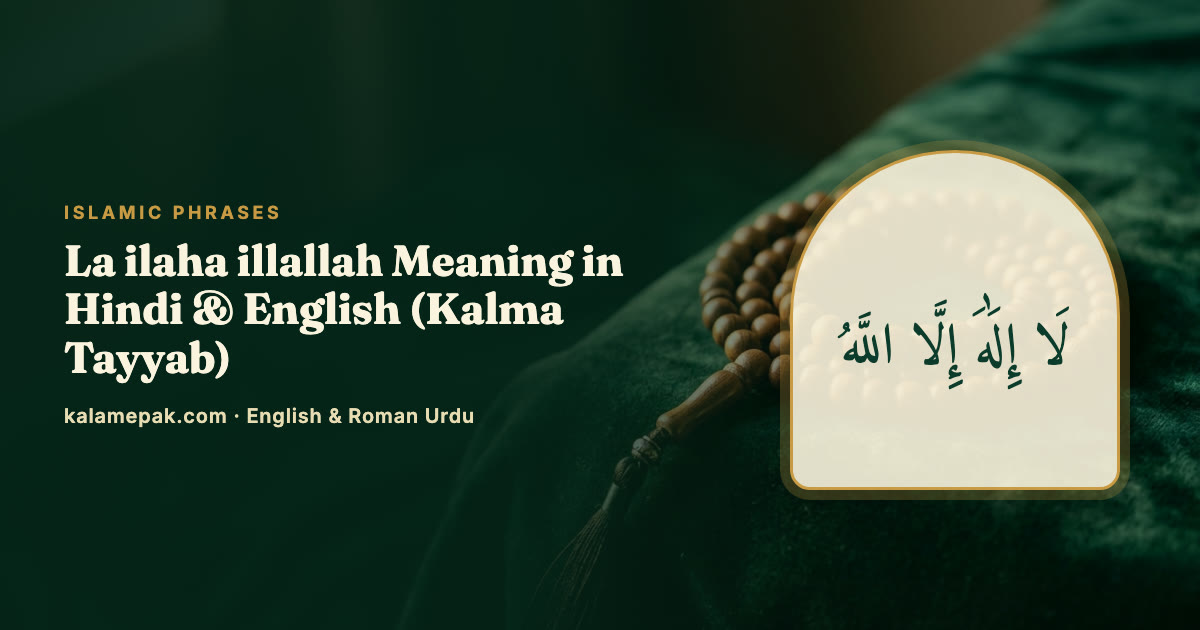
Lā ilāha illa llāh means "There is no god but Allah." In Roman Urdu: "Allah ke siwa koi maabood nahin." In Hindi you'll often hear it explained as "Allah ke alawa koi ibaadat ke laayak nahin."
There is no god but Allah
Allah ke siwa koi maabood nahin
Lā ilāha illa llāh · Quran 47:19, 37:35
It's the first kalma (Kalma Tayyab), the words of the shahada, a line of the adhan, and part of Attahiyat in every namaz. It's also one of the easiest sentences in the whole Quran to understand word by word — because every single word in it is among the most common words of the Quran.
La ilaha illallah word by word
| Arabic | Say it | Meaning | In the book |
|---|---|---|---|
| لَا | lā | no, there is no | word #3 · 1,742 times |
| إِلَٰهَ | ilāha | god, one who is worshipped (maabood) | ilāh, word #283 · 147 times |
| إِلَّا | illā | except, but | word #17 · 659 times |
| اللَّهُ | Allāh | Allah | word #2 · 2,699 times |
Four words: no — god — except — Allah.
Think of it in two halves:
- Lā ilāha — "there is no god". First, everything else is cleared away: no idol, no person, no wealth, no fear, no desire deserves worship.
- illa llāh — "except Allah". Then the one true exception is affirmed.
That's why scholars often describe it as nafi (negation) and ithbāt (affirmation). You say "no" to everything else before you say "yes" to Allah.
Ilāh vs Allah. Ilāh is a general word — "a god, something worshipped". Allāh is the proper name. Both share the root that the book lists under Allah and ilāh. The sentence uses the general word first ("no ilāh") and then the name ("except Allāh").
Kalma Tayyab meaning in Hindi and Roman Urdu
The full first kalma adds the testimony about the Prophet Muhammad ﷺ:
Lā ilāha illallāhu Muḥammadur rasūlullāh Allah ke siwa koi maabood nahin, Muhammad (sallallahu alaihi wa sallam) Allah ke Rasool hain. There is no god but Allah; Muhammad is the Messenger of Allah.
The second half also comes straight from the Quran — it is how Surah Al-Fath 48:29 begins:
Muhammad is the messenger of Allah.
Muhammad (sallallahu alaihi wa sallam) Allah ke Rasool hain
Surah Al-Fath · 48:29
| Arabic | Say it | Meaning | In the book |
|---|---|---|---|
| مُّحَمَّدٌ | Muḥammadun | Muhammad ﷺ | — (name; same root as ḥamd, praise) |
| رَّسُولُ | rasūlu | messenger (of) | rasūl, word #64 · 332 times |
| ٱللَّهِ | Allāh | Allah | word #2 |
A beautiful detail: the name Muḥammad comes from the same root as ḥamd (praise, word #218) — the ḥamd of Alhamdulillah.
Where La ilaha illallah appears in the Quran
The exact four words appear in Surah Muhammad, as a command to know it:
So know (O Muhammad) that there is no Allah save Allah, and ask forgiveness for thy sin and for believing men and believing women.
So (aey Nabi!) aap yaqeen kar lein ke Allah ke siwa koi maabood nahin aur apne gunaahon ki bakhshish maanga karein aur momin mardon aur momin auraton ke haq mein bhi
Surah Muhammad · 47:19
Two things to notice here.
"Fa-ʿlam" — so know. The verse begins with iʿlam, from ʿalima (word #103, "he knew"). The kalma isn't only something to say — it's something to know and be sure of.
Pickthall's wording. Pickthall translates ilāh as "Allah" here, so his English reads "no Allah save Allah". Most translators write "no god but Allah". Junagarhi's Urdu says "Allah ke siwa koi maabood nahin" — maabood means "one who is worshipped", which is exactly the sense of ilāh.
The same four words appear again in Surah As-Saffat:
For when it was said unto them, There is no Allah save Allah, they were scornful
Yeh woh (log) hain ke jab un se kaha jaata hai ke Allah ke siwa koi maabood nahin to yeh sarkashi karte the
Surah As-Saffat · 37:35
And with small changes — illā huwa (except Him) or illā anta (except You) — the same sentence appears many more times. Ayat al-Kursi begins Allāhu lā ilāha illā huwa. Prophet Yunus's dua from inside the darkness (21:87) is lā ilāha illā anta subḥānaka — "There is no god save You, glory be to You." Once you know the four words, you'll recognise it every time. (See Ayatul Kursi meaning.)
You say it in every namaz
If you pray, you say this sentence at least in every sitting of every namaz — inside Attahiyat:
I bear witness that there is no god but Allah, and I bear witness that Muhammad is His servant and His Messenger.
Main gawahi deta hoon ke Allah ke siwa koi maabood nahin, aur main gawahi deta hoon ke Muhammad (sallallahu alaihi wa sallam) Us ke bande aur Us ke Rasool hain.
Tashahhud of Ibn Masʿud · Sahih al-Bukhari 831, Sahih Muslim 402
Ashhadu means "I bear witness" — from shahida, word #313 in the book (44 times in the Quran). That's why this form is called the shahada: the testimony. ʿAbd (servant, word #221) and rasūl (messenger, word #64) come right after. For the whole of Attahiyat, see Attahiyat meaning.
Different kalmas, same core
People in India and Pakistan learn "six kalmas" as children. The first one, Kalma Tayyab ("the pure word"), is the sentence above. The second, Kalma Shahadat, is the ashhadu an lā ilāha illa llāh… form — the same testimony with "I bear witness" added. Whichever you learned, the core four words are identical: lā ilāha illa llāh.
Spelling variants people search
La ilaha illallah, La ilaha illa Allah, La ilaha il Allah, Laa ilaaha illallaah, La ilaha illallahu — all the same. "La ilaha illa Allah" shows the four words best. In Hindi, it's usually written ला इलाहा इल्लल्लाह.
A one-minute reflection
Say lā ilāha slowly and pause. Ask: what do I give too much importance to — money, people's opinion, my phone? That's what the "lā" clears away. Then say illa llāh and let it settle.
The four words of this kalma — lā, ilāh, illā, Allāh — are all in the book 600 Words of the Quran, along with rasūl, ʿabd and shahida. The 600 words are the main word in about 8 out of every 10 words of the Quran (79.8% of its 77,429 words — counting the core word, not small attached letters like wa-, bi- or pronoun endings). You can also read Astaghfirullah meaning — 47:19 above pairs the kalma with istighfar.
Frequently asked questions
What is the meaning of La ilaha illallah?
It means 'There is no god but Allah' — in Roman Urdu, 'Allah ke siwa koi maabood nahin'. No one deserves worship except Allah.
What is the full Kalma Tayyab and its meaning?
Lā ilāha illallāhu Muḥammadur rasūlullāh — 'There is no god but Allah; Muhammad is the Messenger of Allah.' Both halves appear in the Quran: the first in 47:19 and 37:35, the second at the start of 48:29.
Is La ilaha illallah in the Quran?
Yes. The exact words lā ilāha illa llāh appear in Surah Muhammad 47:19 and Surah As-Saffat 37:35, and the same idea with 'illā huwa' (except Him) appears in many more verses.
Are all the words of La ilaha illallah in the 600 most common Quran words?
Yes. Lā (#3), ilāh (#283), illā (#17) and Allah (#2) are all in the book's list of 600 words, and together they appear thousands of times in the Quran.