Alhamdulillah Meaning in English, Hindi & Urdu
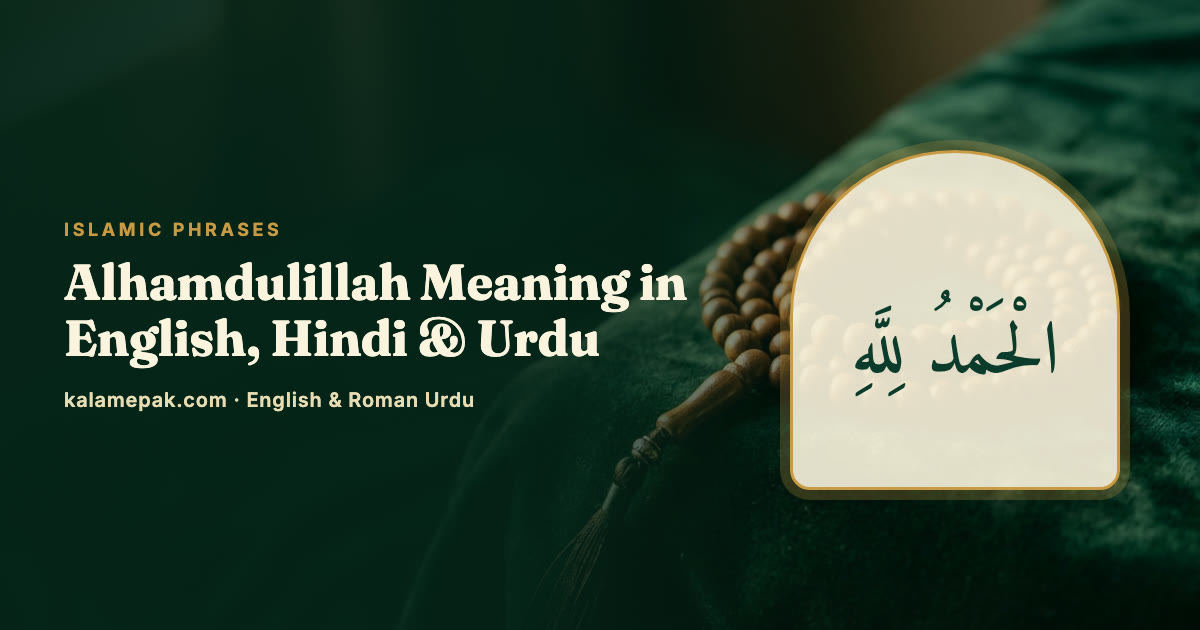
Alhamdulillah means "All praise is for Allah", in Urdu and Hindi, "Tamaam taareef Allah ke liye hai." It is the first sentence of the Quran after the Bismillah, the words you say after a meal, after sneezing, and when someone asks how you are.
Because it is so familiar, most people translate it as "thank God". That is not wrong, but it is only part of it. Let's look at what the three pieces of al-ḥamdu lillāh actually say.
All praise is for Allah
Tamaam taareef Allah ke liye hai
al-ḥamdu lillāh · common phrase (Quran 1:2 begins with it)
Alhamdulillah word by word
| Arabic | Say it | Meaning | In the book |
|---|---|---|---|
| ٱلْحَمْدُ | al-ḥamdu | the praise, all praise: al- "the" + ḥamd | #218 ḥamd · 43× |
| لِلَّهِ | lillāhi | is for Allah, belongs to Allah: li "for" + Allah | #2 Allah · 2,699× |
"In the book" is the word's number in 600 Words of the Quran and how many times it appears in the whole Quran.
Two small things carry a lot of meaning here:
- "al-" (the). It is not "a praise" or "some praise" but the praise: praise as a whole. That is why translators say "all praise" and Urdu says "tamaam" or "sab" taareef.
- "li" (for, belongs to). The same little li- as in lahū mā fi s-samāwāti, "to Him belongs whatever is in the heavens" (in Ayatul Kursi). Praise doesn't just go to Allah; it belongs to Him.
So a fuller way to hear it: "Every praise there is, wherever it is, really belongs to Allah."
Alhamdulillahi Rabbil Alameen: the Fatiha version
Praise be to Allah, Lord of the Worlds,
Sab taareef Allah Ta'ala ke liye hai jo tamaam jahaanon ka paalne wala hai
Surah Al-Fatiha · 1:2
| Arabic | Say it | Meaning | In the book |
|---|---|---|---|
| رَبِّ | rabbi | Lord (of) | #12 rabb · 975× |
| ٱلْعَٰلَمِينَ | al-ʿālamīn | the worlds | #147 ʿālam · 73× |
You recite or hear this in every rak'ah, in the Fatiha. Junagarhi's Urdu for rabb is "paalne wala", the One who raises and looks after. Praise is followed straight away by the reason: He is the Lord who looks after every world. The full surah, word by word, is in Surah Fatiha meaning.
Hamd and shukr: praise and thanks
Urdu speakers know both words: hamd (as in a hamd poem) and shukr (as in shukriya). They are close, but not the same.
- Shukr (shakara, "he thanked", word #217) is thanks for a favour you received.
- Ḥamd is praise of Allah for who He is and what He does, whether or not you have just received something.
That is why Alhamdulillah fits every situation: after good news, yes, but also in difficulty, because Allah's perfection doesn't change with our circumstances. When you say it after a meal, it is both: praise of the One who provides, and thanks for this particular food.
The five surahs that open with Alhamdulillah
After the Bismillah, five surahs of the Quran begin with al-ḥamdu lillāh. Look at how each one gives a different reason for the praise:
| Surah | Opens with… (Pickthall) |
|---|---|
| Al-Fatiha (1:2) | "Praise be to Allah, Lord of the Worlds," |
| Al-An'am (6:1) | "Praise be to Allah, Who hath created the heavens and the earth, and hath appointed darkness and light." |
| Al-Kahf (18:1) | "Praise be to Allah Who hath revealed the Scripture unto His slave…" |
| Saba (34:1) | "Praise be to Allah, unto Whom belongeth whatsoever is in the heavens and whatsoever is in the earth." |
| Fatir (35:1) | "Praise be to Allah, the Creator of the heavens and the earth…" |
His lordship, His creation, His revelation, His ownership. Each surah opens with praise and then shows you something to praise Him for. It is a small lesson in how to say Alhamdulillah with meaning: add a reason, even silently.
The last words of the people of Paradise
One verse shows how far this phrase goes. Describing the people of Paradise, Allah says:
Their prayer therein will be: Glory be to Thee, O Allah! and their greeting therein will be: Peace. And the conclusion of their prayer will be: Praise be to Allah, Lord of the Worlds!
Un ke munh se yeh baat niklegi Subhan Allah aur un ka baahami salaam yeh hoga Assalamu Alaikum aur un ki akheer baat yeh hogi tamaam taareefein Allah ke liye hain jo saare jahaan ka Rabb hai
Surah Yunus · 10:10
The Quran opens with al-ḥamdu lillāhi rabbi l-ʿālamīn in the Fatiha, and the people of Paradise close their prayer with the very same words.
Where Alhamdulillah appears in your namaz
Even if you have never counted, ḥamd comes many times in every prayer:
- Sana: subḥānaka llāhumma wa bi-ḥamdika: "Glory be to You, O Allah, and praise be to You."
- Fatiha: al-ḥamdu lillāhi rabbi l-ʿālamīn, in every rak'ah.
- Rising from ruku: samiʿa llāhu liman ḥamidah, "Allah hears the one who praises Him", then rabbanā wa laka l-ḥamd, "Our Lord, and to You belongs all praise" (Sahih al-Bukhari 732, 789). See ruku and sajda tasbeeh meaning.
Other words from the same root
The root ḥ-m-d (praise) gives several words you already know:
- ḥamīd: Praiseworthy, word #303, 17 times in the Quran. It ends the Durood: innaka ḥamīdun majīd.
- Muḥammad and Aḥmad: names of the Prophet ﷺ, from the same root. Muḥammad means "the praised one".
- ḥamd in subḥāna llāhi wa bi-ḥamdih, "Glory be to Allah and praise be to Him" (Sahih al-Bukhari 6405).
When to say Alhamdulillah
- After eating and drinking: praise and thanks for the provision.
- After sneezing: the Sunnah is to say Alhamdulillah, and the one who hears replies yarḥamuka llāh (Sahih al-Bukhari 6224).
- When asked "How are you?": the answer in many Muslim homes, whatever the day has been like.
- On good news, and in hardship: praise does not depend on the day going well.
- After namaz, as part of the tasbih many people do with SubhanAllah and Allahu Akbar. See SubhanAllah meaning and Allahu Akbar meaning.
A 30-second habit
Next time you say Alhamdulillah, add one reason in your mind, the way the five surahs do: "Alhamdulillah… for this food." "Alhamdulillah… that my mother is well." It turns a habit word back into real praise.
Ḥamd, rabb, ʿālam, Allah: every main word in al-ḥamdu lillāhi rabbi l-ʿālamīn is among the most common words of the Quran. 600 Words of the Quran teaches them in 30 short lessons, each with a real verse and its meaning in English and Roman Urdu.
Frequently asked questions
What does Alhamdulillah mean?
All praise is for Allah. In Urdu and Hindi: 'Tamaam taareef Allah ke liye hai'.
What is the meaning of Alhamdulillahi Rabbil Alameen?
Praise be to Allah, Lord of the Worlds (Quran 1:2, Pickthall). Roman Urdu: Sab taareef Allah Ta'ala ke liye hai jo tamaam jahaanon ka paalne wala hai.
Is Alhamdulillah the same as 'thank you, Allah'?
It includes thanks but is wider. Hamd is praise of Allah for who He is and what He does, whether or not you have just received something; shukr is thanks for a favour received.
How many times is 'hamd' in the Quran?
The word hamd (praise) appears 43 times in the Quran. It is word #218 in 600 Words of the Quran.
Which surahs start with Alhamdulillah?
Five surahs open with 'al-hamdu lillah' after the Bismillah: Al-Fatiha (1), Al-An'am (6), Al-Kahf (18), Saba (34) and Fatir (35).