SubhanAllah Meaning in Hindi, Urdu & English (Word by Word)
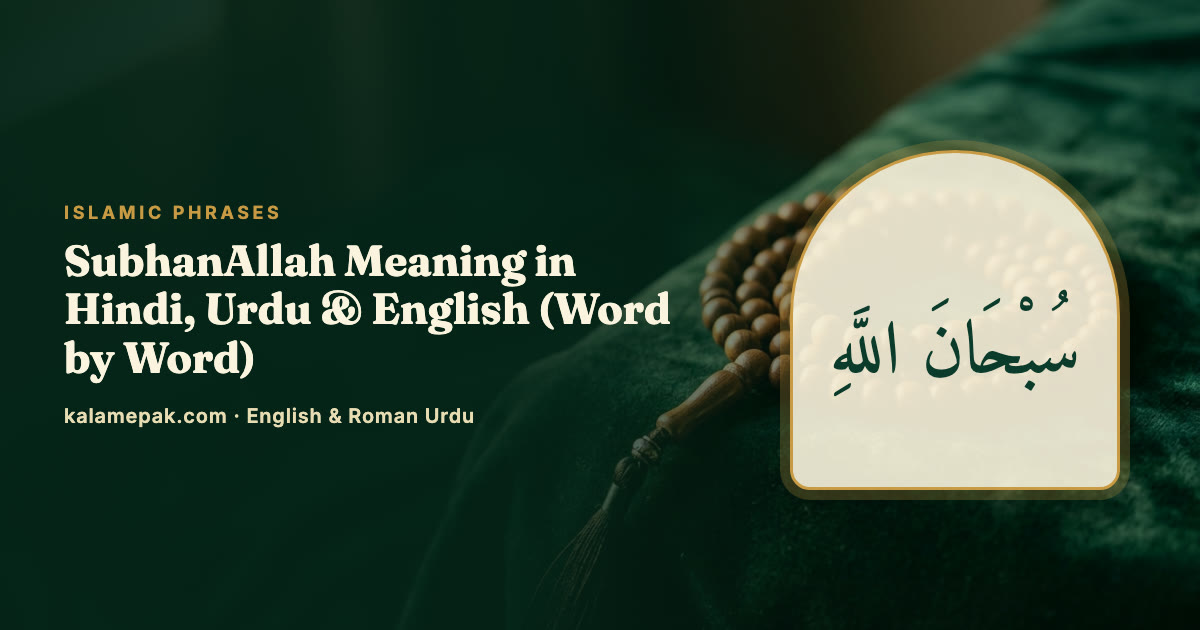
SubhanAllah means "Glory be to Allah" — in Urdu and Hindi, "Allah paak hai." When you say it, you are declaring that Allah is free of every fault, every weakness, and anything that is not worthy of Him.
Glory be to Allah (Allah is free of every fault)
Allah paak hai
Subḥān Allāh
That's the short answer. But "glory be" is a slightly old-fashioned English phrase, and many people use SubhanAllah just to mean "wow". So let's open the word up and see what it actually carries.
SubhanAllah word by word
| Arabic | Say it | Meaning | In the book |
|---|---|---|---|
| سُبْحَانَ | subḥāna | glory be to; far above every fault | subḥān, word #398 · 41 times |
| اللَّهِ | Allāh | Allah | Allah, word #2 · 2,699 times |
So the phrase is just two words. Subḥāna is the important one. It isn't a verb like "I praise"; it's a declaration — "(Allah is) far above anything wrong." Urdu captures it well with paak: clean, pure, free of any flaw.
That's the key difference between SubhanAllah and Alhamdulillah:
- SubhanAllah says what Allah is free of — no weakness, no need, no partner, no mistake.
- Alhamdulillah says what Allah is full of — every praise, every thanks belongs to Him. (See our Alhamdulillah meaning article.)
Put together, they're a complete picture: Allah is free of every fault and deserves every praise. That's exactly why they so often come as a pair.
SubhanAllah meaning in Hindi and Urdu
If someone asks you "Subhanallah ka matlab kya hai?", the simplest honest answer is:
"Allah paak hai" — Allah har aib, har kami aur har buri baat se paak hai.
You'll hear some people translate it as "Allah is great" — but that's Allahu Akbar. SubhanAllah is specifically about Allah being pure and above every shortcoming.
The root s-b-ḥ: tasbeeh, tasbih and more
Subḥān comes from the root s-b-ḥ. You already use this root in Urdu: tasbeeh — both the act of saying SubhanAllah and the string of beads people count it on. The 600-word book has two words from this family:
| Arabic | Say it | Meaning | In the book |
|---|---|---|---|
| سُبْحان | subḥān | glory be to | word #398 · 41 times |
| سَبَّحَ | sabbaḥa | he glorified (did tasbeeh) | word #397 · 42 times |
Here is sabbaḥa as a command, in the verse many people know as the start of Surah Al-Aʿla:
Praise the name of thy Lord the Most High,
Apne bahut hi buland Allah ke naam ki paakeezgi bayaan kar
Surah Al-Aʿla · 87:1
A lovely detail: in Surah Al-Anbiya (21:33), the same root appears in yasbaḥūn to describe the sun and the moon — Pickthall: "They float, each in an orbit." Whether it's the stars moving in their paths or a believer saying SubhanAllah, the same root is at work.
Where "Subhan Allah" appears in the Quran
The exact words subḥāna llāh appear in the Quran, often right after people say something about Allah that isn't worthy of Him:
Glorified be Allah from that which they attribute (unto Him),
Jo kuch yeh (Allah ke baare mein) bayaan kar rahe hain us se Allah Ta'ala bilkul paak hai
Surah As-Saffat · 37:159
This is the core use: Allah is above what they describe. Another verse ties it to the times of the day:
So glory be to Allah when ye enter the night and when ye enter the morning -
Pas Allah Ta'ala ki tasbeeh padha karo jab ke tum shaam karo aur jab subah karo
Surah Ar-Rum · 30:17
And the famous opening of Surah Al-Isra (17:1), about the Night Journey, begins with subḥāna lladhī — "Glorified be He Who carried His servant by night…" Something so amazing that the verse starts by declaring Allah's perfection before telling the story.
The word also appears in the confession of the people of the garden in Surah Al-Qalam:
They said: Glorified be our Lord! Lo! we have been wrong-doers.
To sab kehne lage hamara Rabb paak hai beshak hum hi zaalim the
Surah Al-Qalam · 68:29
See the pattern? "Our Lord is free of fault — we were the ones who did wrong." SubhanAllah can be the start of honest self-reflection, not only of wonder.
You already say SubhanAllah in every namaz
Even if you've never thought about it, the root s-b-ḥ is all over your prayer:
In Sana, right after the opening takbir:
Glory be to You, O Allah, and praise be to You.
Aey Allah! Tu paak hai aur Teri hi taareef hai
Sana · Abu Dawud 775–776, Tirmidhi 242–243
In ruku: سُبْحَانَ رَبِّيَ الْعَظِيمِ — Subḥāna rabbiya l-ʿaẓīm — "Glory be to my Lord, the Most Great" — Paak hai mera Rabb, jo azmat wala hai. (Sahih Muslim 772)
In sajdah: سُبْحَانَ رَبِّيَ الْأَعْلَىٰ — Subḥāna rabbiya l-aʿlā — "Glory be to my Lord, the Most High" — Paak hai mera Rabb, jo sab se buland hai. (Sahih Muslim 772)
Notice how the sajdah tasbih echoes 87:1 above — rabbika l-aʿlā, "your Lord, the Most High". We cover these in full in ruku and sajdah tasbeeh meaning and Sana dua meaning.
So every time you go into ruku or sajdah, you're saying subḥān — now you know it means "paak hai".
Subhanallahi wa bihamdihi meaning
A longer form many people say as dhikr:
Glory be to Allah and praise be to Him
Allah paak hai aur Us hi ki taareef hai
Sahih al-Bukhari 6405
Here subḥān (free of fault) and ḥamd (praise, word #218, 43 times in the Quran) meet in one short line — the same pairing as in Sana.
When do Muslims say SubhanAllah?
- When something amazes you — a sunset, a baby's first steps, a clever design in nature. You're saying: the One who made this is perfect.
- When you hear something wrong said about Allah — the way 37:159 uses it.
- As dhikr — while walking, waiting, or after namaz, many people count it on fingers or a tasbeeh.
- Inside namaz — in Sana, ruku and sajdah, as shown above.
Spelling: SubhanAllah, Subhan Allah, Subhanallah
All of these are the same phrase: SubhanAllah, Subhan Allah, Subhanallah, Subhan'Allah, Subḥān Allāh. In Arabic it's two words — subḥāna and Allāh — which join in speech as subḥānallāh. In Hindi/Devanagari people often write it as सुब्हानअल्लाह. Choose any; the meaning doesn't change.
One small tip for pronunciation: the ḥ in subḥān is the soft, breathy "h" from the throat (as in ḥamd), not the rough "kh".
A tiny practice for today
Next time you say Subḥāna rabbiya l-aʿlā in sajdah, say it once slowly and think the Urdu: "Paak hai mera Rabb, jo sab se buland hai." Just once, with meaning. That single moment changes the whole sajdah.
Learning the meaning of the words you already repeat daily is the fastest way to start understanding the Quran. The book 600 Words of the Quran teaches subḥān, sabbaḥa, ḥamd, rabb and hundreds more, each with a real verse and Roman Urdu meaning.
Frequently asked questions
What is the meaning of SubhanAllah?
SubhanAllah means 'Glory be to Allah' — that Allah is free of every fault, weakness or anything unworthy of Him. In Urdu and Hindi: 'Allah paak hai'.
When do Muslims say SubhanAllah?
When they see something amazing or beautiful, when they hear something said about Allah that is not worthy of Him, as dhikr at any time, and inside namaz in the ruku and sajdah tasbih.
Is it SubhanAllah or Subhan Allah?
Both spellings are fine. In Arabic it is two words, subḥāna + Allāh, pronounced together as subḥānallāh. SubhanAllah, Subhan Allah and Subhanallah all refer to the same phrase.
What does Subhanallahi wa bihamdihi mean?
'Glory be to Allah and praise be to Him' — Allah paak hai aur Us hi ki taareef hai. It is reported in Sahih al-Bukhari 6405.