Ruku & Sajda Tasbih Meaning: Subhana Rabbiyal Azeem & Ala
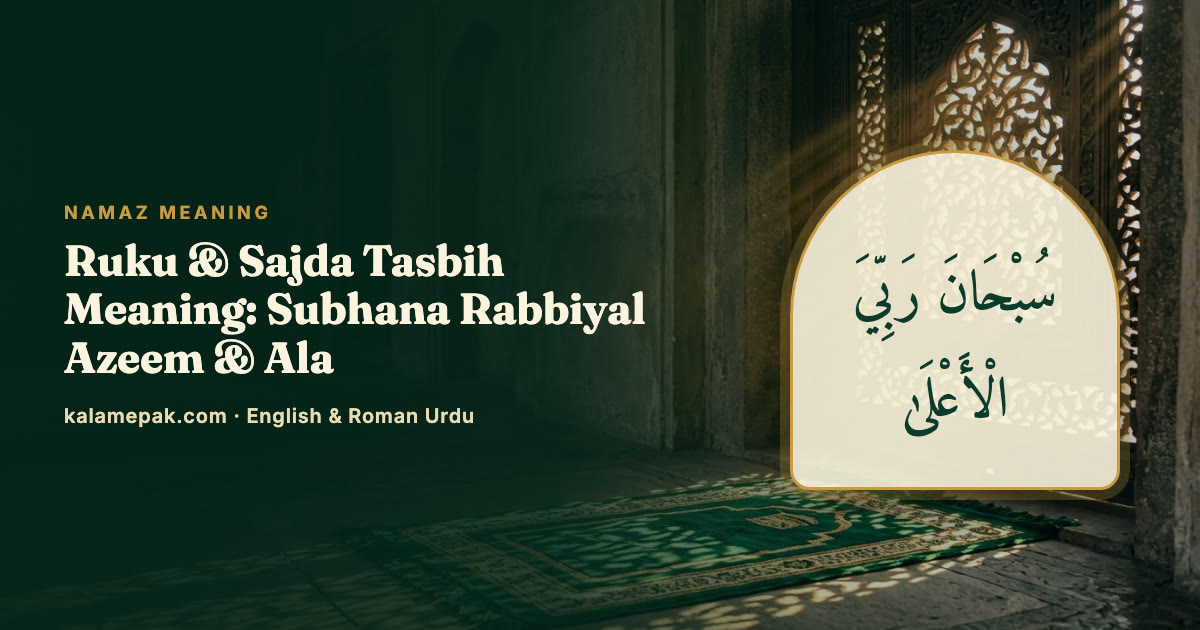
The four short phrases of ruku and sajdah mean: Subḥāna rabbiya l-ʿaẓīm — "Glory be to my Lord, the Most Great" (in ruku); Samiʿa llāhu liman ḥamidah — "Allah hears the one who praises Him" (rising from ruku); Rabbanā wa laka l-ḥamd — "Our Lord, and to You belongs all praise" (standing after ruku); and Subḥāna rabbiya l-aʿlā — "Glory be to my Lord, the Most High" (in sajdah). Below, each one is broken down word by word, with the Quran verses that the ruku and sajdah tasbih answer.
All four phrases at a glance
| When | Arabic | English | Roman Urdu |
|---|---|---|---|
| In ruku | سُبْحَانَ رَبِّيَ الْعَظِيمِ | Glory be to my Lord, the Most Great. | Paak hai mera Rabb, jo azmat wala hai. |
| Rising from ruku | سَمِعَ اللَّهُ لِمَنْ حَمِدَهُ | Allah hears the one who praises Him. | Allah ne us ki sun li jis ne Us ki taareef ki. |
| Standing after ruku | رَبَّنَا وَلَكَ الْحَمْدُ | Our Lord, and to You belongs all praise. | Aey hamare Rabb, aur taareef Tere hi liye hai. |
| In sajdah | سُبْحَانَ رَبِّيَ الْأَعْلَىٰ | Glory be to my Lord, the Most High. | Paak hai mera Rabb, jo sab se buland hai. |
Sources: the ruku and sajdah tasbih — Sahih Muslim 772 (Hudhayfah); rising from ruku — Sahih al-Bukhari 732, 789. The tasbih of ruku and sajdah are said three times or more.
1. Subhana Rabbiyal Azeem meaning (ruku)
Glory be to my Lord, the Most Great.
Paak hai mera Rabb, jo azmat wala hai.
Ruku tasbih · Sahih Muslim 772
| Arabic | Say it | Meaning | In the book |
|---|---|---|---|
| سُبْحَانَ | subḥāna | glory be to | subḥān, word #398 (41 times in the Quran) |
| رَبِّيَ | rabbiya | my Lord | rabb, word #12 (975 times) + -ī / -ya "my" |
| الْعَظِيمِ | al-ʿaẓīm | the Most Great | ʿaẓīm, word #244 (107 times) |
Subḥān means declaring Allah free of every fault and imperfection — Roman Urdu paak. That's why Urdu translations say "paak hai mera Rabb". You already say this word every day in SubḥānAllāh — see SubhanAllah meaning.
2. Sami Allahu liman hamidah meaning (rising from ruku)
Allah hears the one who praises Him.
Allah ne us ki sun li jis ne Us ki taareef ki.
Rising from ruku · Sahih al-Bukhari 732, 789
| Arabic | Say it | Meaning | In the book |
|---|---|---|---|
| سَمِعَ | samiʿa | (has) heard | samiʿa "he heard", word #308 (78 times) |
| اللَّهُ | Allāhu | Allah | word #2 (2,699 times) |
| لِمَنْ | liman | (to) the one who | li "to, for" + man "who, whoever" (word #14, 871 times) |
| حَمِدَهُ | ḥamidah(ū) | praised Him | root of ḥamd "praise" (word #218) + -hu "Him" |
The verb samiʿa is in the past tense — literally "Allah has heard" — which is why the Roman Urdu says sun li. The English "hears" gives the same sense: whoever praises Allah is heard. It's a reassuring moment: you are rising from bowing, and the very next thing you declare is that your praise has been heard.
3. Rabbana wa lakal hamd meaning
Our Lord, and to You belongs all praise.
Aey hamare Rabb, aur taareef Tere hi liye hai.
Sahih al-Bukhari 732, 789
| Arabic | Say it | Meaning | In the book |
|---|---|---|---|
| رَبَّنَا | rabbanā | our Lord | rabb (#12) + -nā "our" |
| وَلَكَ | wa laka | and to You | wa "and" + la "to, for" + -ka "You" |
| الْحَمْدُ | al-ḥamd | (all) the praise | ḥamd, word #218 (43 times) |
Both Rabbanā laka l-ḥamd (without wa) and Rabbanā wa laka l-ḥamd are authentic wordings. It's a direct reply: "Allah hears the one who praises Him" — "Our Lord, and to You belongs the praise!" The same al-ḥamd opens Surah Al-Fatiha — more in Alhamdulillah meaning.
Who says which of these two phrases — the imam, someone praying behind him, or someone praying alone — is a detail on which the schools of fiqh differ. Follow what your scholars teach.
4. Subhana Rabbiyal Ala meaning (sajdah)
Glory be to my Lord, the Most High.
Paak hai mera Rabb, jo sab se buland hai.
Sajdah tasbih · Sahih Muslim 772
| Arabic | Say it | Meaning | In the book |
|---|---|---|---|
| سُبْحَانَ | subḥāna | glory be to | word #398 |
| رَبِّيَ | rabbiya | my Lord | word #12 + "my" |
| الْأَعْلَىٰ | al-aʿlā | the Most High | not in the 600 list — root ʿ-l-w, "height" |
Only one word changes from the ruku tasbih: al-ʿaẓīm becomes al-aʿlā. Al-aʿlā shares its root with taʿālā ("exalted") in the Sana — wa taʿālā jadduka, "exalted is Your majesty".
The Quran connection: you are answering a command
The ruku and sajdah tasbih are closely linked to two verses of the Quran. Look at them side by side.
Therefor (O Muhammad), praise the name of thy Lord, the Tremendous.
Pas apne bahut bade Rabb ke naam ki tasbeeh kiya karo
Surah Al-Waqiʿah · 56:74 (the same words also end Surah Al-Haqqah, 69:52)
Praise the name of thy Lord the Most High,
Apne bahut hi buland Allah ke naam ki paakeezgi bayaan kar
Surah Al-Aʿla · 87:1
Compare the words:
| The Quran says… | In namaz you reply… |
|---|---|
| sabbiḥ — "glorify!" (from sabbaḥa, word #397) | subḥāna — "glory be to" (word #398) |
| rabbika — "your Lord" | rabbiya — "my Lord" |
| al-ʿaẓīm — "the Tremendous" (56:74) | al-ʿaẓīm — in ruku |
| al-aʿlā — "the Most High" (87:1) | al-aʿlā — in sajdah |
The verse says "glorify your Lord, the Great" — and in ruku you say "glory be to my Lord, the Great". The verse says "glorify the name of your Lord, the Most High" — and with your forehead on the ground you say "glory be to my Lord, the Most High". Once you notice this, every ruku and sajdah feels like obeying and answering the Quran in the same breath.
Even the act of ruku itself is in the Quran: "Establish worship, pay the poor-due, and bow your heads with those who bow (in worship)" (2:43, Pickthall).
Why "Great" in ruku and "Most High" in sajdah?
The words match the positions. In ruku you bow, lowering yourself before the One who is ʿaẓīm, Great. In sajdah you put the highest part of your body — your face — on the ground, the lowest point of the prayer, and there you call Allah al-aʿlā, the Most High. The lower you go, the higher you declare Him.
Tips to say them with meaning
- Don't rush the three. Say the first one slowly, thinking of its meaning. The second and third will follow naturally.
- Hear the "my". Rabbiya is personal. You're not describing someone else's Lord — you're speaking about yours.
- Listen for the change. In sajdah, consciously notice ʿaẓīm has become aʿlā.
- Practise for a day. In our 7-day plan to understand your namaz, these four phrases are Day 5.
For the complete prayer with meaning, see namaz ka tarjuma. And if you'd like to recognise words like rabb, ʿaẓīm, samiʿa and ḥamd across the whole Quran, our book 600 Words of the Quran teaches the most common Quran words in 30 lessons, each with a real verse and meanings in English and Roman Urdu.
Frequently asked questions
What does Subhana Rabbiyal Azeem mean?
It means: Glory be to my Lord, the Most Great. In Roman Urdu: Paak hai mera Rabb, jo azmat wala hai. It is said in ruku, three times or more (Sahih Muslim 772).
What does Subhana Rabbiyal Ala mean?
It means: Glory be to my Lord, the Most High. In Roman Urdu: Paak hai mera Rabb, jo sab se buland hai. It is said in sajdah, three times or more (Sahih Muslim 772).
What does Sami Allahu liman hamidah mean?
It means: Allah hears the one who praises Him. In Roman Urdu: Allah ne us ki sun li jis ne Us ki taareef ki. It is said while rising from ruku.
Is it Rabbana lakal hamd or Rabbana wa lakal hamd?
Both wordings are authentic, as reported in Sahih al-Bukhari (732, 789). Either can be said.