Namaz ka Tarjuma: Full Namaz Meaning in English & Roman Urdu
Here is the complete namaz ka tarjuma — every part of the prayer, in order, in Arabic with its meaning in English and Roman Urdu. In short: namaz begins with Allāhu akbar ("Allah is the Greatest"), praises Allah in the Sana, recites Surah Al-Fatiha and a short surah, glorifies Him in ruku and sajdah, bears witness in the Attahiyat, sends blessings on the Prophet Muhammad ﷺ, asks Allah for forgiveness, and ends with a greeting of peace. Below, each step is explained so you can follow what you're saying.
A note before we begin: the basic structure of namaz is shared by all Muslims, but the schools of fiqh differ in some details — for example hand positions, what is recited aloud or silently, and what someone praying behind an imam recites. This article is about meanings, not rulings. For how to pray, follow what your trusted scholars teach.
Namaz step by step with meaning
1. Takbir (Takbir-e-Tahrima) — starting the prayer
After making the intention for the prayer, you raise your hands and say:
Allah is the Greatest.
Allah sab se bada hai
Takbir · said to begin the prayer and when moving between positions
You'll say this many times in each prayer. Akbar is word #528 in the book ("greater, greatest"). More in Allahu Akbar meaning.
2. Sana — the opening praise (first rakʿah)
Glory be to You, O Allah, and praise be to You. Blessed is Your name, exalted is Your majesty, and there is no god but You.
Aey Allah! Tu paak hai aur Teri hi taareef hai, Tera naam barkat wala hai, Teri shaan buland hai, aur Tere siwa koi maabood nahin.
Sana · Abu Dawud 775–776, Tirmidhi 242–243
Other authentic opening duas also exist; Sana is the one most taught in India and Pakistan. Word by word in Sana dua meaning.
3. Taʿawwudh — seeking refuge
I seek refuge in Allah from Satan, the rejected (outcast).
Main Allah ki panaah maangta hoon shaitaan mardood se.
Taʿawwudh · Quran 16:98 commands it; the wording is the standard formula
The Quran says: "And when thou recitest the Qur'an, seek refuge in Allah from Satan the outcast" (16:98, Pickthall).
4. Bismillah
In the name of Allah, the Beneficent, the Merciful.
Shuru karta hoon Allah Ta'ala ke naam se jo bada meherbaan nihaayat bahut zyada rahm wala hai
Surah Al-Fatiha · 1:1
See Bismillah meaning for each word.
5. Surah Al-Fatiha (every rakʿah)
| Verse | Arabic | English (Pickthall) | Roman Urdu |
|---|---|---|---|
| 1:2 | ٱلْحَمْدُ لِلَّهِ رَبِّ ٱلْعَٰلَمِينَ | Praise be to Allah, Lord of the Worlds, | Sab taareef Allah Ta'ala ke liye hai jo tamaam jahaanon ka paalne wala hai |
| 1:3 | ٱلرَّحْمَٰنِ ٱلرَّحِيمِ | The Beneficent, the Merciful. | Bada meherbaan nihaayat rahm karne wala |
| 1:4 | مَٰلِكِ يَوْمِ ٱلدِّينِ | Master of the Day of Judgment, | Badle ke din (yaani Qayamat) ka maalik hai |
| 1:5 | إِيَّاكَ نَعْبُدُ وَإِيَّاكَ نَسْتَعِينُ | Thee (alone) we worship; Thee (alone) we ask for help. | Hum sirf teri hi ibaadat karte hain aur sirf tujh hi se madad chaahte hain |
| 1:6 | ٱهْدِنَا ٱلصِّرَٰطَ ٱلْمُسْتَقِيمَ | Show us the straight path, | Humein seedhi (aur sachchi) raah dikha |
| 1:7 | صِرَٰطَ ٱلَّذِينَ أَنْعَمْتَ عَلَيْهِمْ غَيْرِ ٱلْمَغْضُوبِ عَلَيْهِمْ وَلَا ٱلضَّآلِّينَ | The path of those whom Thou hast favoured; Not the (path) of those who earn Thine anger nor of those who go astray. | Un logon ki raah jin par tu ne inaam kiya un ki nahi jin par ghazab gussa kiya gaya (yaani woh log jinhon ne haq ko pehchaana, magar us par amal pairaa amal karne wale nahi hue) aur na gumraahon ki (yaani woh log jo jahaalat ke sabab raah-e-haq se bargashta phir gaye ho gaye) |
After Fatiha, āmīn is said. (Schools differ on whether it is said aloud or silently.) The full word-by-word breakdown is in Surah Fatiha meaning.
6. A short surah (first two rakʿahs)
In common practice a short surah or a few verses follow Fatiha in the first two rakʿahs. Surah Al-Ikhlas is one of the most loved:
| Verse | Arabic | English (Pickthall) | Roman Urdu |
|---|---|---|---|
| 112:1 | قُلْ هُوَ ٱللَّهُ أَحَدٌ | Say: He is Allah, the One! | Aap keh dijiye ke woh Allah Ta'ala ek (hi) hai |
| 112:2 | ٱللَّهُ ٱلصَّمَدُ | Allah, the eternally Besought of all! | Allah Ta'ala be-niyaaz kisi ka mohtaaj nahi hai |
| 112:3 | لَمْ يَلِدْ وَلَمْ يُولَدْ | He begetteth not nor was begotten. | Na us se koi paida hua na woh kisi se paida hua |
| 112:4 | وَلَمْ يَكُن لَّهُۥ كُفُوًا أَحَدٌۢ | And there is none comparable unto Him. | Aur na koi us ka hamsar barabar wala hai |
More in Surah Ikhlas meaning. For other short surahs, see what to recite in namaz.
7. Ruku — bowing
Say Allāhu akbar and bow. In ruku, say three times or more:
Glory be to my Lord, the Most Great.
Paak hai mera Rabb, jo azmat wala hai.
Ruku tasbih · Sahih Muslim 772
8. Rising from ruku
Allah hears the one who praises Him.
Allah ne us ki sun li jis ne Us ki taareef ki.
Rising from ruku · Sahih al-Bukhari 732, 789
Then, standing:
Our Lord, and to You belongs all praise.
Aey hamare Rabb, aur taareef Tere hi liye hai.
Sahih al-Bukhari 732, 789 (both "Rabbanā laka l-ḥamd" and "Rabbanā wa laka l-ḥamd" are authentic)
Who says which of these two phrases — the imam, the follower, or someone praying alone — is one of those details where schools differ.
9. Sajdah — prostration
Say Allāhu akbar and go into sajdah. Say three times or more:
Glory be to my Lord, the Most High.
Paak hai mera Rabb, jo sab se buland hai.
Sajdah tasbih · Sahih Muslim 772
Then sit up briefly with Allāhu akbar, and make the second sajdah the same way. The ruku and sajdah phrases are explained word by word, with their Quran links, in ruku and sajdah tasbih meaning.
That completes one rakʿah. The second rakʿah is the same, without the Sana.
10. Attahiyat (Tashahhud) — sitting
After every two rakʿahs, and in the final sitting, you recite:
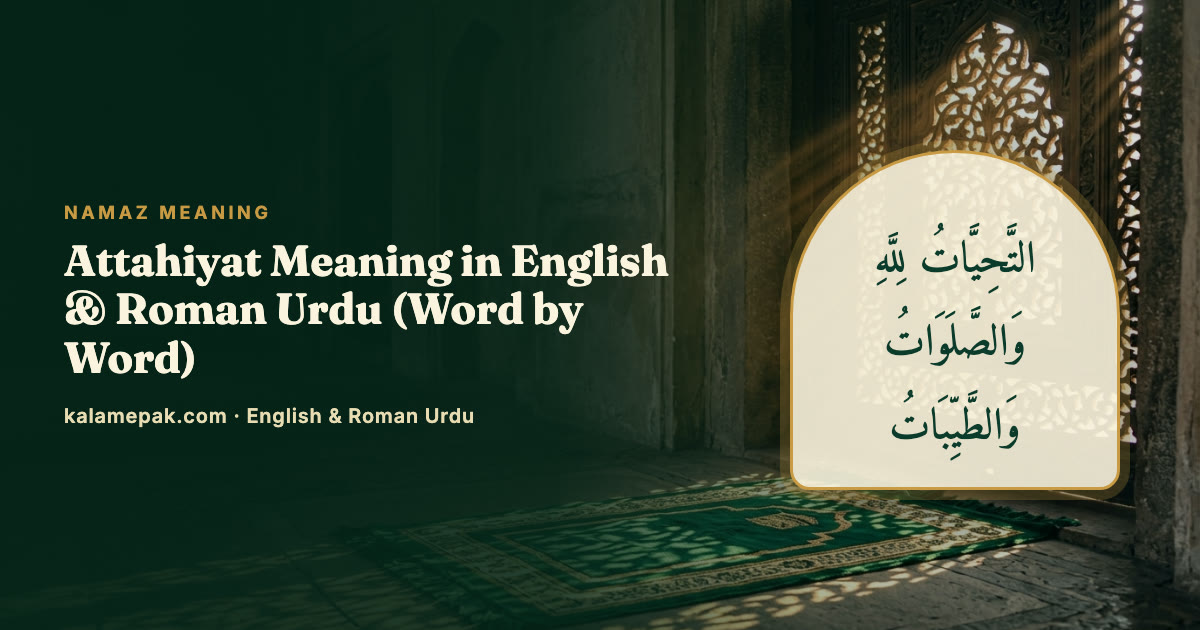
All greetings (of respect) are for Allah, and all prayers and all good things. Peace be upon you, O Prophet, and the mercy of Allah and His blessings. Peace be upon us and upon the righteous servants of Allah. I bear witness that there is no god but Allah, and I bear witness that Muhammad is His servant and His Messenger.
Tamaam qauli, badani aur maali ibadatein Allah hi ke liye hain. Aey Nabi! Aap par salaam ho, aur Allah ki rehmat aur us ki barkatein. Salaam ho hum par aur Allah ke nek bandon par. Main gawahi deta hoon ke Allah ke siwa koi maabood nahin, aur main gawahi deta hoon ke Muhammad (sallallahu alaihi wa sallam) Us ke bande aur Us ke Rasool hain.
Tashahhud of Ibn Masʿud · Sahih al-Bukhari 831, Sahih Muslim 402
Full word by word in Attahiyat meaning.
11. Durood Ibrahim (final sitting)
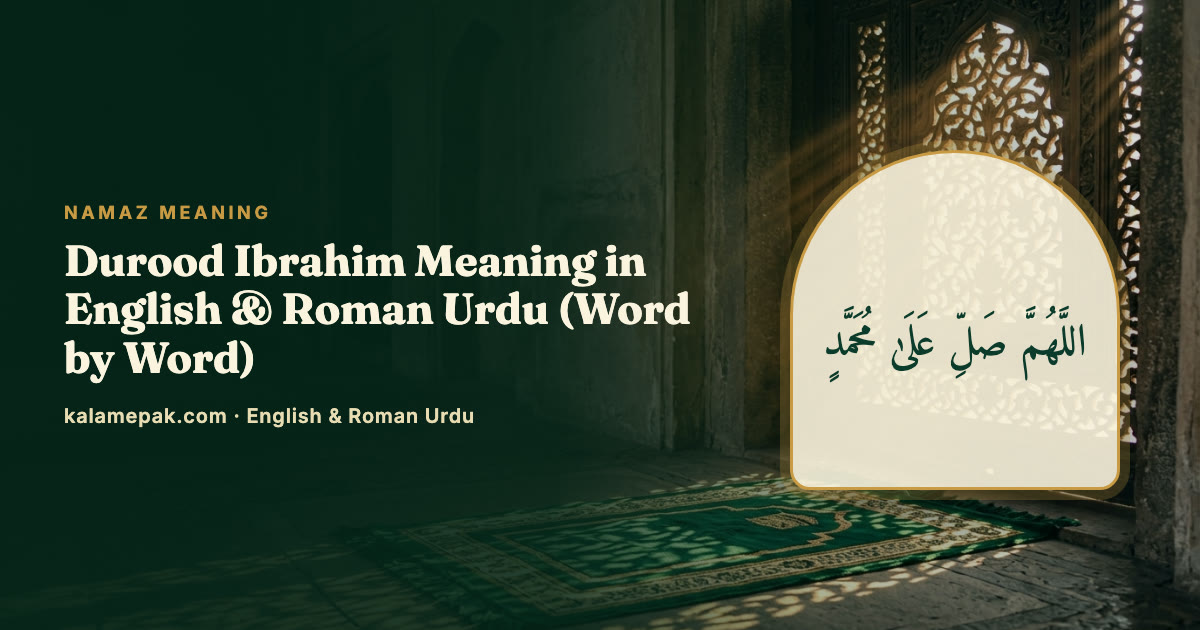
O Allah, send Your grace (blessings and honour) upon Muhammad and upon the family of Muhammad, as You sent grace upon Ibrahim and the family of Ibrahim; You are Praiseworthy, Glorious. O Allah, bless Muhammad and the family of Muhammad, as You blessed Ibrahim and the family of Ibrahim; You are Praiseworthy, Glorious.
Aey Allah! Rehmat naazil farma Muhammad par aur Muhammad ki aal par, jaise Tu ne rehmat naazil farmaayi Ibrahim par aur Ibrahim ki aal par; beshak Tu taareef wala, buzurgi wala hai. Aey Allah! Barkat naazil farma Muhammad par aur Muhammad ki aal par, jaise Tu ne barkat naazil farmaayi Ibrahim par aur Ibrahim ki aal par; beshak Tu taareef wala, buzurgi wala hai.
Durood Ibrahim · Sahih al-Bukhari 3370, 6357 (several authentic wordings exist; this is the one most taught in India)
Explained simply in Durood Ibrahim meaning.
12. Dua before salam
A commonly taught dua here is the one the Prophet ﷺ taught Abu Bakr for his prayer:
O Allah, I have wronged myself greatly, and no one forgives sins except You. So forgive me with forgiveness from You, and have mercy on me. You are the Forgiving, the Merciful.
Aey Allah! Main ne apni jaan par bahut zulm kiya, aur gunaahon ko Tere siwa koi maaf nahin karta. Bas apni taraf se mujhe maaf farma de aur mujh par rahm farma. Beshak Tu hi bahut maaf karne wala, nihaayat rahm wala hai.
Sahih al-Bukhari 834, Sahih Muslim 2705
Many also recite this Quranic dua:
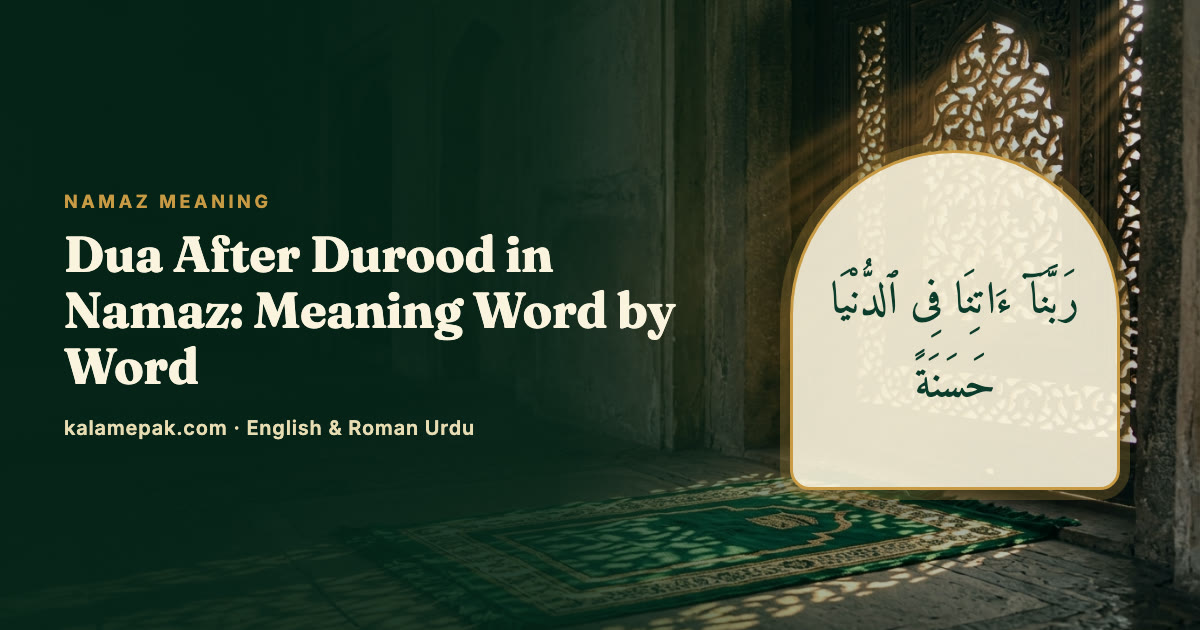
Our Lord! Give unto us in the world that which is good and in the Hereafter that which is good, and guard us from the doom of Fire.
Aey hamare Rabb! Humein duniya mein neki de aur aakhirat mein bhi bhalaai ata farma aur humein azaab-e-jahannam se najaat de
Surah Al-Baqarah · 2:201
Both are explained word by word in dua after Durood in namaz.
13. Salam — ending the prayer
Turn the face to the right, then to the left, saying each time:
Peace be upon you and the mercy of Allah.
Tum par salaamti ho aur Allah ki rehmat.
Salam · Abu Dawud 996, Tirmidhi 295
Namaz ka tarjuma in Hindi (short parts)
If you read Hindi script, here are the shortest, most repeated parts with their meaning in Hindi — the same Roman Urdu meanings as above, written in Devanagari:
| Arabic | Say it | Hindi meaning |
|---|---|---|
| اللَّهُ أَكْبَرُ | Allāhu akbar | अल्लाह सब से बड़ा है |
| سُبْحَانَ رَبِّيَ الْعَظِيمِ | Subḥāna rabbiya l-ʿaẓīm | पाक है मेरा रब, जो अज़मत वाला है |
| سَمِعَ اللَّهُ لِمَنْ حَمِدَهُ | Samiʿa llāhu liman ḥamidah | अल्लाह ने उस की सुन ली जिस ने उस की तारीफ़ की |
| رَبَّنَا وَلَكَ الْحَمْدُ | Rabbanā wa laka l-ḥamd | ऐ हमारे रब, और तारीफ़ तेरे ही लिए है |
| سُبْحَانَ رَبِّيَ الْأَعْلَىٰ | Subḥāna rabbiya l-aʿlā | पाक है मेरा रब, जो सब से बुलंद है |
| السَّلَامُ عَلَيْكُمْ وَرَحْمَةُ اللَّهِ | As-salāmu ʿalaykum wa raḥmatu llāh | तुम पर सलामती हो और अल्लाह की रहमत |
What the whole prayer "says"
Read the meanings in order and namaz becomes a conversation with a clear shape: you declare Allah's greatness; you praise Him; you ask His protection from Satan; you begin in His name; you praise Him as Lord of the worlds and Master of the Day of Judgment, promise to worship Him alone, and ask Him for the straight path; you bow and prostrate declaring His greatness and highness; you send greetings and bear witness; you ask blessings for His Prophet ﷺ; you ask forgiveness; and you leave with peace.
How to learn all this without feeling overwhelmed
Don't try to learn every meaning today. Start with the parts you repeat most — Fatiha and the ruku and sajdah tasbih — and add one part at a time. Our 7-day plan to understand your namaz breaks it into a small daily step.
You'll also notice the same words coming back again and again: Allah, rabb ("Lord"), ḥamd ("praise"), raḥma ("mercy"), ʿabd ("servant"). These are some of the most common words in the whole Quran — which is exactly why our book, 600 Words of the Quran, starts from them: understanding namaz is the doorway to understanding the Quran.
Frequently asked questions
What is namaz ka tarjuma?
It means the translation of everything we recite in namaz — the opening takbir, Sana, Surah Al-Fatiha, a short surah, the tasbih of ruku and sajdah, Attahiyat, Durood and the final dua — so you know what you are saying to Allah.
Does namaz have to be recited in Arabic?
The recitation of namaz is done in Arabic, as taught by the Prophet Muhammad ﷺ. Learning the translation doesn't change the prayer; it lets you understand the Arabic words while you say them.
Why do different people pray slightly differently?
The main structure of namaz is the same for all Muslims, but the schools of fiqh differ in some details, such as hand positions or what is recited silently or aloud. Follow what your trusted scholars teach; this article covers the meanings.
What is the fastest way to learn the meaning of namaz?
Learn one part at a time, starting with the parts you repeat most: Surah Al-Fatiha and the ruku and sajdah tasbih. Our 7-day plan breaks the whole prayer into daily steps.