Attahiyat Meaning in English & Roman Urdu (Word by Word)
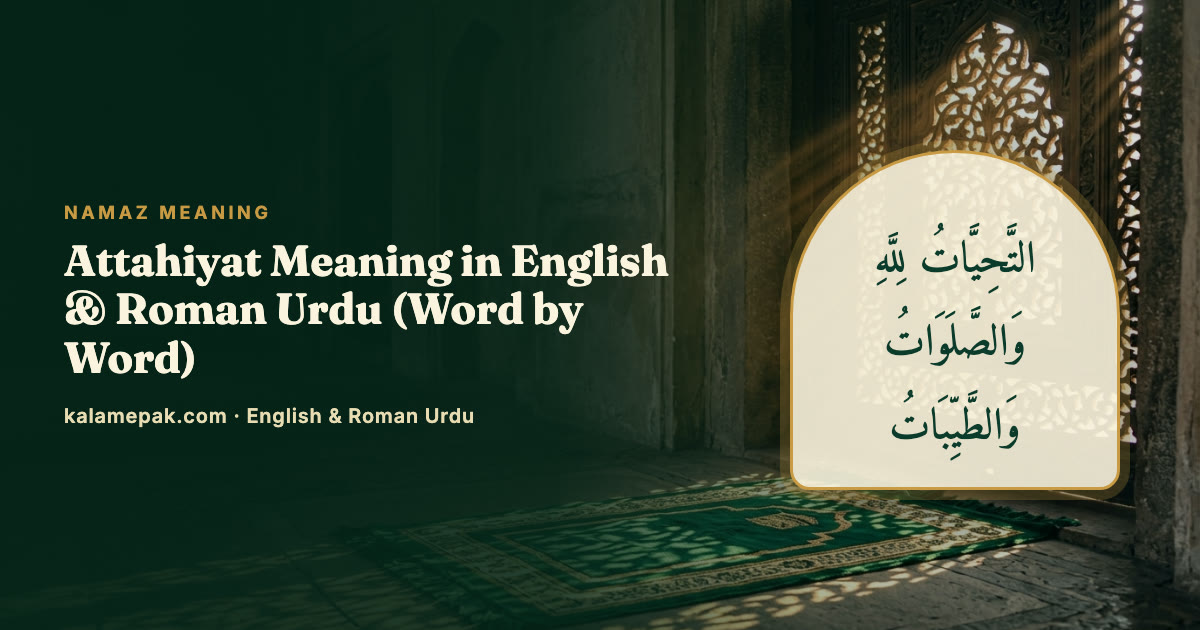
Attahiyat means: "All greetings (of respect) are for Allah, and all prayers and all good things. Peace be upon you, O Prophet, and the mercy of Allah and His blessings. Peace be upon us and upon the righteous servants of Allah. I bear witness that there is no god but Allah, and I bear witness that Muhammad is His servant and His Messenger."
You say this every time you sit in namaz, often without a pause to think. It is short, but it holds four different things: praise of Allah, a greeting to the Prophet Muhammad ﷺ, a dua for every good believer, and the testimony of faith. Let us open each one.
The full Attahiyat: Arabic, English and Roman Urdu
All greetings (of respect) are for Allah, and all prayers and all good things. Peace be upon you, O Prophet, and the mercy of Allah and His blessings. Peace be upon us and upon the righteous servants of Allah. I bear witness that there is no god but Allah, and I bear witness that Muhammad is His servant and His Messenger.
Tamaam qauli, badani aur maali ibadatein Allah hi ke liye hain. Aey Nabi! Aap par salaam ho, aur Allah ki rehmat aur us ki barkatein. Salaam ho hum par aur Allah ke nek bandon par. Main gawahi deta hoon ke Allah ke siwa koi maabood nahin, aur main gawahi deta hoon ke Muhammad (sallallahu alaihi wa sallam) Us ke bande aur Us ke Rasool hain.
Tashahhud of Abdullah ibn Mas'ud · Sahih al-Bukhari 831, Sahih Muslim 402
Transliteration: At-taḥiyyātu lillāhi wa ṣ-ṣalawātu wa ṭ-ṭayyibāt. As-salāmu ʿalayka ayyuha n-nabiyyu wa raḥmatu llāhi wa barakātuh. As-salāmu ʿalaynā wa ʿalā ʿibādi llāhi ṣ-ṣāliḥīn. Ashhadu an lā ilāha illa llāh, wa ashhadu anna Muḥammadan ʿabduhū wa rasūluh.
This is the tashahhud of Ibn Mas'ud, the one used in most of India and Pakistan. Other Companions reported slightly different authentic wordings, and some schools use those. If you learned a different one, it is not "wrong"; keep to what your teachers taught you.
Attahiyat word by word
Below, "In the book" is the word's number in 600 Words of the Quran and how many times it appears in the Quran. Words marked "not in the list" are still easy. You will learn them here.
Part 1: Praise that belongs only to Allah
| Arabic | Say it | Meaning | In the book |
|---|---|---|---|
| التَّحِيَّاتُ | at-taḥiyyātu | all greetings, words of honour | not in the list |
| لِلَّهِ | lillāhi | are for Allah: li "for" + Allah | #2 Allah · 2,699× |
| وَالصَّلَوَاتُ | wa ṣ-ṣalawātu | and the prayers | from ṣalāh #208 · 83× |
| وَالطَّيِّبَاتُ | wa ṭ-ṭayyibātu | and the good (pure) things | from ṭayyib "good, pure" #539 |
Kings of old were greeted with special words of honour. This line says: every such greeting really belongs to Allah. The Roman Urdu you learned as a child, "tamaam qauli, badani aur maali ibadatein", explains the three words as worship by the tongue (greetings, praise), the body (prayers) and wealth (good things given for His sake).
Taḥiyya (greeting) also appears in the Quran. About the people of Paradise, Allah says "their greeting therein will be: Peace" (10:10).
Part 2: A greeting to the Prophet ﷺ
| Arabic | Say it | Meaning | In the book |
|---|---|---|---|
| السَّلَامُ | as-salāmu | peace | #138 salām · 42× |
| عَلَيْكَ | ʿalayka | upon you: ʿalā + -ka "you" | #9 ʿalā · 1,444× |
| أَيُّهَا | ayyuha | O … (calling someone) | — |
| النَّبِيُّ | an-nabiyyu | the Prophet | #69 nabiyy · 75× |
| وَرَحْمَةُ | wa raḥmatu | and the mercy (of) | #285 raḥma · 114× |
| اللَّهِ | llāhi | Allah | #2 |
| وَبَرَكَاتُهُ | wa barakātuhū | and His blessings | not in the list |
The words raḥmatu llāhi wa barakātuhū ("the mercy of Allah and His blessings") are the same words the angels said to the household of Ibrahim (peace be upon him) in the Quran:
The mercy of Allah and His blessings be upon you, O people of the house! Lo! He is Owner of Praise, Owner of Glory!
Tum par aey is ghar ke logo Allah ki rehmat aur us ki barkatein naazil hon, beshak Allah hamd-o-sana ka sazaawaar aur badi shaan wala hai
Surah Hud · 11:73 (part)
You will meet ḥamīdun majīd again at the end of Durood Ibrahim, which comes right after the Attahiyat.
Part 3: A dua for yourself and every good servant
| Arabic | Say it | Meaning | In the book |
|---|---|---|---|
| السَّلَامُ | as-salāmu | peace | #138 |
| عَلَيْنَا | ʿalaynā | upon us | #9 ʿalā |
| وَعَلَىٰ | wa ʿalā | and upon | #9 |
| عِبَادِ | ʿibādi | the servants (of) | plural of ʿabd #221 · 131× |
| اللَّهِ | llāhi | Allah | #2 |
| الصَّالِحِينَ | aṣ-ṣāliḥīn | the righteous | #190 ṣāliḥ · 74× |
This is easy to rush past, but it is a gift. With one sentence you send peace to yourself and to every righteous servant of Allah, the living, the dead, people you have never met. Say it slowly and mean it.
Part 4: The testimony (Shahadah)
| Arabic | Say it | Meaning | In the book |
|---|---|---|---|
| أَشْهَدُ | ashhadu | I bear witness | #313 shahida · 44× |
| أَنْ | an | that | #18 · 616× |
| لَا | lā | (there is) no | #3 · 1,742× |
| إِلَٰهَ | ilāha | god (worthy of worship) | #283 ilāh · 147× |
| إِلَّا | illā | except | #17 · 659× |
| اللَّهُ | Allāhu | Allah | #2 |
| وَأَشْهَدُ | wa ashhadu | and I bear witness | #313 |
| أَنَّ | anna | that | #26 · 362× |
| مُحَمَّدًا | Muḥammadan | Muhammad ﷺ | — |
| عَبْدُهُ | ʿabduhū | His servant: ʿabd + -hū "His" | #221 ʿabd · 131× |
| وَرَسُولُهُ | wa rasūluhū | and His Messenger | #64 rasūl · 332× |
Notice the order: servant first, then Messenger. Every time you sit in namaz, you affirm both: the Prophet ﷺ is the most honoured of people, and he is a servant of Allah.
Both halves of the Shahadah are found in the Quran's own words. The first, لَآ إِلَٰهَ إِلَّا ٱللَّهُ (lā ilāha illa llāh), appears in 47:19. The second:
Muhammad is the messenger of Allah.
Muhammad (sallallahu alaihi wa sallam) Allah ke Rasool hain
Surah Al-Fath · 48:29 (part)
For a deeper look at the first half, see La ilaha illallah meaning.
Attahiyat meaning in Hindi (simple words)
The Roman Urdu above is everyday Hindustani, so Hindi speakers can use it directly. The few words that may be new:
- ibaadat: worship · qauli / badani / maali: of the tongue / of the body / of wealth
- salaam: peace · rehmat: mercy · barkat: blessing
- nek bande: good, righteous servants
- gawahi: testimony, witness · maabood: the one who is worshipped · Rasool: messenger
When you say it, and what comes after
You recite the Attahiyat in the sitting after every two rak'ahs and in the final sitting. What is added in the middle sitting of a 3- or 4-rak'ah prayer differs slightly between schools; in the Hanafi way common in India and Pakistan, you stand up right after the Attahiyat. In the final sitting, it is followed by the Durood and then a dua before the salam. See the dua after Durood for the two most common ones. Details such as how you sit or move your finger differ between schools; follow the way you were taught.
A simple way to make it stick
Try this for one week:
- Day 1–2: Only Part 1. As you say at-taḥiyyātu lillāh, think "every word of honour is His".
- Day 3–4: Add Part 2. Picture sending salaam to the Prophet ﷺ, with Allah's mercy and blessings.
- Day 5: Add Part 3. At ʿalaynā, think of yourself; at ʿibādi llāhi ṣ-ṣāliḥīn, think of your parents and teachers.
- Day 6–7: The Shahadah. Say ashhadu like someone really giving testimony.
If you want a day-by-day plan for the whole prayer, understand your namaz in 7 days takes you through each part the same way.
Many words here (salām, raḥma, ʿabd, ṣāliḥ, ilāh, rasūl) are among the most common words in the Quran. Learn them once in your namaz and you will recognise them across the whole Quran. That is how 600 Words of the Quran is built: 30 short lessons, each word with a real verse and its meaning in English and Roman Urdu.
Frequently asked questions
What is the meaning of Attahiyat in English?
All greetings (of respect) are for Allah, and all prayers and all good things. Peace be upon you, O Prophet, and the mercy of Allah and His blessings. Peace be upon us and upon the righteous servants of Allah. I bear witness that there is no god but Allah, and I bear witness that Muhammad is His servant and His Messenger.
Where does the Attahiyat come from?
This wording is the tashahhud taught by the Prophet ﷺ to Abdullah ibn Mas'ud, recorded in Sahih al-Bukhari 831 and Sahih Muslim 402. It is the version most used in India and Pakistan.
When is Attahiyat recited in namaz?
It is recited while sitting after every two rak'ahs and in the final sitting. In a 2-rak'ah prayer that is once; in a 3- or 4-rak'ah prayer it is recited in both sittings.
What is the difference between Attahiyat and Tashahhud?
They are the same thing. 'Tashahhud' means 'bearing witness', because the text ends with the two testimonies; 'Attahiyat' is simply its first word.
Are there other versions of the tashahhud?
Yes. Other Companions also reported authentic wordings with small differences, and some schools prefer one of those. The meaning is very close in all of them.