Understand Your Namaz in 7 Days: A Simple Day-by-Day Plan
You can understand the meaning of your whole namaz in one week by learning one part a day — about 15 minutes each day. Day 1 is the takbir and Sana, days 2–4 cover the Bismillah and Surah Al-Fatiha, day 5 the ruku and sajdah, day 6 the Attahiyat, and day 7 the Durood, final dua and salam. Each day below gives you the text's meaning, the handful of Arabic words to learn, and a 1-minute exercise to use in that day's prayers.
Why "samajh kar" namaz changes everything
Most of us learned namaz as a set of sounds. We say them correctly, but the mind wanders — to work, to the phone, to dinner. When you know what each phrase means, you have something to hold your attention: you're not just saying words, you're saying something to Allah.
The Quran describes successful believers this way:
Successful indeed are the believers
Yaqeenan imaan waalon ne falaah haasil kar li
Surah Al-Mu'minun · 23:1
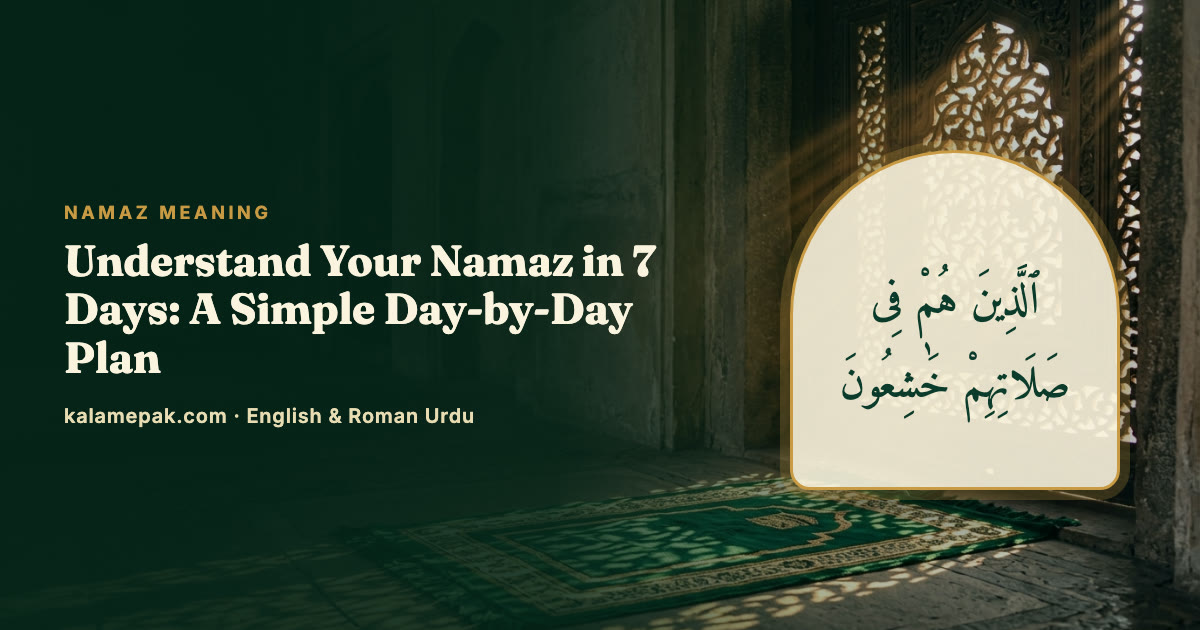
Who are humble in their prayers,
Jo apni namaz mein khushoo karte hain
Surah Al-Mu'minun · 23:2
Understanding doesn't create humility by itself — but it certainly helps. So let's begin.
How to use this plan: do each day's lesson after Fajr or whenever you have 15 quiet minutes. Then use the 1-minute exercise in every prayer that day. If a day feels heavy, take two days for it. No rush.
Day 1 — Allahu Akbar and the Sana
Today you learn how the prayer opens. Allāhu akbar means "Allah is the Greatest" (Roman Urdu: Allah sab se bada hai). The Sana means: "Glory be to You, O Allah, and praise be to You. Blessed is Your name, exalted is Your majesty, and there is no god but You."
| Word | Say it | Meaning | In the book |
|---|---|---|---|
| أَكْبَر | akbar | greater, greatest | #528 |
| سُبْحان | subḥān | glory be to | #398 |
| حَمْد | ḥamd | praise | #218 |
| اسْم | ism | name | #295 |
| إِلٰه | ilāh | god, deity | #283 |
| غَيْر | ghayr | other than | #37 |
1-minute exercise: At every Allāhu akbar today, pause for one breath and think: "Allah is greater than whatever I was just thinking about."
Full word by word: Sana dua meaning.
Day 2 — Taʿawwudh and Bismillah
Aʿūdhu billāhi mina sh-shayṭāni r-rajīm — "I seek refuge in Allah from Satan, the rejected." Bismillāhi r-raḥmāni r-raḥīm — "In the name of Allah, the Beneficent, the Merciful" (Roman Urdu: Shuru karta hoon Allah Ta'ala ke naam se jo bada meherbaan nihaayat rahm wala hai).
| Word | Say it | Meaning | In the book |
|---|---|---|---|
| مِن | min | from | #1 (3,226 times) |
| شَيْطان | shayṭān | Satan | #188 |
| رَحْمٰن | raḥmān | the Most Gracious | #289 |
| رَحِيم | raḥīm | most merciful | #284 |
Notice ism ("name") from yesterday is hiding inside bismi = bi ("in") + ism ("name"). Your Day 1 word is already paying off.
1-minute exercise: When you say ar-raḥmān ar-raḥīm, remember one mercy Allah showed you this week.
Day 3 — Surah Al-Fatiha, verses 2–4
"Praise be to Allah, Lord of the Worlds, the Beneficent, the Merciful, Master of the Day of Judgment." (Roman Urdu: Sab taareef Allah Ta'ala ke liye hai jo tamaam jahaanon ka paalne wala hai…)
| Word | Say it | Meaning | In the book |
|---|---|---|---|
| رَبّ | rabb | Lord | #12 (975 times) |
| عالَم | ʿālam | world | #147 |
| يَوْم | yawm | day | #20 |
| دِين | dīn | judgment; religion | #167 |
Only four new words — because ḥamd, Allah, raḥmān and raḥīm you already know. That's how quickly namaz vocabulary builds on itself.
1-minute exercise: When you say māliki yawmi d-dīn, remember that you will stand before Him on that Day — and that you are standing before Him right now.
Day 4 — Surah Al-Fatiha, verses 5–7
"Thee (alone) we worship; Thee (alone) we ask for help. Show us the straight path, the path of those whom Thou hast favoured; not the (path) of those who earn Thine anger nor of those who go astray." (Pickthall)
| Word | Say it | Meaning | In the book |
|---|---|---|---|
| إِيّا | iyyā | (object) you | #386 |
| عَبَدَ | ʿabada | he worshipped | #205 |
| هَدَى | hadā | he guided | #184 |
| صِراط | ṣirāṭ | path | #197 |
| مُسْتَقِيم | mustaqīm | straight | #352 |
| لا | lā | not, nor | #3 |
Verse 5 is the heart of the prayer: a promise and a request in one breath. The full surah word by word is in Surah Fatiha meaning.
1-minute exercise: Say ihdinā ṣ-ṣirāṭa l-mustaqīm slowly, as a real request — about one decision you're facing today.
Day 5 — Ruku and sajdah
In ruku: Subḥāna rabbiya l-ʿaẓīm — "Glory be to my Lord, the Most Great." Rising: Samiʿa llāhu liman ḥamidah — "Allah hears the one who praises Him," and Rabbanā wa laka l-ḥamd — "Our Lord, and to You belongs all praise." In sajdah: Subḥāna rabbiya l-aʿlā — "Glory be to my Lord, the Most High."
| Word | Say it | Meaning | In the book |
|---|---|---|---|
| عَظِيم | ʿaẓīm | great, mighty | #244 |
| سَمِعَ | samiʿa | he heard | #308 |
| مَن | man | who, whoever | #14 |
| rabbiya / rabbanā | — | my Lord / our Lord | rabb + "my" / "our" |
Al-aʿlā ("the Most High") isn't in the 600 list, but it's easy to remember as the opposite position: your forehead is at the lowest point while you glorify the Most High. More in ruku and sajdah tasbih meaning.
1-minute exercise: In your next sajdah, say the tasbih once slowly and feel the meaning of "my Lord" — rabbī, not just "the Lord".
Day 6 — Attahiyat
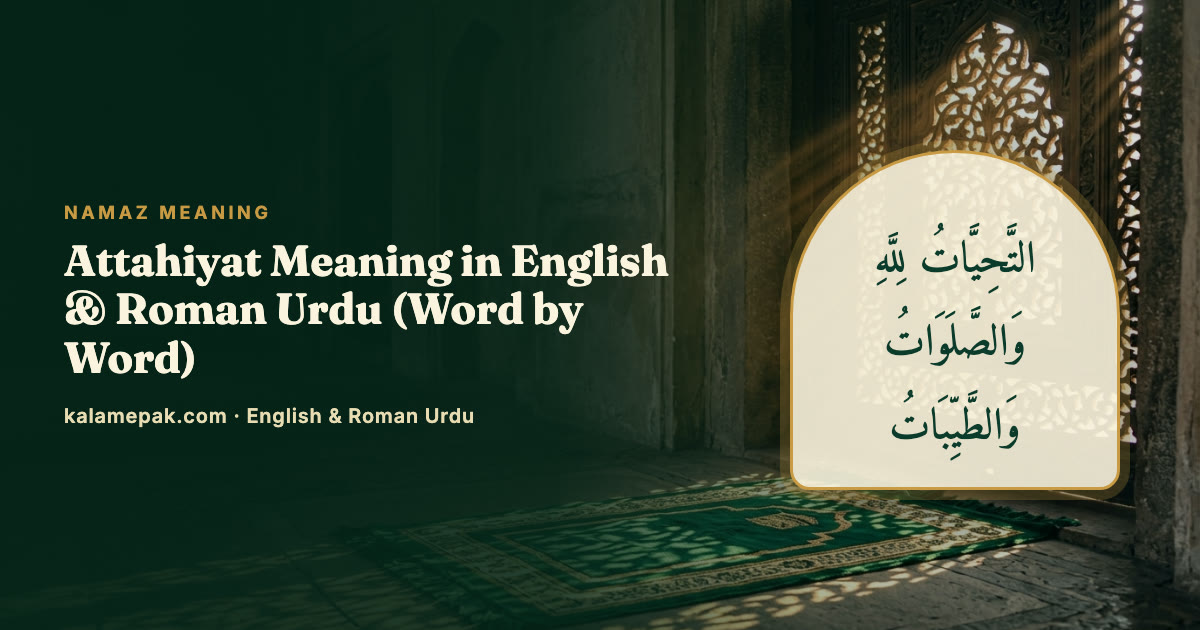
"All greetings (of respect) are for Allah, and all prayers and all good things. Peace be upon you, O Prophet, and the mercy of Allah and His blessings. Peace be upon us and upon the righteous servants of Allah. I bear witness that there is no god but Allah, and I bear witness that Muhammad is His servant and His Messenger." (Tashahhud of Ibn Masʿud — Sahih al-Bukhari 831, Sahih Muslim 402)
| Word | Say it | Meaning | In the book |
|---|---|---|---|
| سَلام | salām | peace | #138 |
| نَبِيّ | nabiyy | prophet | #69 |
| رَحْمَة | raḥma | mercy | #285 |
| عَبْد | ʿabd | servant (plural ʿibād) | #221 |
| صالِح | ṣāliḥ | righteous (plural ṣāliḥīn) | #190 |
| شَهِدَ | shahida | he testified (ashhadu = I testify) | #313 |
| رَسُول | rasūl | messenger | #64 |
This is the longest text so far, but look how many words you already know: Allah, ilāh, lā, ʿabd, raḥma. See Attahiyat meaning for every word.
1-minute exercise: At as-salāmu ʿalaynā wa ʿalā ʿibādi llāhi ṣ-ṣāliḥīn, think of the righteous people you love — living or passed away — whom this greeting includes.
Day 7 — Durood, the final dua and salam
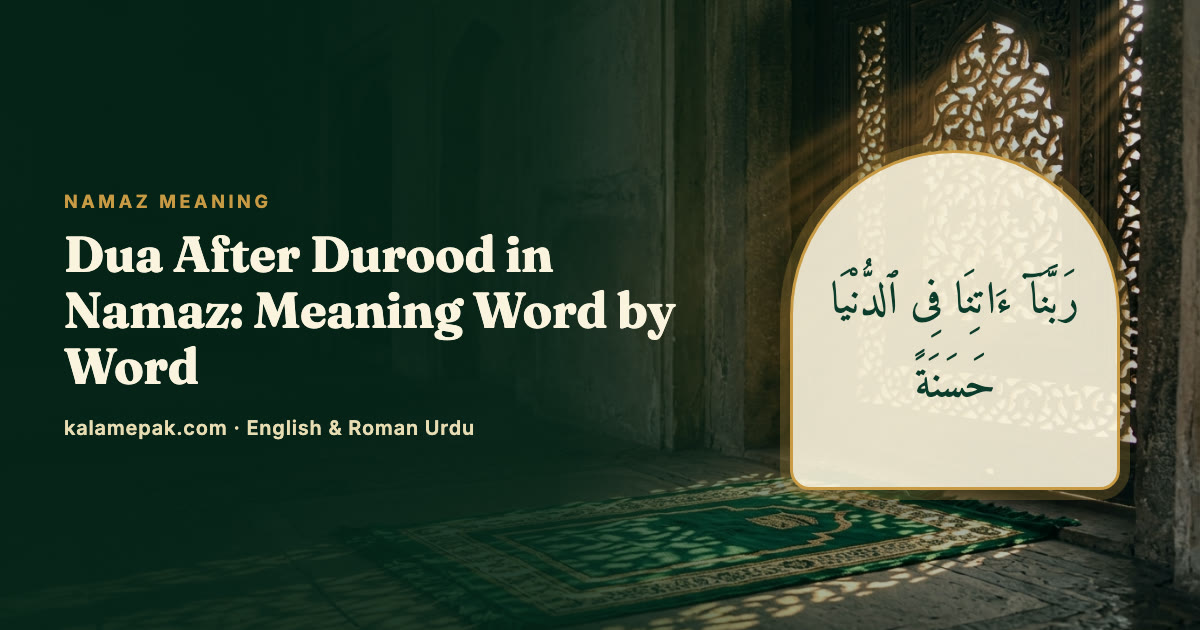
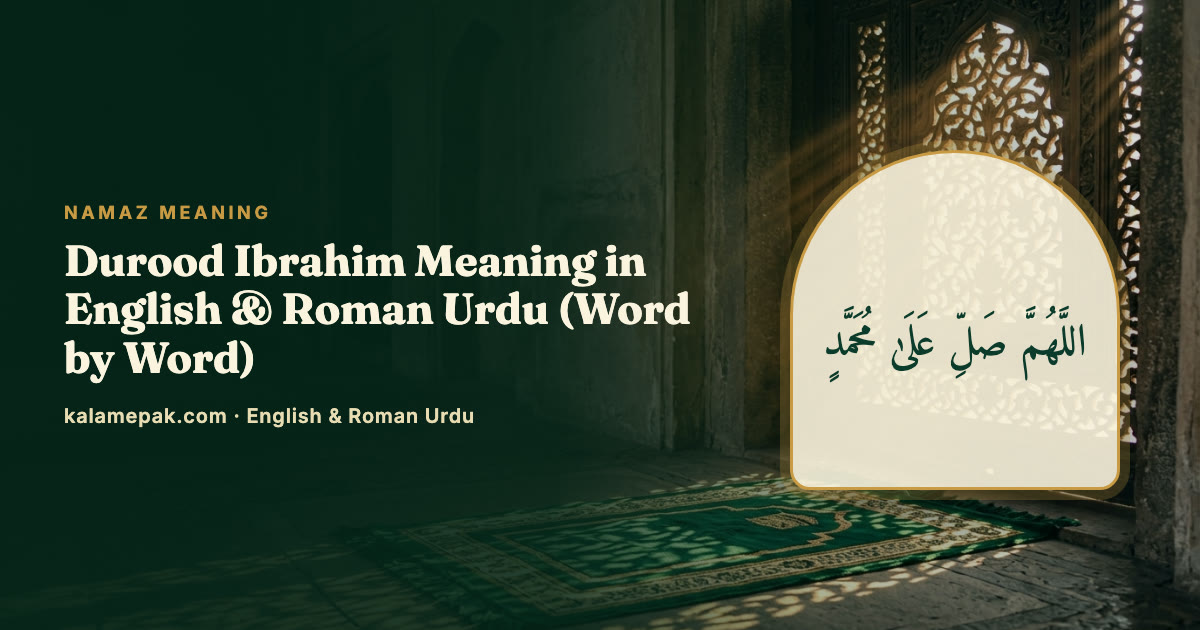
The Durood asks Allah to send His grace and blessings on the Prophet Muhammad ﷺ and his family, as He did on Ibrahim and his family. The dua Allāhumma innī ẓalamtu nafsī… means "O Allah, I have wronged myself greatly, and no one forgives sins except You. So forgive me… and have mercy on me." The salam, as-salāmu ʿalaykum wa raḥmatu llāh, means "Peace be upon you and the mercy of Allah."
| Word | Say it | Meaning | In the book |
|---|---|---|---|
| آل | āl | family (of) | #452 |
| إِبْراهِيم | Ibrāhīm | Ibrahim | #74 |
| نَفْس | nafs | soul, self | #219 |
| ظَلَمَ | ẓalama | he wronged | #187 |
| غَفَرَ | ghafara | he forgave | #130 |
| غَفُور | ghafūr | Most Forgiving | #287 |
1-minute exercise: In the final dua, when you say ẓalamtu nafsī ("I have wronged myself"), bring to mind one specific mistake — and mean the request for forgiveness.
After the 7 days
Congratulations — you now know what you're saying from the first Allāhu akbar to the final salam. Keep the complete text with meanings handy in namaz ka tarjuma, and review one day's words each week so they stay fresh.
You've also learned about 35 of the most common words in the Quran along the way — words like rabb, raḥma, ʿabd and yawm that appear hundreds of times. If you'd like to keep going, our book 600 Words of the Quran continues exactly this way: 30 short lessons, each word shown in a real verse with its meaning in English and Roman Urdu. The words of your namaz become the doorway to the whole Quran.
Frequently asked questions
Can I really understand my namaz in 7 days?
You can learn the meaning of every part of the prayer and its key words in a week, at about 15 minutes a day. Making that understanding feel natural in every prayer takes a little longer, through daily practice.
What should I learn first to understand namaz?
Start with what you repeat most: Allahu akbar, Surah Al-Fatiha, and the ruku and sajdah tasbih. They come in every rakʿah, so you revise them many times a day.
How do I keep my mind focused in namaz?
Knowing the meaning helps a lot. A practical habit is to recite slowly and let the meaning of each phrase pass through your mind as you say it, especially in Fatiha and the tasbih.