Dua e Qunoot Meaning in English & Roman Urdu (Word by Word)
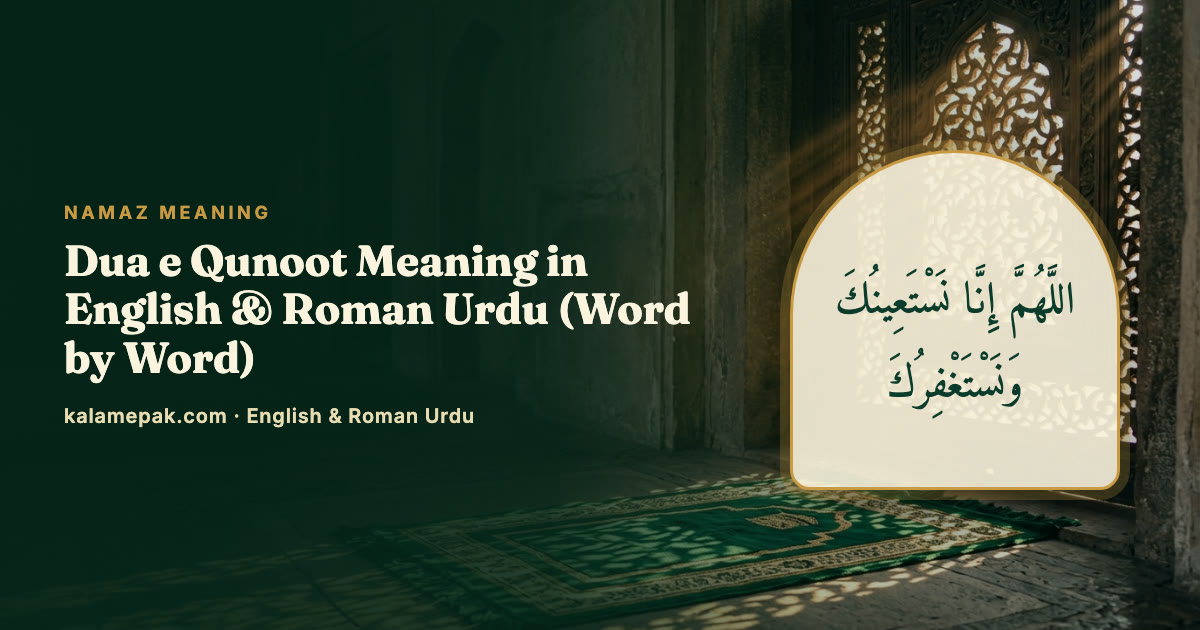
Dua e Qunoot (the version most read in India and Pakistan) means: "O Allah, we ask You for help and we ask Your forgiveness; we believe in You and put our trust in You; we praise You with all good, we thank You and we are not ungrateful to You; we cast off and leave whoever disobeys You. O Allah, You alone we worship; to You we pray and prostrate; towards You we hasten and serve; we hope for Your mercy and fear Your punishment. Surely Your punishment will overtake the disbelievers."
Many of us memorised this in childhood for Witr and have said it hundreds of times without knowing it is a string of short, powerful promises to Allah. There is also a second, equally well-known version. We will go through both.
Two versions, both practised
| Version A | Version B | |
|---|---|---|
| Begins with | Allāhumma innā nastaʿīnuka… | Allāhumma hdinī fīman hadayt… |
| Reported from | ʿUmar ibn al-Khattab (Musannaf Ibn Abi Shaybah; al-Bayhaqi, as-Sunan al-Kubra 2/210) | al-Hasan ibn ʿAli, who said the Prophet ﷺ taught it to him for Witr (Abu Dawud 1425, Tirmidhi 464, Nasa'i 1745) |
| Mostly used by | the Hanafi school, most mosques in India and Pakistan | widely used, especially outside the Hanafi school |
| Speaks as | "we" | "me" |
Both are respected and both are practised. Where exactly the qunoot is said and on which nights is also discussed differently by the schools, so follow the practice you were taught.
Version A: Allahumma inna nasta'inuka
O Allah, we ask You for help and we ask Your forgiveness; we believe in You and put our trust in You; we praise You with all good, we thank You and we are not ungrateful to You; we cast off and leave whoever disobeys You. O Allah, You alone we worship; to You we pray and prostrate; towards You we hasten and serve; we hope for Your mercy and fear Your punishment. Surely Your punishment will overtake the disbelievers.
Aey Allah! Hum Tujh hi se madad maangte hain aur Tujh hi se maafi chahte hain, Tujh par imaan laate hain aur Tujh hi par bharosa karte hain, aur Teri achhi taareef karte hain, Tera shukr ada karte hain aur Teri na-shukri nahin karte, aur jo Teri naafarmaani kare use chhod dete hain aur us se alag ho jaate hain. Aey Allah! Hum Teri hi ibadat karte hain, Tere hi liye namaz padhte aur sajda karte hain, Teri hi taraf daudte aur jhapakte hain, Teri rehmat ki umeed rakhte hain aur Tere azaab se darte hain. Beshak Tera azaab kaafiron ko pahunchne wala hai.
Reported from ʿUmar ibn al-Khattab · Musannaf Ibn Abi Shaybah; al-Bayhaqi, as-Sunan al-Kubra 2/210
Key phrases word by word
Almost every phrase is a verb that starts with na- or nu-, which means "we". Spot that and the dua becomes a list: we ask, we believe, we trust, we praise, we thank…
"In the book" = the word's number in 600 Words of the Quran and how often it appears in the Quran.
| Arabic | Say it | Meaning | In the book |
|---|---|---|---|
| نَسْتَعِينُكَ | nastaʿīnuka | we ask You for help | — (same verb as nastaʿīn in the Fatiha) |
| وَنَسْتَغْفِرُكَ | wa nastaghfiruka | and we ask Your forgiveness | #399 istaghfara · 40× |
| وَنُؤْمِنُ بِكَ | wa nuʾminu bika | and we believe in You | #19 āmana · 537× |
| وَنَتَوَكَّلُ عَلَيْكَ | wa natawakkalu ʿalayka | and we put our trust in You | #140 tawakkala · 40× |
| الْخَيْرَ | al-khayra | (with) all good | #182 khayr · 178× |
| وَنَشْكُرُكَ | wa nashkuruka | and we thank You | #217 shakara · 46× |
| وَلَا نَكْفُرُكَ | wa lā nakfuruka | and we are not ungrateful to You | #121 kafara · 289× |
| وَنَتْرُكُ | wa natruku | and we leave | #336 taraka · 40× |
| مَنْ يَفْجُرُكَ | man yafjuruka | whoever disobeys You | #14 man · 871× |
| إِيَّاكَ نَعْبُدُ | iyyāka naʿbudu | You alone we worship | #386 iyyā, #205 ʿabada · 122× |
| وَنَسْجُدُ | wa nasjudu | and we prostrate | #400 sajada · 35× |
| نَسْعَىٰ | nasʿā | we hasten, we strive | #275 saʿā · 20× |
| وَنَرْجُو | wa narjū | and we hope (for) | #425 rajā · 22× |
| رَحْمَتَكَ | raḥmataka | Your mercy | #285 raḥma · 114× |
| وَنَخْشَىٰ | wa nakhshā | and we fear | #139 khashiya · 40× |
| عَذَابَكَ | ʿadhābaka | Your punishment | #162 ʿadhāb · 322× |
| بِالْكُفَّارِ | bil-kuffāri | the disbelievers | plural of kāfir #125 · 156× |
Two small but important details:
- Shukr and kufr are opposites here. Nashkuruka wa lā nakfuruka = "we thank You and are not ungrateful to You." The root k-f-r is usually translated "disbelieve" in the Quran, but it also carries the sense of ingratitude, as the English and Roman Urdu of this dua show.
- Hope and fear together. Narjū raḥmataka wa nakhshā ʿadhābak: a believer holds both. Not so much fear that he despairs, not so much hope that he becomes careless.
Version B: Allahummahdini fiman hadayt
O Allah, guide me among those You have guided, grant me well-being among those You have granted well-being, take care of me among those You take care of, bless me in what You have given, and protect me from the evil of what You have decreed. For You decree and none can decree over You, and whoever You befriend is never humiliated. Blessed are You, our Lord, and Exalted.
Aey Allah! Mujhe hidayat de un logon mein jin ko Tu ne hidayat di, mujhe aafiyat de un mein jin ko Tu ne aafiyat di, meri sarparasti farma un mein jin ki Tu ne sarparasti ki, jo Tu ne mujhe diya us mein barkat de, aur jo Tu ne faisla kiya us ki buraai se mujhe bacha. Kyunki Tu hi faisla karta hai aur Tere khilaaf faisla nahin kiya jaata, aur jise Tu dost bana le woh kabhi zaleel nahin hota. Aey hamare Rabb! Tu barkat wala aur buland hai.
al-Hasan ibn ʿAli · Abu Dawud 1425, Tirmidhi 464, Nasa'i 1745
Key phrases word by word
This version has a beautiful pattern: do for me, among those You have done it for. Guide me among the guided, keep me well among the well.
| Arabic | Say it | Meaning | In the book |
|---|---|---|---|
| اهْدِنِي | ihdinī | guide me | #184 hadā · 144× |
| فِيمَنْ | fīman | among those whom: fī + man | #4 fī, #14 man |
| هَدَيْتَ | hadayta | You have guided | #184 |
| وَعَافِنِي | wa ʿāfinī | and grant me well-being | — |
| وَتَوَلَّنِي | wa tawallanī | and take care of me (as my protector) | root of waliyy "protector" #223 |
| أَعْطَيْتَ | aʿṭayta | You have given | — |
| وَقِنِي | wa qinī | and protect me | #594 waqā · 16× |
| شَرَّ | sharra | the evil (of) | #363 sharr · 30× |
| قَضَيْتَ | qaḍayta | You have decreed | #98 qaḍā · 59× |
| رَبَّنَا | rabbanā | our Lord | #12 rabb · 975× |
Hidden links to the Fatiha
If you know the meaning of Surah Fatiha, you already know parts of the Qunoot:
- Version A says إِيَّاكَ نَعْبُدُ iyyāka naʿbudu, "You alone we worship", exactly as in Fatiha 1:5. It also says nastaʿīnuka, "we ask You for help", from the same verb as nastaʿīn in that verse.
- Version B says ihdinī, "guide me". In the Fatiha you say ihdinā, "guide us". Same verb, -nī (me) instead of -nā (us).
- Version B says wa qinī, "protect me". In Rabbana atina you say wa qinā, "protect us". Same pattern.
How to memorise it with meaning
Break Version A into five short chunks and learn one a day:
- nastaʿīnuka wa nastaghfiruk: help and forgiveness
- nuʾminu bika wa natawakkalu ʿalayk: faith and trust
- nuthnī ʿalayka l-khayr, nashkuruka wa lā nakfuruk, wa nakhlaʿu wa natruku man yafjuruk: praise, thanks, and turning away from disobedience
- iyyāka naʿbud… nuṣallī wa nasjud… nasʿā wa naḥfid: worship and effort
- narjū raḥmataka wa nakhshā ʿadhābak…: hope and fear
Say each chunk's meaning just before the Arabic. After a week, the meaning comes by itself.
To see where the Qunoot fits among everything else you say in prayer, read what to recite in namaz, and for forgiveness words such as nastaghfiruka, see Astaghfirullah meaning.
Most of the key words in the tables above, āmana, khayr, shakara, kafara, sajada, raḥma, ʿadhāb, rabb, are among the most common words of the Quran. 600 Words of the Quran teaches them in 30 short lessons, each word with a real verse and its meaning in English and Roman Urdu.
Frequently asked questions
What is the meaning of Dua e Qunoot in short?
The version most read in India and Pakistan says: O Allah, we ask You for help and forgiveness, we believe in You and trust You, we praise and thank You and are not ungrateful, we leave whoever disobeys You; You alone we worship, we hope for Your mercy and fear Your punishment.
Which Dua e Qunoot is correct?
Both well-known versions are practised. 'Allahumma inna nasta'inuka…' is reported from 'Umar ibn al-Khattab and taught in the Hanafi school; 'Allahummahdini fiman hadayt…' is reported by al-Hasan ibn 'Ali from the Prophet ﷺ (Abu Dawud 1425, Tirmidhi 464, Nasa'i 1745). Follow the one your teachers or school use.
When is Dua e Qunoot recited?
It is best known as part of the Witr prayer. Exactly where it is said (before or after ruku) and on which nights differs between the schools of fiqh.
What does 'nastaghfiruka' mean?
'We ask Your forgiveness.' It comes from the root gh-f-r (forgive), the same root as Astaghfirullah.