Durood Ibrahim Meaning in English & Roman Urdu (Word by Word)
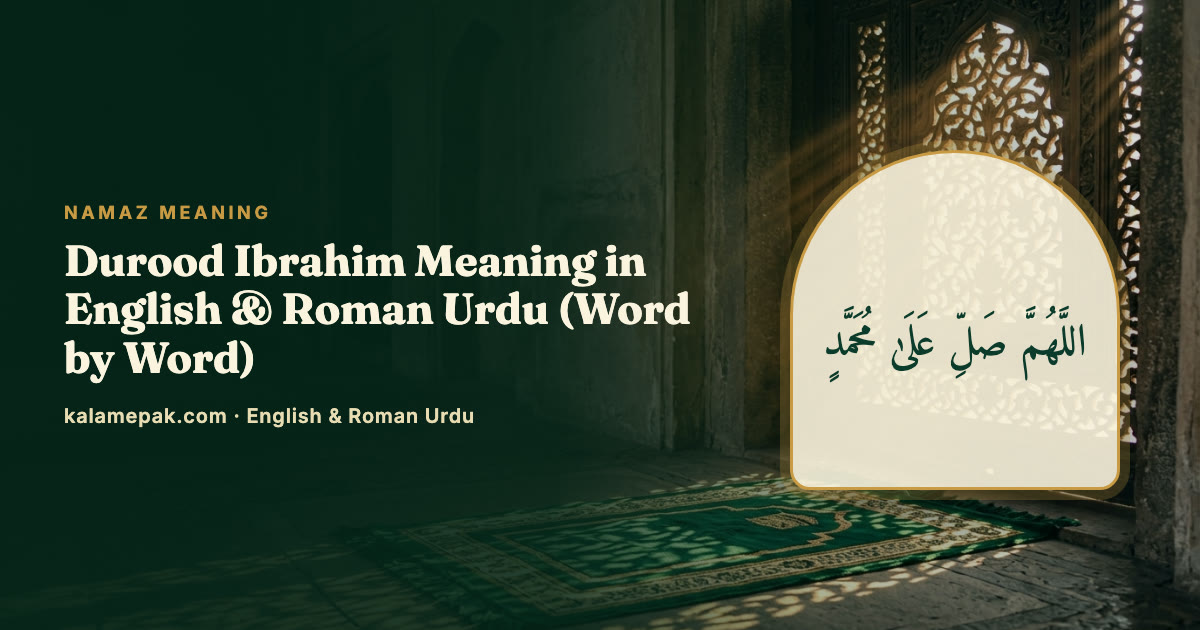
Durood Ibrahim means: "O Allah, send Your grace (blessings and honour) upon Muhammad and upon the family of Muhammad, as You sent grace upon Ibrahim and the family of Ibrahim; You are Praiseworthy, Glorious. O Allah, bless Muhammad and the family of Muhammad, as You blessed Ibrahim and the family of Ibrahim; You are Praiseworthy, Glorious."
Look closely and you will see it is really one sentence said twice, with one word changed. The first half asks Allah to ṣalli (send grace), the second half asks Him to bārik (bless). Once you notice that, the whole Durood becomes easy to understand, and you only need to learn 14 different words.
Durood Ibrahim in Arabic, English and Roman Urdu
O Allah, send Your grace (blessings and honour) upon Muhammad and upon the family of Muhammad, as You sent grace upon Ibrahim and the family of Ibrahim; You are Praiseworthy, Glorious.
Aey Allah! Rehmat naazil farma Muhammad par aur Muhammad ki aal par, jaise Tu ne rehmat naazil farmaayi Ibrahim par aur Ibrahim ki aal par; beshak Tu taareef wala, buzurgi wala hai.
Durood Ibrahim, first half · Sahih al-Bukhari 3370, 6357
O Allah, bless Muhammad and the family of Muhammad, as You blessed Ibrahim and the family of Ibrahim; You are Praiseworthy, Glorious.
Aey Allah! Barkat naazil farma Muhammad par aur Muhammad ki aal par, jaise Tu ne barkat naazil farmaayi Ibrahim par aur Ibrahim ki aal par; beshak Tu taareef wala, buzurgi wala hai.
Durood Ibrahim, second half · Sahih al-Bukhari 3370, 6357
Transliteration: Allāhumma ṣalli ʿalā Muḥammadin wa ʿalā āli Muḥammad, kamā ṣallayta ʿalā Ibrāhīma wa ʿalā āli Ibrāhīm, innaka ḥamīdun majīd. Allāhumma bārik ʿalā Muḥammadin wa ʿalā āli Muḥammad, kamā bārakta ʿalā Ibrāhīma wa ʿalā āli Ibrāhīm, innaka ḥamīdun majīd.
This wording was reported by Ka'b ibn 'Ujrah, when the Companions asked the Prophet Muhammad ﷺ how they should send salat upon him. Several authentic wordings of the Durood exist with small differences; the one above is the one most taught in India and Pakistan.
Why do we send Durood at all?
Because Allah asks us to, in plain words:
Lo! Allah and His angels shower blessings on the Prophet. O ye who believe! Ask blessings on him and salute him with a worthy salutation.
Allah Ta'ala aur us ke farishte is Nabi par rehmat bhejte hain. Aey imaan walo! Tum (bhi) un par durood bhejo aur khoob salaam (bhi) bhejte raha karo
Surah Al-Ahzab · 33:56
The verse asks for two things: ṣallū (send salat) and sallimū (send salaam). In namaz you have already sent the salaam in the Attahiyat ("as-salāmu ʿalayka ayyuha n-nabiyy"). The Durood that follows completes the other half.
What "ṣalli" and "bārik" mean, simply
Ṣalli comes from the same root as ṣalāh, prayer (word #208 in the book, 83 times in the Quran). When we do ṣalāh, we pray. When we ask Allah to do ṣalāh upon the Prophet ﷺ, it means something different: we ask Him to send His grace, mercy and honour upon him. Many scholars explain it as Allah praising and honouring him. The Roman Urdu "rehmat naazil farma" is the simple way it has been taught for generations.
Bārik comes from barakah. Barakah is good that stays and grows: a little food that is enough for many, a short life that benefits people for centuries. So bārik ʿalā Muḥammad asks Allah to make everything good given to the Prophet ﷺ and his family last and increase.
A simple way to hold it in your heart: ṣalli = honour and mercy, bārik = lasting, growing good.
Durood Ibrahim word by word
"In the book" gives the word's number in 600 Words of the Quran and how often it appears in the Quran.
| Arabic | Say it | Meaning | In the book |
|---|---|---|---|
| اللَّهُمَّ | Allāhumma | O Allah | — (from Allah #2 · 2,699×) |
| صَلِّ | ṣalli | send (Your) grace, mercy, honour | root of ṣalāh #208 |
| عَلَىٰ | ʿalā | upon | #9 · 1,444× |
| مُحَمَّدٍ | Muḥammadin | Muhammad ﷺ | — |
| وَعَلَىٰ | wa ʿalā | and upon | #9 |
| آلِ | āli | the family (of) | #452 āl · 26× |
| كَمَا | kamā | just as: ka "like" + mā | — |
| صَلَّيْتَ | ṣallayta | You sent grace | root of ṣalāh #208 |
| إِبْرَاهِيمَ | Ibrāhīma | Ibrahim (Abraham) | #74 Ibrāhīm · 69× |
| إِنَّكَ | innaka | truly You: inna + -ka | #5 inna · 1,682× |
| حَمِيدٌ | ḥamīdun | Praiseworthy | #303 ḥamīd · 17× |
| مَجِيدٌ | majīd | Glorious | — |
| بَارِكْ | bārik | bless (give lasting good) | — |
| بَارَكْتَ | bārakta | You blessed | — |
That is the entire vocabulary of the Durood. Ḥamīd shares its root with ḥamd, praise, the word that opens the Fatiha (al-ḥamdu lillāh). So ḥamīd is the One who is praised, the One who deserves all praise.
Why "as You blessed Ibrahim"?
The Quran itself records Allah's mercy and blessings on the household of Ibrahim (peace be upon him). When the angels brought Ibrahim's wife the news of a son, they said:
The mercy of Allah and His blessings be upon you, O people of the house! Lo! He is Owner of Praise, Owner of Glory!
Tum par aey is ghar ke logo Allah ki rehmat aur us ki barkatein naazil hon, beshak Allah hamd-o-sana ka sazaawaar aur badi shaan wala hai
Surah Hud · 11:73 (part)
Look at the last two words: ḥamīdun majīd, the same ending as the Durood. Ibrahim's family was blessed with prophets for generations after him. In the Durood, we ask Allah to do for Muhammad ﷺ and his family what He is known to have done for Ibrahim and his family. Scholars have discussed the comparison in more than one way; the heart of it is a request for the same kind of honour and lasting blessing.
The Quran also sends peace on Ibrahim directly: "Peace be unto Abraham!" (37:109), in Arabic سَلَٰمٌ عَلَىٰٓ إِبْرَٰهِيمَ. You can see ʿalā ("upon") there too, the same little word that appears eight times in the Durood. For more prophets named in the Quran, see prophets' names in the Quran.
Durood e Ibrahim meaning in Hindi (easy words)
The Roman Urdu is plain Hindustani. Key words:
- rehmat: mercy, grace · barkat: blessing that lasts and grows
- naazil farma: send down (please) · aal: family, household
- jaise: just as · beshak: truly, without doubt
- taareef wala: worthy of praise · buzurgi wala: glorious, full of greatness
Where it comes in namaz, and a tip for saying it with meaning
In the final sitting, the order is: Attahiyat → Durood Ibrahim → a dua → salam. The two most common duas at that point are explained in the dua after Durood in namaz. For the whole prayer in order, see namaz ka tarjuma.
A tip that helps: say the first half thinking "honour and mercy", and the second half thinking "lasting blessing". Each time you say āli Muḥammad, remember you are also praying for his family. Each time you reach ḥamīdun majīd, you end by praising Allah, just as the angels did in Surah Hud.
Words like ʿalā, āl, Ibrāhīm, inna and ḥamīd are all among the 600 most common words of the Quran. If you enjoy seeing how your namaz connects to the Quran like this, 600 Words of the Quran teaches those words in 30 short lessons, each with a real verse and its meaning in English and Roman Urdu.
Frequently asked questions
What is the meaning of Allahumma salli ala Muhammad?
O Allah, send Your grace (blessings and honour) upon Muhammad. In Roman Urdu: Aey Allah! Rehmat naazil farma Muhammad par.
What is the difference between 'salli' and 'barik' in Durood Ibrahim?
'Salli' asks Allah to send His grace, mercy and honour upon the Prophet ﷺ. 'Barik' asks Allah to bless him, that is, to make the good given to him last and increase. The first half of the Durood uses 'salli', the second half 'barik'.
Where does Durood Ibrahim come from?
The Prophet ﷺ taught it when the Companions asked how to send salat upon him. This wording is recorded in Sahih al-Bukhari 3370 and 6357 from Ka'b ibn 'Ujrah. Several authentic wordings exist; this is the one most taught in India.
When is Durood Ibrahim recited in namaz?
In the final sitting of the prayer, after the Attahiyat and before the closing dua and salam.
What does 'innaka hamidun majid' mean?
Truly You are Praiseworthy, Glorious. Roman Urdu: Beshak Tu taareef wala, buzurgi wala hai.