Surah Ikhlas Meaning in English & Roman Urdu (Word by Word)
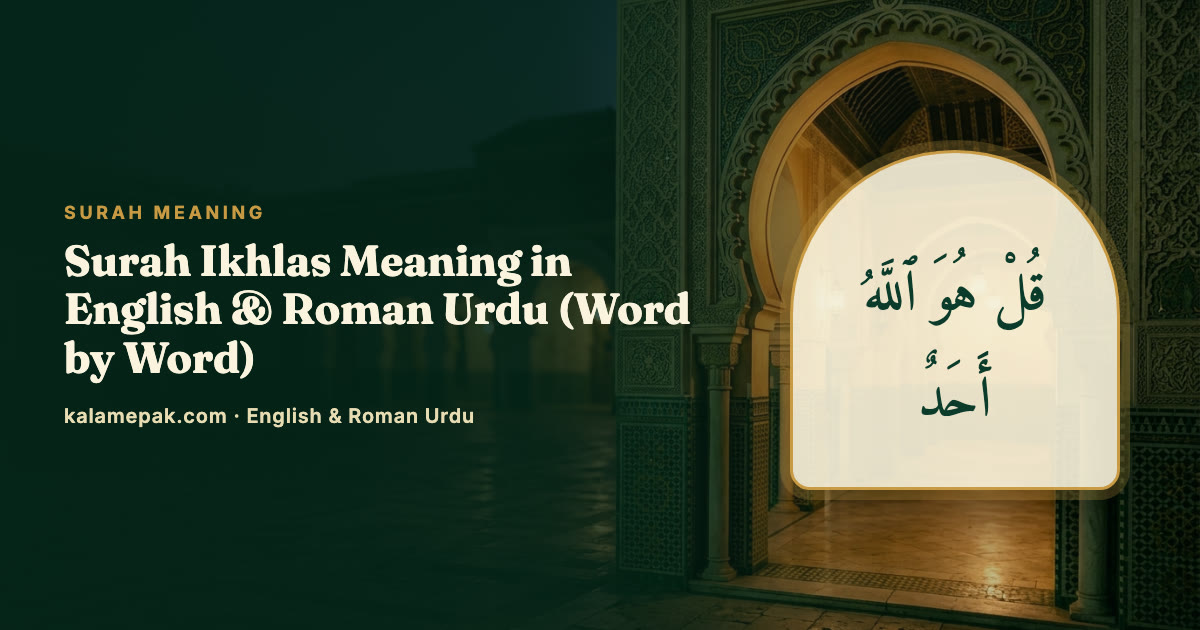
Surah Ikhlas means: "Say: He is Allah, the One! Allah, the eternally Besought of all! He begetteth not nor was begotten. And there is none comparable unto Him." In Roman Urdu: Aap keh dijiye ke woh Allah Ta'ala ek (hi) hai. Allah Ta'ala be-niyaaz hai. Na us se koi paida hua na woh kisi se paida hua. Aur na koi us ka hamsar hai.
That's the whole surah — four short verses you have probably recited thousands of times. Below you'll find each verse with its meaning, then every single word broken down, so the next time you say Qul huwallahu ahad in namaz, you know exactly what each sound means.
Surah Ikhlas meaning in English and Roman Urdu (verse by verse)
Say: He is Allah, the One!
Aap keh dijiye ke woh Allah Ta'ala ek (hi) hai
Surah Al-Ikhlas · 112:1
Allah, the eternally Besought of all!
Allah Ta'ala be-niyaaz kisi ka mohtaaj nahi hai
Surah Al-Ikhlas · 112:2
He begetteth not nor was begotten.
Na us se koi paida hua na woh kisi se paida hua
Surah Al-Ikhlas · 112:3
And there is none comparable unto Him.
Aur na koi us ka hamsar barabar wala hai
Surah Al-Ikhlas · 112:4
Surah Ikhlas meaning in Hindi: the Roman Urdu lines above read the same way in Hindi — "Kaho: woh Allah ek hai. Allah be-niyaaz hai. Na us se koi paida hua, na woh kisi se paida hua. Aur koi us ke barabar nahi." If you speak Hindi or Urdu at home, you already understand this translation.
Surah Ikhlas word by word
Here is every word of the surah. Where a word is one of the 600 words taught in our book, you'll see its number and how many times it appears in the Quran.
Verse 1 — Qul huwa Allahu ahad
| Arabic | Say it | Meaning | In the book |
|---|---|---|---|
| قُلْ | qul | say | from word #6 qāla (he said) — 1,618 times |
| هُوَ | huwa | He | pronoun |
| ٱللَّهُ | Allāhu | Allah | word #2 — 2,699 times |
| أَحَدٌ | aḥad | One | word #288 — 74 times |
Verse 2 — Allahus Samad
| Arabic | Say it | Meaning | In the book |
|---|---|---|---|
| ٱللَّهُ | Allāhu | Allah | word #2 |
| ٱلصَّمَدُ | aṣ-ṣamad | the eternally Besought of all (be-niyaaz) | — |
Verse 3 — Lam yalid wa lam yulad
| Arabic | Say it | Meaning | In the book |
|---|---|---|---|
| لَمْ | lam | did not | word #27 — 348 times |
| يَلِدْ | yalid | beget (have a child) | same root as word #236 walad (child) |
| وَلَمْ | wa lam | and did not | wa = and + word #27 |
| يُولَدْ | yūlad | was begotten (born) | same root as word #236 |
Verse 4 — Wa lam yakun lahu kufuwan ahad
| Arabic | Say it | Meaning | In the book |
|---|---|---|---|
| وَلَمْ | wa lam | and not | word #27 |
| يَكُن | yakun | is | from word #10 kāna — 1,358 times |
| لَّهُۥ | lahu | to Him / for Him | li (for) + hu (him) |
| كُفُوًا | kufuwan | equal, comparable (hamsar) | — |
| أَحَدٌۢ | aḥad | anyone | word #288 |
Look at the last column. Apart from the small pronouns (huwa, lahu), only two words — aṣ-ṣamad and kufuwan — have no link to the book's list. Everything else — qul, Allah, aḥad, lam, kāna, and the walad family — comes back again and again all over the Quran.
One word, two jobs: aḥad
The word أَحَد (aḥad) opens and closes this surah. In verse 1 it means One — Allah is One. In verse 4 it means anyone — there is not anyone equal to Him. The book's gloss for word #288 is exactly this: "one; anyone".
That's a nice trick to remember. Whenever you hear aḥad after a "not" word (lam, lā, mā), it usually means "anyone" or "no one". When it describes Allah, it means "One".
The pair lam yalid wa lam yulad is also worth a second look. The same root gives both verbs, and the same root gives walad (child), word #236 in the book. Once you know walad, you can hear "child" inside yalid and yulad — "He has no child, and He is no one's child."
What Surah Ikhlas teaches
The name Ikhlas means sincerity or purity, and the surah is a pure, short description of who Allah is:
- He is One — not one of many, and not divided.
- Everyone needs Him; He needs no one — that is the sense of aṣ-ṣamad, which Junagarhi explains as be-niyaaz (kisi ka mohtaaj nahi).
- He has no children and no parents — He was not born, and nothing is born from Him.
- Nothing is like Him — no equal, no match, no rival.
Four short lines, and together they answer the most basic question a person can ask: who is Allah? This is why the surah is so loved. A well-known hadith in Sahih al-Bukhari (5013) records the Prophet Muhammad ﷺ saying that it is equal to a third of the Quran.
When is Surah Ikhlas commonly recited?
- In namaz, after Surah Al-Fatiha — it is one of the most common short surahs people choose. (See what to recite in namaz for more options.)
- Together with Surah Al-Falaq and Surah An-Nas, the three "Quls", which many Muslims recite in the morning and evening and before sleeping.
- As a first surah for children, because it is short and its meaning is so central.
A tip for namaz: pause on the one word you know best
The next time you pray, try this. When you reach Qul huwa Allahu aḥad, let the word aḥad land in your heart: One. When you reach wa lam yakun lahu kufuwan aḥad, let it land again: no one. You are not adding anything to the prayer — you are simply knowing what your tongue is saying.
A one-minute exercise for today: cover the "Meaning" column in the tables above and try to say the meaning of each word from memory. Words like Allah, lam and walad may already feel familiar, which makes a good start.
Keep going with other short surahs
Surah Ikhlas is the perfect first step, because many of its words — qul, Allah, lam, kāna — repeat in the surahs next to it. Read Surah Falaq meaning and Surah Nas meaning next; together, the three Quls take less than a minute to recite. If you want to understand every surah you recite in prayer, the last 10 surahs with meaning is a good next read, and Surah Fatiha meaning covers the surah you say in every rakat.
Our book, 600 Words of the Quran, teaches these repeating words one by one, each with a real verse, the English meaning and the Roman Urdu meaning — so that verses like these start to make sense on their own.
Frequently asked questions
What is the meaning of Surah Ikhlas in one line?
Allah is One; everyone depends on Him and He depends on no one; He has no child and no parent; and nothing is equal to Him.
What does 'Qul huwallahu ahad' mean?
It means 'Say: He is Allah, the One!' Qul = say, huwa = He, Allah, ahad = one.
What does 'Allahus Samad' mean?
Pickthall translates it as 'Allah, the eternally Besought of all', and Junagarhi as 'Allah Ta'ala be-niyaaz hai' — everyone turns to Him in need, and He needs no one.
How many verses are in Surah Ikhlas?
Surah Al-Ikhlas is the 112th surah of the Quran and has 4 verses.