Surah Falaq Meaning in English, Urdu & Hindi (Word by Word)
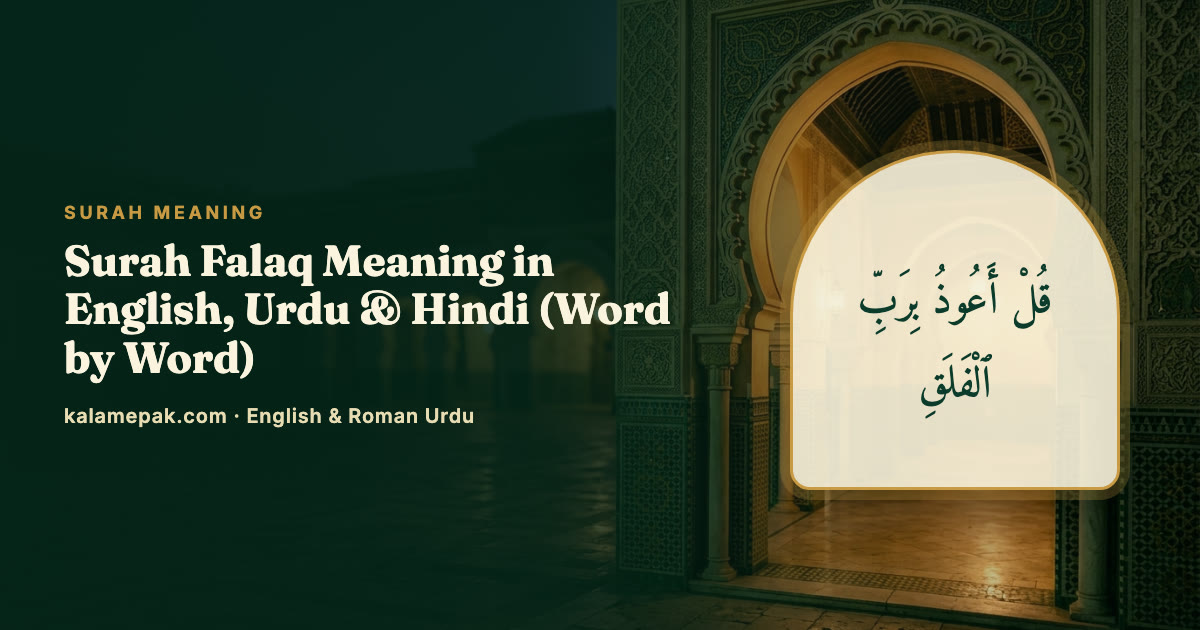
Surah Falaq is a short prayer for protection. Its meaning in one breath: "Say: I seek refuge in the Lord of the Daybreak, from the evil of what He created, from the evil of the darkness when it spreads, from the evil of those who blow on knots, and from the evil of the envier when he envies."
Think of a night when you couldn't sleep — a worry, a bad feeling, a fear you couldn't name. This surah gives words to exactly that moment. You name each thing you are afraid of, and you hand it over to the Lord who brings the morning.
Surah Falaq meaning in Urdu and English (verse by verse)
Say: I seek refuge in the Lord of the Daybreak
Aap keh dijiye! ke main subah ke Rabb ki panaah mein aata hoon
Surah Al-Falaq · 113:1
From the evil of that which He created;
Har us cheez ke shar buraai se jo us ne paida ki hai
Surah Al-Falaq · 113:2
From the evil of the darkness when it is intense,
Aur andheri raat ki taareeki ke shar se jab us ka andhera phail jaaye
Surah Al-Falaq · 113:3
And from the evil of malignant witchcraft,
Aur girah gaanth (laga kar un) mein phoonkne waliyon ke shar se (bhi)
Surah Al-Falaq · 113:4
And from the evil of the envier when he envieth.
Aur hasad jalan karne wale ki buraai se bhi jab woh hasad kare
Surah Al-Falaq · 113:5
Surah Falaq meaning in Hindi: read the Roman Urdu lines aloud and they are plain Hindustani — "Kaho, main subah ke Rabb ki panaah maangta hoon — har us cheez ki buraai se jo us ne banaayi, andheri raat ki buraai se jab andhera phail jaaye, gaanth mein phoonkne waliyon ki buraai se, aur hasad karne wale ki buraai se jab woh hasad kare."
The key word: sharr (evil), four times in five verses
Read the Arabic again and listen for one sound: شَرِّ — sharr. It appears in verses 2, 3, 4 and 5. Every verse after the first begins almost the same way:
- min sharri mā khalaq — from the evil of what He created
- wa min sharri ghāsiqin idhā waqab — and from the evil of the darkness
- wa min sharri n-naffāthāti fil-ʿuqad — and from the evil of those who blow on knots
- wa min sharri ḥāsidin idhā ḥasad — and from the evil of the envier
So once you know two words — min (from) and sharr (evil) — you understand the shape of the whole surah. Min is word #1 in our book, the most common word in the Quran (3,226 times). Sharr is word #363 (30 times). The Roman Urdu word shar is the same word, which Urdu speakers already use.
The pattern goes like this: first a general line (everything He created), then three specific ones. Darkness, magic, envy — three things that work in hiding.
Surah Falaq word by word
| Arabic | Say it | Meaning | In the book |
|---|---|---|---|
| قُلْ | qul | say | from word #6 qāla — 1,618 times |
| أَعُوذُ | aʿūdhu | I seek refuge | — |
| بِرَبِّ | bi-rabbi | in the Lord (of) | bi + word #12 rabb — 975 times |
| ٱلْفَلَقِ | al-falaq | the daybreak | — |
| مِن | min | from | word #1 — 3,226 times |
| شَرِّ | sharri | the evil (of) | word #363 — 30 times |
| مَا | mā | that which | word #7 mā (what, that which) — 1,592 times |
| خَلَقَ | khalaqa | He created | word #144 — 184 times |
| غَاسِقٍ | ghāsiq | darkness (of night) | — |
| إِذَا | idhā | when | word #24 — 383 times |
| وَقَبَ | waqaba | it spreads, becomes intense | — |
| ٱلنَّفَّٰثَٰتِ | an-naffāthāt | those who blow (on knots) | — |
| فِى | fī | in, on | word #4 — 1,701 times |
| ٱلْعُقَدِ | al-ʿuqad | the knots | — |
| حَاسِدٍ | ḥāsid | an envier | — |
| حَسَدَ | ḥasada | he envies | — |
Two words here you already know from Urdu: ḥāsid and ḥasad are the same as Urdu haasid and hasad. And khalaqa shares its root with Urdu khalq and makhlooq (creation).
What Surah Falaq teaches
- Protection is asked from Allah alone. The surah does not tell you to fear these things; it tells you where to run: to Rabb al-falaq, the Lord of the daybreak.
- The Lord of the morning is Lord over the night. Asking the One who splits the darkness with light, for protection from darkness, is a beautiful pairing.
- Evil is named plainly. Darkness, harmful magic and envy are real, and the Quran doesn't pretend otherwise — but each of them is only "min sharri mā khalaq", something created, and the Creator is greater.
- Envy is named too. The last protection asked for is from the envier "when he envies" — a reminder to seek Allah's help against it, and to keep envy out of our own hearts as well.
When is Surah Falaq commonly recited?
Surah Al-Falaq and Surah An-Nas are known together as al-Muʿawwidhatayn — "the two surahs of seeking refuge". Many Muslims recite them:
- in the morning and evening, along with Surah Ikhlas;
- before sleeping;
- after namaz;
- when afraid, unwell, or worried about harm.
They are also short and easy to recite in the second rakat of namaz after Surah Al-Fatiha.
A namaz tip: count the sharrs
Here is a simple way to stay present when you recite this surah in prayer. Silently count the four sharrs as they come: one — everything created; two — the dark night; three — the knots; four — the envier. With each one, picture handing it over. You are no longer just reciting; you are asking.
A 30-second exercise: say out loud "min sharri" and its meaning, "from the evil of", five times. After that, every time the phrase comes in the surah, the meaning will arrive on its own.
Read next
This surah is almost a twin of the next one — compare it with Surah Nas meaning, which also begins qul aʿūdhu bi-rabbi. For the third of the "three Quls", see Surah Ikhlas meaning. If you want to learn the most repeated words — like min, mā and rabb — in one place, start with the most common words in the Quran, or see how a word like rabb grows from its root in Arabic root words in the Quran.
The words in these tables are taught one by one in 600 Words of the Quran, each with a real verse and meanings in English and Roman Urdu.
Frequently asked questions
What does 'Qul a'udhu bi rabbil falaq' mean?
It means 'Say: I seek refuge in the Lord of the Daybreak.' In Roman Urdu: Aap keh dijiye ke main subah ke Rabb ki panaah mein aata hoon.
What does 'falaq' mean?
Pickthall translates al-falaq as 'the Daybreak', and Junagarhi as 'subah' (morning) — the moment light breaks through the darkness.
How many verses are in Surah Falaq?
Surah Al-Falaq is the 113th surah of the Quran and has 5 verses.
What is the difference between Surah Falaq and Surah Nas?
Both begin with 'Qul a'udhu bi rabbi' (say: I seek refuge in the Lord of...). Surah Falaq asks protection from outside harms — darkness, witchcraft, envy — while Surah Nas asks protection from the whisperer inside the heart.