Last 10 Surahs of Quran with Meaning (105–114)
The last 10 surahs of the Quran, from Surah Al-Fil (105) to Surah An-Nas (114), are the ones most of us learned first and still recite most in namaz. Together they are only 48 verses. Below is each surah with its first verse in Arabic, English and Roman Urdu, a one-line meaning of the whole surah, and a link to its full word-by-word guide. At the end, you will see which words keep repeating across all ten, which is the quickest way to start understanding them.
The last 10 surahs at a glance
| No. | Surah | Verses | In one line |
|---|---|---|---|
| 105 | Al-Fil (The Elephant) | 5 | How Allah dealt with the army of the elephant |
| 106 | Quraish | 4 | Worship the Lord of this House, who fed you and made you safe |
| 107 | Al-Ma'un (Small Kindnesses) | 7 | Denying the Judgment shows in how you treat orphans, the needy and prayer |
| 108 | Al-Kawthar (Abundance) | 3 | We have given you abundance, so pray and sacrifice |
| 109 | Al-Kafirun (The Disbelievers) | 6 | No mixing in worship: to you your religion, to me mine |
| 110 | An-Nasr (Help) | 3 | When Allah's help and victory come, praise and seek forgiveness |
| 111 | Al-Masad / Lahab | 5 | Abu Lahab's wealth did not save him |
| 112 | Al-Ikhlas (Sincerity) | 4 | Allah is One, needs no one, and none is like Him |
| 113 | Al-Falaq (Daybreak) | 5 | Seeking refuge from outer harms |
| 114 | An-Nas (Mankind) | 6 | Seeking refuge from the whisperer within |
105. Surah Al-Fil
Hast thou not seen how thy Lord dealt with the owners of the Elephant?
Kya tu ne na dekha ke tere Rabb ne haathi walon ke saath kya kiya?
Surah Al-Fil · 105:1
An army with an elephant came to destroy the Ka'bah. Allah sent swarms of birds that pelted them with stones of baked clay and left them "like green crops devoured". This happened in the well-known Year of the Elephant, the year the Prophet Muhammad ﷺ was born. → Surah Fil meaning
106. Surah Quraish
For the taming of Qureysh.
Quraish ke maanoos aadi karne ke liye
Surah Quraish · 106:1
The Quraysh travelled safely in winter and summer for trade. The surah reminds them who made that possible: "So let them worship the Lord of this House, Who hath fed them against hunger and hath made them safe from fear" (106:3–4). → Surah Quraish meaning
107. Surah Al-Ma'un
Hast thou observed him who belieth religion?
Kya tu ne (use bhi) dekha jo (roz) jaza badla ko jhutlaata hai?
Surah Al-Ma'un · 107:1
The one who denies the Judgment pushes away the orphan and does not urge feeding the needy. Then a warning that hits close: woe to those who pray but are heedless of their prayer, pray to be seen, and refuse small kindnesses. → Surah Maun meaning
108. Surah Al-Kawthar
Lo! We have given thee Abundance;
Yaqeenan humne tujhe (Hauz) Kausar (aur bahut kuch) diya hai
Surah Al-Kawthar · 108:1
The shortest surah of the Quran. Allah has given the Prophet ﷺ abundance, so "pray unto thy Lord, and sacrifice", and it is his insulter, not he, who is cut off. → Surah Kausar meaning
109. Surah Al-Kafirun
Say: O disbelievers!
Aap keh dijiye ke aey kaafiro!
Surah Al-Kafirun · 109:1
A clear, calm statement that worship is not shared or traded: "I worship not that which ye worship", ending with "Unto you your religion, and unto me my religion" (109:6). → Surah Kafirun meaning
110. Surah An-Nasr
When Allah's succour and the triumph cometh
Jab Allah ki madad aur fateh aa jaaye
Surah An-Nasr · 110:1
When help and victory come and people enter Allah's religion in crowds, the response is not pride but tasbeeh, hamd and istighfar: glorify your Lord with praise and seek His forgiveness. → Surah Nasr meaning
111. Surah Al-Masad (Lahab)
The power of Abu Lahab will perish, and he will perish.
Abu Lahab ke donon haath toot gaye aur woh (khud) halaak barbaad ho gaya
Surah Al-Masad · 111:1
Abu Lahab was the Prophet's own uncle and a fierce opponent. "His wealth and gains will not exempt him" (111:2). Family ties and money do not save anyone who fights the truth. → Surah Lahab meaning
112. Surah Al-Ikhlas
Say: He is Allah, the One!
Aap keh dijiye ke woh Allah Ta'ala ek (hi) hai
Surah Al-Ikhlas · 112:1
Four verses that describe Allah: One, "the eternally Besought of all", who "begetteth not nor was begotten", and to whom none is comparable. → Surah Ikhlas meaning
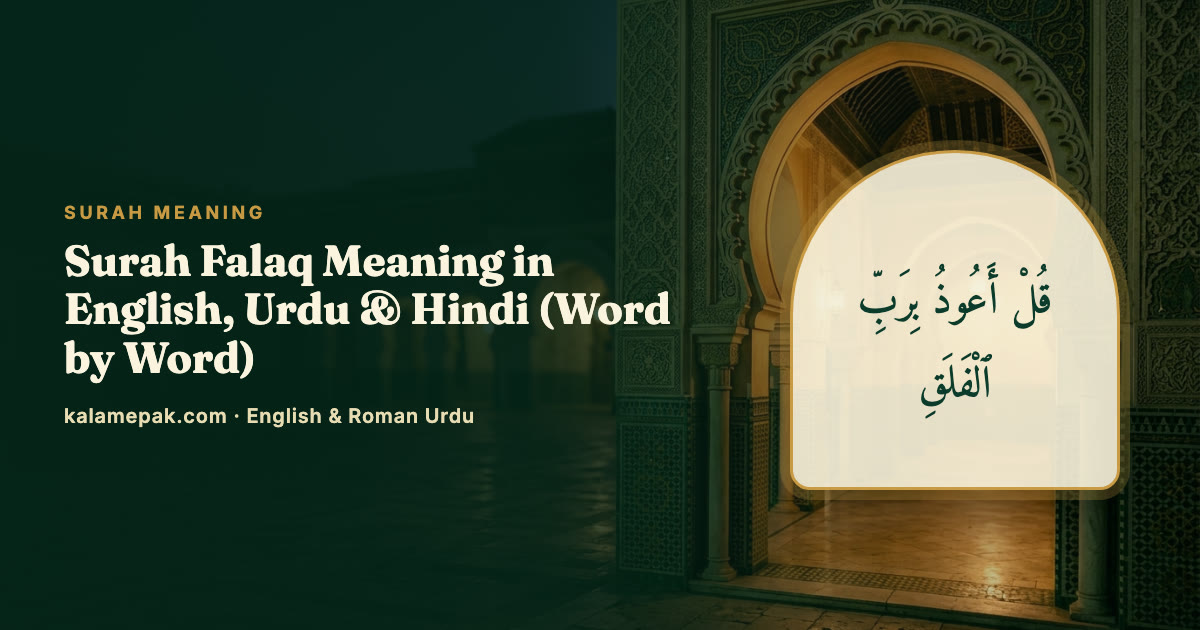
113. Surah Al-Falaq
Say: I seek refuge in the Lord of the Daybreak
Aap keh dijiye! ke main subah ke Rabb ki panaah mein aata hoon
Surah Al-Falaq · 113:1
Refuge from four evils: the evil of what He created, of darkness when it spreads, of witchcraft (Pickthall: "malignant witchcraft"; Junagarhi: those who blow on knots, girah mein phoonkne waliyon), and of the envier when he envies. → Surah Falaq meaning
114. Surah An-Nas
Say: I seek refuge in the Lord of mankind,
Aap keh dijiye! ke main logon ke Parwardigar paalne wale ki panaah mein aata hoon
Surah An-Nas · 114:1
Refuge in the Lord of mankind, the King of mankind, the God of mankind: three titles, rabb, malik, ilāh, against one enemy, "the sneaking whisperer, who whispereth in the hearts of mankind", whether from jinn or people. → Surah Nas meaning
Words that repeat across the last 10 surahs
Here is the useful part. These ten surahs are short, but they share a small set of words. Learn these and you will recognise something in every one of them. "In the book" is the word's number in 600 Words of the Quran; "Quran-wide" is how often it appears in the whole Quran.
| Word | Meaning | Where in 105–114 | In the book | Quran-wide |
|---|---|---|---|---|
| رَبّ rabb | Lord | 105, 106, 108, 110, 113, 114 | #12 | 975× |
| قالَ qāla → qul | he said → "Say!" | opens 109, 112, 113, 114 | #6 | 1,618× |
| الَّذِي alladhī | who, the one who | 106, 107, 114 | #8 | 1,468× |
| رَأَى raʾā | he saw | 105:1, 107:1, 110:2 | #104 | 271× |
| دِين dīn | judgment; religion | 107:1, 109:6, 110:2 | #167 | 92× |
| عَبَدَ ʿabada | he worshipped | 106:3 and all through 109 | #205 | 122× |
| ناس nās | people, mankind | 110:2, and five times in 114 | #220 | 241× |
| شَرّ sharr | evil, harm | four times in 113, once in 114 | #363 | 30× |
| إِذا idhā | when | 110:1, 113:3, 113:5 | #24 | 383× |
| لَم lam | did not | 105:1–2, 112:3–4 | #27 | 348× |
A few patterns worth noticing:
- "Alam tara… araʾayta… raʾayta": three surahs use the verb "see". Surah Al-Fil asks "Have you not seen?", Al-Ma'un "Have you observed?", and An-Nasr "you see people entering". Same word #104, three different moments.
- Dīn changes meaning with context. In 107:1 Junagarhi renders it jaza (the Judgment, the recompense); in 109:6 and 110:2 it is religion. It is the same word as in māliki yawmi d-dīn in the Fatiha.
- The four "Qul" surahs (109, 112, 113, 114) all begin with Allah telling the Prophet ﷺ what to say, and we still say those words today.
For a wider list of the words that return again and again, see the most common words in the Quran.
Which ones to learn first for namaz?
If you are building up your short surahs for namaz, a gentle order is: Ikhlas → Kawthar → Nas → Falaq → Asr (Surah 103, also three verses; see Surah Asr meaning) → Nasr → Kafirun → Quraish → Fil → Ma'un → Lahab. Start with the shortest, then add one a week. For what to recite at each step of the prayer, see what to recite in namaz.
Each surah's own page has the full word-by-word table. And if you would like to learn the words behind all of them in one place, 600 Words of the Quran teaches the 600 most common Quranic words in 30 short lessons, each with a real verse and its meaning in English and Roman Urdu.
Frequently asked questions
Which are the last 10 surahs of the Quran?
Surah Al-Fil (105), Quraish (106), Al-Ma'un (107), Al-Kawthar (108), Al-Kafirun (109), An-Nasr (110), Al-Masad or Lahab (111), Al-Ikhlas (112), Al-Falaq (113) and An-Nas (114).
How many verses are in the last 10 surahs?
48 verses in total: 5, 4, 7, 3, 6, 3, 5, 4, 5 and 6 verses respectively.
Which is the shortest surah of the Quran?
Surah Al-Kawthar (108), with three short verses.
Which word appears most across the last 10 surahs?
Among the main words, 'rabb' (Lord) appears in six of the ten surahs, and 'qul' (Say) opens four of them: 109, 112, 113 and 114.