Surah Fil Meaning in Urdu & Hindi (Word by Word)
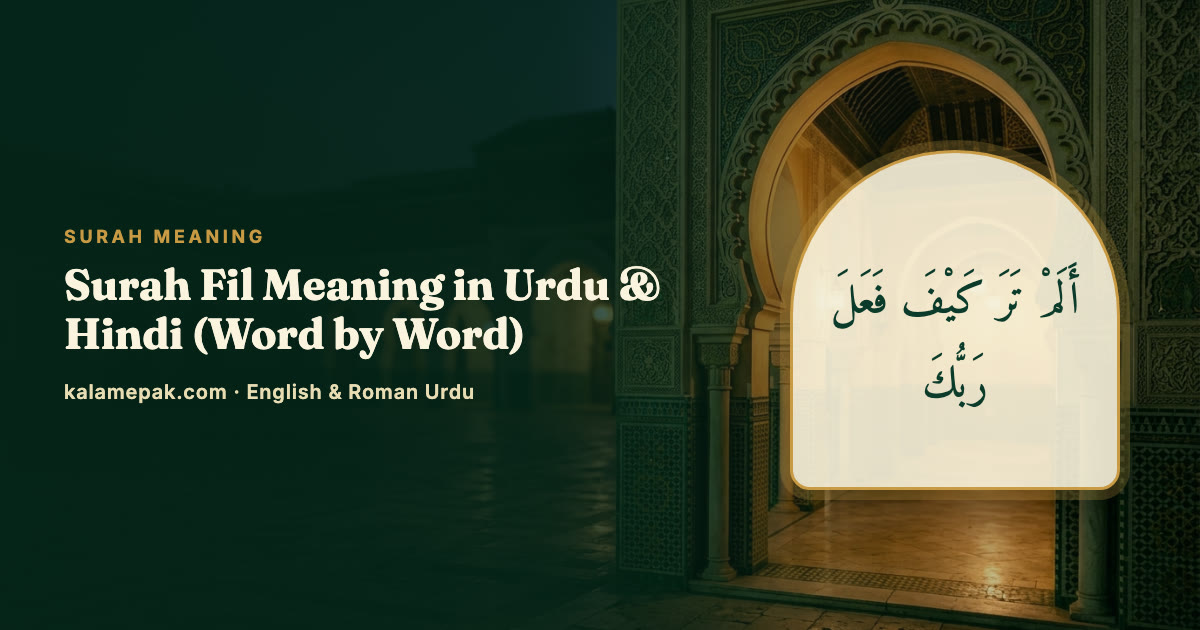
Surah Fil meaning in Urdu: Kya tu ne na dekha ke tere Rabb ne haathi walon ke saath kya kiya? Kya un ke makr ko bekaar nahi kar diya? Aur un par parindon ke jhund ke jhund bhej diye, jo unhein mitti aur patthar ki kankariyaan maar rahe the. Pas unhein khaaye hue bhoose ki tarah kar diya.
In English (Pickthall): "Hast thou not seen how thy Lord dealt with the owners of the Elephant? Did He not bring their stratagem to naught, and send against them swarms of flying creatures, which pelted them with stones of baked clay, and made them like green crops devoured (by cattle)?"
Fīl means elephant — that is why it is called Surah Al-Fil (and why many people in India search for it as "Surah Feel").
The story behind Surah Fil
Surah Al-Fil points to an event the people of Makkah knew well — it had happened in their own city, within living memory. According to the well-known account, an army came towards Makkah with elephants, intending to destroy the Kaaba. The people of Makkah could not defend it. Allah sent flocks of birds carrying stones, and the army was destroyed.
That year became known as the Year of the Elephant (ʿĀm al-Fīl). It is also well known as the year in which the Prophet Muhammad ﷺ was born.
Notice that the surah itself does not tell the story in detail. It doesn't name the army's leader or count the elephants. It simply asks: Haven't you seen what your Lord did? The listeners already knew — the surah reminds them what it meant.
Surah Fil meaning verse by verse
Hast thou not seen how thy Lord dealt with the owners of the Elephant?
Kya tu ne na dekha ke tere Rabb ne haathi walon ke saath kya kiya?
Surah Al-Fil · 105:1
Did He not bring their stratagem to naught,
Kya un ke makr chaal ko bekaar nahi kar diya?
Surah Al-Fil · 105:2
And send against them swarms of flying creatures,
Aur un par parindon ke jhund ke jhund bhej diye
Surah Al-Fil · 105:3
Which pelted them with stones of baked clay,
Jo unhein mitti aur patthar ki kankariyaan maar rahe the
Surah Al-Fil · 105:4
And made them like green crops devoured (by cattle)?
Pas unhein khaaye hue bhoose ki tarah kar diya
Surah Al-Fil · 105:5
Surah Feel meaning in Hindi: "Kya tumne nahi dekha ki tumhare Rabb ne haathi walon ke saath kya kiya? Kya unki chaal ko bekaar nahi kar diya? Aur un par parindon ke jhund bheje, jo un par kankariyaan maarte the. Phir unhein khaaye hue bhoose jaisa bana diya."
Surah Fil word by word
| Arabic | Say it | Meaning | In the book |
|---|---|---|---|
| أَلَمْ | a-lam | did not…? | a (question) + word #27 lam — 348 times |
| تَرَ | tara | you see | word #104 raʾā (he saw) — 271 times |
| كَيْفَ | kayfa | how | word #46 — 83 times |
| فَعَلَ | faʿala | He did, dealt | word #89 — 88 times |
| رَبُّكَ | rabbuka | your Lord | word #12 rabb — 975 times |
| بِأَصْحَٰبِ | bi-aṣḥābi | with the people (of) | bi + word #225 aṣḥāb — 78 times |
| ٱلْفِيلِ | al-fīl | the elephant | — |
| يَجْعَلْ | yajʿal | make | word #81 jaʿala — 340 times |
| كَيْدَهُمْ | kaydahum | their plan, scheme | word #370 kayd — 26 times |
| فِى | fī | into | word #4 — 1,701 times |
| تَضْلِيلٍ | taḍlīl | going astray, ruin | — |
| وَأَرْسَلَ | wa arsala | and He sent | word #68 arsala — 130 times |
| عَلَيْهِمْ | ʿalayhim | against them | word #9 ʿalā + him |
| طَيْرًا | ṭayran | birds | word #514 ṭayr — 19 times |
| أَبَابِيلَ | abābīl | in flocks | — |
| تَرْمِيهِم | tarmīhim | pelting them | — |
| بِحِجَارَةٍ | bi-ḥijāratin | with stones | — |
| مِّن | min | of | word #1 — 3,226 times |
| سِجِّيلٍ | sijjīl | baked clay | — |
| فَجَعَلَهُمْ | fa-jaʿalahum | so He made them | word #81 jaʿala |
| كَعَصْفٍ | ka-ʿaṣf | like straw, crops | ka (like) + ʿaṣf |
| مَّأْكُولٍۭ | maʾkūl | eaten | root shared with #88 akala (he ate) |
The word aṣḥāb is worth remembering. It means "companions" or "people of" — so aṣḥāb al-fīl is "the people of the elephant". You know it from Urdu sahaba and sahib. The same pattern gives aṣḥāb al-janna (people of Paradise) and aṣḥāb an-nār (people of the Fire) elsewhere in the Quran.
The question that opens the surah
Surah Al-Fil begins with a question: a-lam tara — "have you not seen?" It isn't a question looking for information. It is a way of saying: you know this — think about it.
And the Quran uses these exact words more than once. Here is a verse from Surah Al-Fajr that starts almost identically:
Dost thou not consider how thy Lord dealt with (the tribe of) A'ad,
Kya aap ne nahi dekha ke aap ke Rabb ne Aadiyon qaum-e-Aad ke saath kya kiya
Surah Al-Fajr · 89:6
A-lam tara kayfa faʿala rabbuka bi-… — "have you not seen how your Lord dealt with…" In Surah Al-Fil it's the people of the elephant; in Surah Al-Fajr it's the people of ʿĀd. Learn these five words once, and you'll recognise the pattern wherever it comes. All five — lam, raʾā, kayfa, faʿala, rabb — are in our book's list.
What Surah Fil teaches
- Allah protects His House. No army, however strong, could harm the Kaaba against His will.
- Power is not what it looks like. Elephants — the tanks of their time — were defeated by small birds and small stones.
- Plans fail when Allah wills. The key word is kayd (scheme). Verse 2 says their scheme was made into taḍlīl — gone astray, brought to nothing.
When is Surah Fil commonly recited?
It is one of the short surahs from the last part of the Quran that many people memorise and recite in namaz after Surah Al-Fatiha. It is often learned together with Surah Quraish, which comes right after it.
A namaz tip: see the picture
Surah Al-Fil is almost a film in five scenes: the elephants — the failed plan — the birds — the stones — the field of chewed straw. When you recite it in namaz, let each verse bring its picture. It's much harder for the mind to wander when it's watching a story.
Try this today: read the word table once, then recite the surah slowly and name each scene to yourself as it arrives.
Read next
Continue with Surah Quraish meaning — the next surah, and a natural follow-on from this one. For more short surahs, see the last 10 surahs with meaning. Words like raʾā, faʿala and jaʿala are among the most common verbs in the Quran, and small words like fī, min and ʿalā are covered in common prepositions in the Quran.
Every word in the table with a number is taught in 600 Words of the Quran, each with a real verse and meanings in English and Roman Urdu.
Frequently asked questions
What does 'Alam tara kaifa fa'ala rabbuka bi ashabil fil' mean?
It means 'Hast thou not seen how thy Lord dealt with the owners of the Elephant?' Roman Urdu: Kya tu ne na dekha ke tere Rabb ne haathi walon ke saath kya kiya?
What is the Year of the Elephant?
It is the year an army with elephants came to attack the Kaaba in Makkah and was destroyed. It is well known as the year in which the Prophet Muhammad ﷺ was born.
What are 'tayran ababil'?
Pickthall translates it as 'swarms of flying creatures'; the Roman Urdu says 'parindon ke jhund ke jhund' — flocks upon flocks of birds.
How many verses are in Surah Fil?
Surah Al-Fil is the 105th surah of the Quran and has 5 verses.