Most Common Verbs in the Quran: Top 20 with Meaning
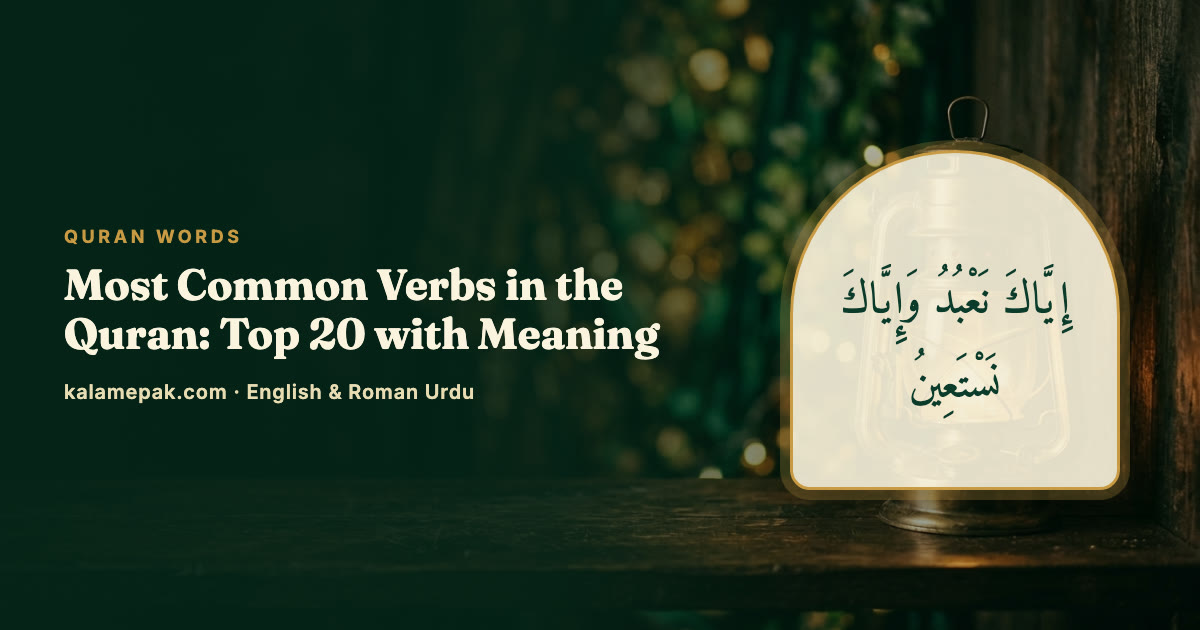
The most common verb in the Quran is قالَ qāla, "he said", which appears 1,618 times across all its forms. Next come kāna "he was" (1,358), āmana "he believed" (537), ʿalima "he knew" (382) and jaʿala "he made" (340). Here are the top 20 verbs, then a simple look at how each one changes shape, using real words from real verses.
The 20 most common verbs in the Quran
| Rank | Arabic | Say it | Meaning | Roman Urdu | Times in the Quran |
|---|---|---|---|---|---|
| 6 | قالَ | qāla | he said | kaha | 1,618 |
| 10 | كانَ | kāna | he was, he became | tha, ho gaya | 1,358 |
| 19 | آمَنَ | āmana | he believed | imaan laaya | 537 |
| 26 | عَلِمَ | ʿalima | he knew | jaana | 382 |
| 31 | جَعَلَ | jaʿala | he made | banaaya | 340 |
| 38 | كَفَرَ | kafara | he disbelieved | inkaar kiya, kufr kiya | 289 |
| 41 | جاءَ | jāʾa | he came | aaya | 278 |
| 42 | عَمِلَ | ʿamila | he did, he worked | amal kiya, kaam kiya | 276 |
| 43 | آتَى | ātā | he gave | diya | 271 |
| 44 | رَأَى | raʾā | he saw | dekha | 271 |
| 46 | أَتَى | atā | he came | aaya, pahuncha | 264 |
| 51 | شاءَ | shāʾa | he willed, wished | chaaha | 236 |
| 57 | خَلَقَ | khalaqa | he created | paida kiya | 184 |
| 58 | أَنزَلَ | anzala | he sent down | naazil kiya, utaara | 183 |
| 60 | كَذَّبَ | kadhdhaba | he denied | jhutlaaya | 176 |
| 62 | دَعا | daʿā | he called, prayed | pukaara, dua ki | 170 |
| 63 | اتَّقَى | ittaqā | he feared (Allah) | Allah se dara, taqwa ikhtiyaar kiya | 166 |
| 76 | هَدَى | hadā | he guided | hidaayat di, raah dikhaai | 144 |
| 79 | أَرادَ | arāda | he wanted, intended | iraada kiya, chaaha | 139 |
| 82 | اتَّبَعَ | ittabaʿa | he followed | pairvi ki, peeche chala | 136 |
Two things stand out. First, the list is about speaking, believing and knowing: qāla, āmana, kafara, ʿalima, kadhdhaba "he denied". The Quran is constantly asking people how they respond to the truth. Second, a lot of it is about what Allah does: He created (khalaqa), made (jaʿala), sent down (anzala), guided (hadā).
Why verbs are listed as "he did"
An Arabic dictionary gives a verb in its simplest shape: the past tense for "he". So qāla is "he said" and khalaqa is "he created". That shape carries the three root letters, and every other form of the verb is built around them. Our guide to Arabic root words in the Quran goes deeper into roots.
The counts include every form. When you learn qāla, you have learned qul and qālū too, once you know how the shapes change. Here is how they change, kept simple.
Past: "he did", "they did", "We did"
The past tense is changed with endings.
| Ending | Meaning | Real example | Say it |
|---|---|---|---|
| (none) | he did | قَالَ | qāla, he said |
| -ū | they did | قَالُوا۟ | qālū, they said |
| -ū | they did | ءَامَنُوا۟ | āmanū, they believed |
| -nā | We did | خَلَقْنَا | khalaqnā, We created |
| -nā | We did | أَنزَلْنَا | anzalnā, We sent down |
| -tum | you (all) did | كُنتُمْ | kuntum, you were |
When Allah speaks of Himself as "We" (khalaqnā, anzalnā), it is the plural of majesty, not a number.
The phrase alladhīna āmanū, "those who believe", is one of the most repeated in the whole Quran. Once you know -ū means "they", āmanū is easy.
Present and future: "he does", "we do"
The present form adds a letter at the front:
- ya- = he: يَعْلَمُ yaʿlamu "he knows", يَشَآءُ yashāʾu "he wills", يَخْلُقُ yakhluqu "he creates"
- ya- … -ūna = they: يَعْلَمُونَ yaʿlamūna "they know", يُؤْمِنُونَ yuʾminūna "they believe"
- ta- … -ūna = you (all): تَعْلَمُونَ taʿlamūna "you know"
- na- = we: نَعْبُدُ naʿbudu "we worship"
You say that last one in every rakʿah:
Thee (alone) we worship; Thee (alone) we ask for help.
Hum sirf teri hi ibaadat karte hain aur sirf tujh hi se madad chaahte hain
Surah Al-Fātiḥah · 1:5
Naʿbudu is from ʿabada "he worshipped" (rank 92). The na- at the front is "we". So iyyāka naʿbudu is "You alone we worship" (the rest of the surah is explained word by word in our Surah Fatiha meaning). This same form also covers the future, so yaʿlamu can mean "he knows" or "he will know"; the context decides.
One more useful rule: after lam "did not" (rank 30), the present shape gives a past meaning.
Teacheth man that which he knew not.
Jis ne insaan ko woh sikhaaya jise woh nahi jaanta tha
Surah Al-ʿAlaq · 96:5
Lam yaʿlam is "he did not know", even though yaʿlam looks like a present form.
Commands: "say!", "read!", "fear Allah!"
The command form is usually short and punchy:
- قُلْ qul "say!", from qāla. It opens Surahs Al-Ikhlas, Al-Falaq, An-Nas and Al-Kafirun.
- ٱقْرَأْ iqraʾ "read!", from qaraʾa, the opening word of Surah Al-ʿAlaq, widely known as the first revelation.
- وَٱتَّقُوا۟ wa-ttaqū "and fear (Allah)!", from ittaqā, with wa- "and" in front.
Read: In the name of thy Lord Who createth,
Padh apne Rabb ke naam se jis ne paida kiya
Surah Al-ʿAlaq · 96:1
In this one verse you have a command (iqraʾ) and a past verb (khalaqa, "who created"). Two of the verbs from our table in five words.
Same letters, different vowels: active and passive
Look at these two forms of anzala "he sent down":
- أَنزَلَ anzala "he sent down"
- أُنزِلَ unzila "it was sent down"
Same letters, different vowels. The second is passive, "was sent down", and it is common in verses about the Quran and earlier scriptures. You do not need to master this yet; just know that when the vowels change, the meaning may shift from "did" to "was done".
How to learn these verbs
- Learn the meaning first. Take four verbs a day from the table. In five days you have all twenty.
- Then learn three shapes. For each verb, find the "he did", "they did" and "he does" forms. The examples above give you a start.
- Listen for the fronts and ends. In recitation, a ya- at the front or -ūna at the end is your signal that a verb is passing by.
Verbs make up a large part of our book 600 Words of the Quran, and each verb page shows the forms you will actually meet while reading, with a real verse. You can see the lessons on the book page. For the nouns and little words, start with the most common words in the Quran, and for the small connecting words, see min, fi, ala and the other little words.
Frequently asked questions
What is the most common verb in the Quran?
Qāla, 'he said'. Counting all its forms, such as qālū 'they said' and qul 'say!', it appears 1,618 times. Next is kāna, 'he was', with 1,358.
Why are Arabic verbs listed as 'he did'?
Arabic dictionaries list a verb by its simplest form, the past tense for 'he': qāla 'he said', khalaqa 'he created'. Every other form is built from it.
How do I tell past from present in a Quran verb?
As a simple rule, a verb that starts with ya-, ta-, na- or a- is usually the present/future form, like yaʿlamu 'he knows' or naʿbudu 'we worship'. The past form usually starts straight with the root letters, like ʿalima or khalaqa.
Do I need grammar to learn Quran verbs?
Not to start. Learn the meaning of the main verbs first, then notice a few patterns like the ya- prefix for 'he does' and the -ū ending for 'they did'. That alone helps a lot.