Do 600 Words Really Make Up 80% of the Quran?
Yes, roughly, but only if you are clear about what is being counted. By our own count, the 600 words in the book are the main word in about 8 out of every 10 words of the Quran (79.8% of its 77,429 words — counting the core word, not small attached letters like wa-, bi- or pronoun endings). That is a fact about how often words repeat. It is not a promise that you will understand 80% of the Quran.
This page explains how that number is reached, shows it working on two real verses, and is honest about what it does and does not give you.
Why would so few words cover so much?
Every language repeats a small group of words constantly: "the", "and", "is", "from". The Quran is no different. A word like مِن min "from" appears 3,226 times, and the name Allah 2,699 times. The verb qāla "he said" appears 1,618 times once you count all its forms.
Meanwhile thousands of other words appear only a handful of times, many just once. So a short list of very frequent words ends up doing most of the work. That pattern is what the "80 percent of Quranic words" idea is built on.
How we counted: the method, step by step
- Every word of the Quran. We started from the word-by-word data of the Quranic Arabic Corpus: 77,429 words.
- Find the core word. Arabic joins small pieces onto words. لِلَّهِ lillāh is li- "for" + Allah. وَرَبُّكَ wa-rabbuka is wa- "and" + rabb "Lord" + -ka "your". We count the core word (Allah, rabb), not the attached pieces.
- Use the dictionary form. Qāla "he said", qālū "they said" and qul "say!" are all one word, "to say". Each appearance counts toward that one dictionary word.
- Rank and add up. Sort the dictionary words from most to least frequent, take the top 600, and see what share of the Quran's words have one of them as their core.
The answer is 79.8%. That is where "about 8 out of every 10" comes from.
See it on a real verse
Surah Al-Fatiha 1:2: every core word is in the list
Praise be to Allah, Lord of the Worlds,
Sab taareef Allah Ta'ala ke liye hai jo tamaam jahaanon ka paalne wala hai
Surah Al-Fātiḥah · 1:2
| Word | Core word | Meaning | In the 600 list? |
|---|---|---|---|
| ٱلْحَمْدُ | حَمْد ḥamd | praise | Yes, rank 255 |
| لِلَّهِ | اللَّه Allah | Allah | Yes, rank 2 |
| رَبِّ | رَبّ rabb | Lord | Yes, rank 12 |
| ٱلْعَٰلَمِينَ | عالَم ʿālam | world | Yes, rank 150 |
Four words, four hits. Someone who has learned these four words hears this verse and knows: praise, Allah, Lord, worlds.
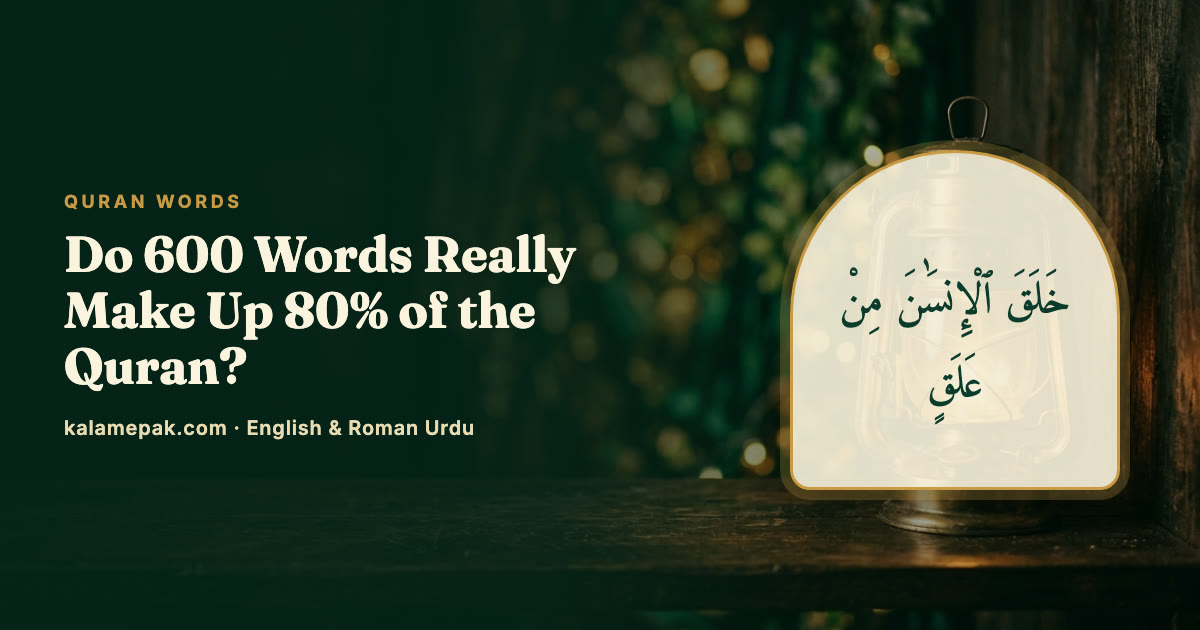
Surah Al-ʿAlaq 96:2: three out of four
Createth man from a clot.
Jis ne insaan ko khoon ke lothde se paida kiya
Surah Al-ʿAlaq · 96:2
| Word | Core word | Meaning | In the 600 list? |
|---|---|---|---|
| خَلَقَ | خَلَقَ khalaqa | he created | Yes, rank 57 |
| ٱلْإِنسَٰنَ | إِنسان insān | human being | Yes, rank 156 |
| مِنْ | مِن min | from | Yes, rank 1 |
| عَلَقٍ | ʿalaq | clot | No |
Here you would understand "He created man from…" and then miss the last word, which happens to be the word the whole surah is named after. This one verse shows both sides of the 80% idea: it gets you most of the way, and the missing word can still matter a lot.
What "80 percent" does not mean
- It is not 80% understanding. Knowing each word is different from understanding the sentence. Arabic grammar tells you who did what, and when.
- The rare words can carry the key meaning. As ʿalaq shows, a single less common word can be the heart of a verse.
- Words have more than one meaning. Dīn is "judgment" in yawmi d-dīn (Al-Fatiha) and "religion" elsewhere. The list gives you the main meanings; the verse decides.
- It does not replace tafsir. Why a verse was revealed, and how scholars have explained it, is a separate and important study.
Anyone who tells you that a word list alone makes you "understand the Quran" is overselling it.
What it does mean for you
It means the Quran stops being a stream of unfamiliar sounds. In namaz you start catching rabb, yawm, raḥīm, qul, lā ilāha illā. When you read a translation, you can look at the Arabic line and actually match words to meanings. And when you do study some grammar later, you are not memorising vocabulary and rules at the same time, which is what makes most people give up.
For a practical plan, see our guide on how to understand the Quran, and for the words themselves, the most common words in the Quran list.
Is there an "80 percent of Quranic words" PDF?
Several word lists are shared online under that name. Ours is a book: 600 Words of the Quran, a PDF of 30 lessons. Lesson 1 is the 25 most frequent words; the rest are grouped by topic, like Allah and His names, the Prophets and the Hereafter. Every word has a real verse where it appears, its meaning in English and Roman Urdu, and its count. Four bonuses come with it: flashcards for all 600 words, a test for each lesson with an answer key, a progress tracker, and the surahs used in namaz with meaning. It costs ₹299, and you can look inside on the book page before deciding.
If you are not ready for that, start with the free Lesson 1 sample and our Quran vocabulary guide for beginners. Twenty-five words, learned well, will already change how Surah Al-Fatiha sounds to you, InshaAllah.
Frequently asked questions
Is it true that learning a few hundred words covers 80% of the Quran?
In terms of word count, roughly yes. By our count, 600 words are the main word in about 8 out of every 10 words of the Quran (79.8% of 77,429 words). But recognising words is not the same as understanding every verse.
Why don't prefixes like wa- and bi- count?
They are tiny letters attached to other words, such as wa- 'and' or bi- 'with'. Our count looks at the core word each time, so a word like wa-rabbuka is counted as rabb.
Can I understand the Quran just by learning 600 words?
You will recognise most of the words you hear, which makes translation and recitation far more meaningful. Full understanding also needs basic grammar, the less common words, and trusted tafsir.
How long does it take to learn 600 Quran words?
At five words a day, 600 words take 120 days, about four months. Many people go slower and review more, which is fine.