Min, Fi, Ala Meaning: Common Prepositions & Particles in Quran
Min means "from" (Urdu se), fī means "in" (mein) and ʿalā means "on, upon" (par). These three little words alone appear 3,226, 1,701 and 1,444 times in the Quran. Together with a handful of others, like ilā "to", lā "not", illā "except" and idhā "when", they are the glue of almost every verse. Here are the twelve most common, with their meaning in Roman Urdu, their exact count, and a short verse for each.
The small words at a glance
| Arabic | Say it | Meaning | Roman Urdu | Times in the Quran |
|---|---|---|---|---|
| مِن | min | from, of | se, mein se | 3,226 |
| فِي | fī | in | mein | 1,701 |
| عَلَى | ʿalā | on, upon, over | par | 1,444 |
| إِلَى | ilā | to, towards | ki taraf | 742 |
| عَن | ʿan | from, about | se, ke baare mein | 465 |
| لا | lā | not, no | nahi, na | 1,742 |
| ما | mā | not | nahi | 973 |
| إِلّا | illā | except, but, only | magar, siwa, sirf | 659 |
| ما | mā | what, that which | jo, jo kuch | 1,592 |
| إِن | in | if | agar | 703 |
| إِذا | idhā | when | jab | 383 |
| قَد | qad | indeed, already | yaqeenan, beshak | 406 |
All twelve are in the top 25 words of the whole Quran. If you learn only one group of words this week, make it this one.
Why these little words unlock whole verses
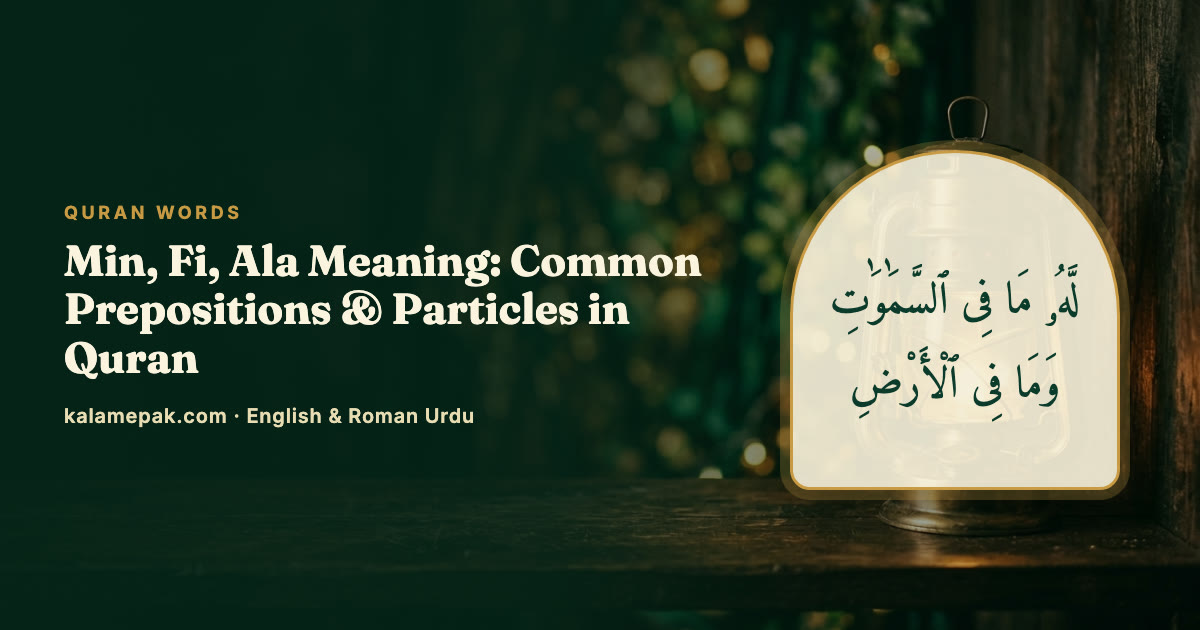
Look at this line from Ayatul Kursi:
Unto Him belongeth whatsoever is in the heavens and whatsoever is in the earth.
Us ki milkiyat mein zameen aur aasmaanon ki tamaam cheezein hain.
Surah Al-Baqarah · 2:255 (part)
| Arabic | Parts | Meaning |
|---|---|---|
| لَّهُۥ | la- + -hu | to Him, His |
| مَا | mā | whatever |
| فِى | fī | in |
| ٱلسَّمَٰوَٰتِ | as-samāwāt | the heavens |
| وَمَا | wa- + mā | and whatever |
| فِى | fī | in |
| ٱلْأَرْضِ | al-arḍ | the earth |
Seven words, and five of them are little words or built on them. Add samāʾ "sky, heaven" and arḍ "earth" (both in the top 35), and the whole line opens up. The full verse is explained in our Ayatul Kursi meaning guide.
Direction words: min, fi, ala, ila, an
Min meaning: "from, of" (se)
Fleeing from a lion?
Jo sher se bhaage hon
Surah Al-Muddaththir · 74:51
Fi meaning: "in" (mein)
In the Gardens of delight,
Nematon wali jannaton mein
Surah Aṣ-Ṣāffāt · 37:43
Ala meaning: "on, upon" (par)
Peace be unto Abraham!
Ibraheem (alaihis salaam) par salaam ho
Surah Aṣ-Ṣāffāt · 37:109
When a pronoun is attached, ʿalā changes its last letter: ʿalayhim "upon them", which you say twice in the last verse of Surah Al-Fatiha, and ʿalayka "upon you", as in as-salāmu ʿalayka ayyuhā n-nabiyy in Attahiyat. Same word, different ending.
Ila meaning: "to, towards" (ki taraf)
Lo! unto thy Lord is the return.
Yaqeenan lautna tere Rabb ki taraf hai
Surah Al-ʿAlaq · 96:8
An meaning: "from, about" (se, ke baare mein)
Who are heedless of their prayer;
Jo apni namaaz se ghaafil hain
Surah Al-Māʿūn · 107:5
A handy way to remember the five: min is where you come from, ilā is where you are going to, fī is inside, ʿalā is on top, and ʿan is away from or about.
"Not" and "except": la, ma, illa
La meaning: "not, no" (nahi)
And laugh and not weep,
Aur hans rahe ho? rote nahi?
Surah An-Najm · 53:60
Ma meaning "not" (nahi)
And your comrade is not mad.
Aur tumhaara saathi deewaana nahi hai
Surah At-Takwīr · 81:22
Illa meaning: "except, but, only" (magar, sirf)
Thou art but a warner.
Aap to sirf daraane wale hain
Surah Fāṭir · 35:23
Put lā and illā together and you have the heart of the Kalima: lā ilāha illā llāh, "there is no god except Allah". Our La ilaha illallah meaning guide takes it word by word.
"What", "if", "when" and "indeed": ma, in, idha, qad
Ma meaning "what, that which" (jo)
Doer of what He will.
jo chaahe use kar guzarne wala hai
Surah Al-Burūj · 85:16
So mā has two jobs. In a sentence like "your comrade is not mad" (81:22) it means "not"; in phrases like mā fī s-samāwāt it means "what, whatever". The sentence always makes it clear.
In meaning: "if" (agar)
If now ye have any wit, outwit Me.
Pas agar tum mujh se koi chaal chal sakte ho to chal lo
Surah Al-Mursalāt · 77:39
Do not confuse in "if" with inna "indeed" (rank 5). Inna usually has a double n and is followed by a noun: inna llāha "indeed Allah".
Idha meaning: "when" (jab)
When the sun is overthrown,
jab sooraj lapet liya jaayega
Surah At-Takwīr · 81:1
Qad meaning: "indeed, already" (yaqeenan)
Successful indeed are the believers
yaqeenan imaan walon ne falaah haasil kar li
Surah Al-Muʾminūn · 23:1
Qad before a past verb makes it definite: "has truly happened". Qad aflaḥa, "successful indeed are…", opens Surah Al-Muʾminun.
What about wa, bi, li and fa?
Some of the most frequent little words are only one letter long and are written joined to the next word: wa- "and", fa- "so, then", bi- "with, by", li- "for, to", ka- "like". You have already seen wa-mā and la-hu above. Because they are attached, word lists (including ours) count the word they are attached to, not the prefix. They are still worth learning on day one; our guide on how to understand the Quran word by word shows how to split them off.
A 5-minute practice
Open Surah Al-Fatiha and look for ʿalā in verse 7 and lā at its end. Then open Surah Al-Ikhlas and find lam "did not". Finally, recite Ayatul Kursi slowly and count how many times you hear mā and fī.
These twelve words are the first lesson of our book 600 Words of the Quran, and the "Little Words" lessons later add the rest: lam, lan, bal, ḥattā, maʿa and more, each with a verse and meaning in English and Roman Urdu. See the full lesson plan on the book page, or continue with the most common verbs in the Quran.
Frequently asked questions
What does min mean in the Quran?
Min means 'from' or 'of' (Urdu 'se', 'mein se'). It is the most common separate word in the Quran, appearing 3,226 times.
What is the difference between fi and ala?
Fī means 'in' (Urdu 'mein') and ʿalā means 'on, upon, over' (Urdu 'par'). For example, fī s-samāwāt is 'in the heavens', and ʿalayhim is 'upon them'.
Why does ala sometimes look like alayhi or alayka?
When a pronoun ending is attached, the last letter of ʿalā changes: ʿalayhi 'upon him', ʿalayka 'upon you', ʿalayhim 'upon them'. It is the same word.
Is 'ma' in the Quran always 'not'?
No. Mā can mean 'not', but it very often means 'what, that which', as in 'whatsoever is in the heavens'. The two uses are counted as separate words: 1,592 times for 'what' and 973 for 'not'.