How to Understand the Quran Word by Word (Simple Method)
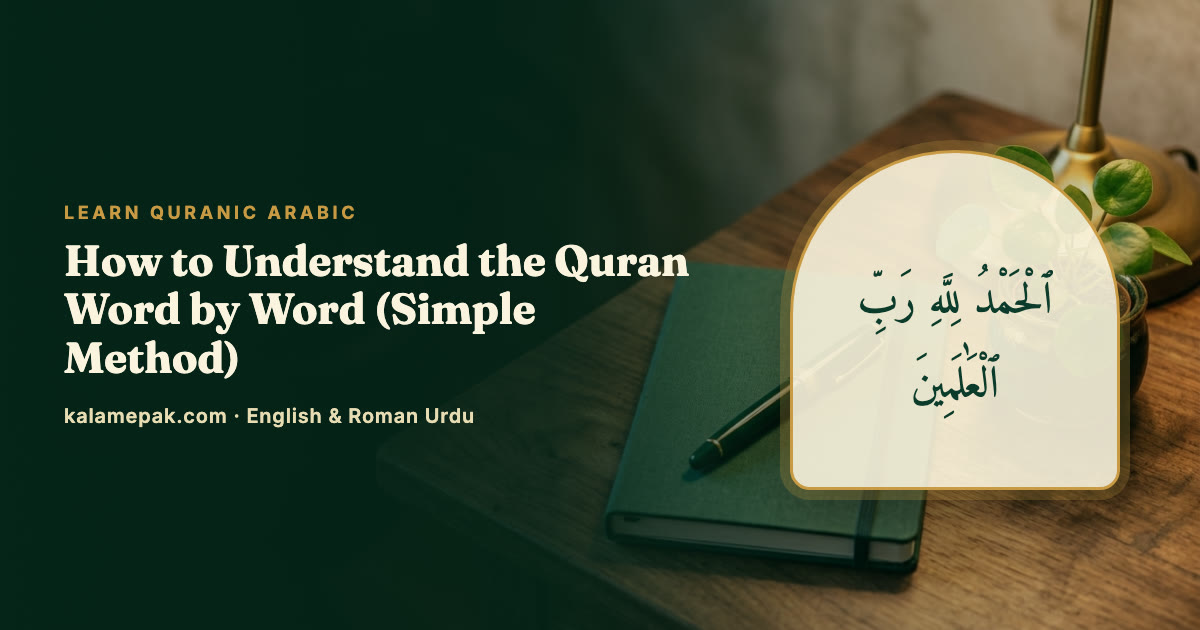
To understand the Quran word by word, you need three simple skills: peel off the small letters stuck to the front of a word (like wa- "and" or li- "for"), peel off the endings (like -ka "your" or -hum "them"), and recognise the core word that's left, often by its root. With these three moves, even long-looking Arabic words break into pieces you can understand. Below is the method, with full worked examples from Surah Al-Fatiha and Surah Al-Ikhlas.
Why Arabic words look so long
In English, "and for your Lord" is four separate words. In Arabic, several of these small words are written joined together as one. So when you look at a verse, you are often seeing two, three or even four words glued into one.
Take this short verse from Surah Al-Kawthar:
So pray unto thy Lord, and sacrifice.
Pas tu apne Rabb ke liye namaaz padh aur qurbaani kar
Surah Al-Kawthar · 108:2
It looks like three words. It is really seven pieces:
| Piece | Say it | Meaning |
|---|---|---|
| fa- | fa | so |
| ṣalli | ṣalli | pray! |
| li- | li | for, unto |
| rabbi | rabbi | Lord |
| -ka | ka | your (thy) |
| wa- | wa | and |
| nḥar | nḥar | sacrifice! |
Once you know that fa, li, -ka and wa are tiny helper words, the verse becomes: "So — pray — for — Lord — your — and — sacrifice." That's word by word understanding.
Skill 1: Peel off the front letters
These are the most common helpers that stick to the front of a word. Learn them once and you'll spot them in almost every verse.
| Front letter | Meaning | Example | Where |
|---|---|---|---|
| wa- | and | وَإِيَّاكَ wa-iyyāka — "and You (alone)" | 1:5 |
| bi- | with, in, by | بِسْمِ bi-smi — "in the name" | 1:1 |
| li- | for, to, belonging to | لِلَّهِ li-llāhi — "for Allah" | 1:2 |
| fa- | so, then | فَصَلِّ fa-ṣalli — "so pray" | 108:2 |
| al- | the | ٱلْحَمْدُ al-ḥamdu — "the praise" | 1:2 |
A note on al-: in writing, it often "disappears" in sound. You write al-raḥmān but say ar-raḥmān. The meaning is still simply "the".
Skill 2: Peel off the endings
Pronouns like "your", "his", "them" and "us" are usually attached to the end of a word.
| Ending | Meaning | Example | Where |
|---|---|---|---|
| -ka | you, your | رَبِّكَ rabbi-ka — "your Lord" | 108:2 |
| -hu | him, his | لَّهُۥ la-hu — "unto Him" | 112:4 |
| -hum | them, their | عَلَيْهِمْ ʿalay-him — "on them" | 1:7 |
| -nā | us, our | ٱهْدِنَا ihdi-nā — "guide us" | 1:6 |
| -ī / -ya | me, my | رَبِّيَ rabbi-ya — "my Lord" | ruku tasbih |
(-hum sounds like -him after an "i" sound, as in ʿalayhim. Same meaning.)
This is why the Fatiha's ʿalayhim and the ruku's rabbiya feel unfamiliar at first: you already know ʿalā ("on") and rabb ("Lord") — they are just wearing an ending.
Skill 3: Find the core word (and its root)
Once the front and back are gone, you have the core word. Most Arabic core words are built from a root of three letters, and words from the same root share a family meaning.
Two families you'll meet in the very first verses of the Quran:
Root r-ḥ-m (mercy)
| Word | Meaning | In the book | Times in the Quran |
|---|---|---|---|
| رَحْمٰن raḥmān | the Most Gracious | word #289 | 57 |
| رَحِيم raḥīm | most merciful | word #284 | 116 |
| رَحْمَة raḥma | mercy | word #285 | 114 |
| رَحِمَ raḥima | he had mercy | word #298 | 28 |
Root ʿ-l-m (knowing)
| Word | Meaning | In the book | Times in the Quran |
|---|---|---|---|
| عَلِمَ ʿalima | he knew | word #103 | 382 |
| عَلِيم ʿalīm | all-knowing | word #282 | 163 |
| عِلْم ʿilm | knowledge | word #107 | 105 |
| عالَم ʿālam | world | word #147 | 73 |
A root is a clue, not a guarantee. ʿĀlam ("world") shares its root with ʿilm ("knowledge"), but you would never guess "world" from "knowing". So use roots to recognise words, and a translation to confirm them.
Worked example 1: Surah Al-Fatiha, verse 2
Praise be to Allah, Lord of the Worlds,
Sab taareef Allah Ta'ala ke liye hai jo tamaam jahaanon ka paalne wala hai
Surah Al-Fatiha · 1:2
Apply the three skills to each word:
- ٱلْحَمْدُ — front: al- (the). Core: ḥamd, "praise" (word #218, 43 times). → "the praise"
- لِلَّهِ — front: li- (for). Core: Allah (word #2, 2,699 times). → "for Allah"
- رَبِّ — nothing to peel. Core: rabb, "Lord" (word #12, 975 times). → "Lord of"
- ٱلْعَٰلَمِينَ — front: al- (the). Core: ʿālam, "world" (word #147), with the plural ending -īn. → "the worlds"
Put together: "The praise — for Allah — Lord of — the worlds." Compare it with Pickthall's "Praise be to Allah, Lord of the Worlds" and you'll see every piece lines up.
Worked example 2: Surah Al-Ikhlas, verse 1
Say: He is Allah, the One!
Aap keh dijiye ke woh Allah Ta'ala ek (hi) hai
Surah Al-Ikhlas · 112:1
| Arabic | Say it | Meaning | In the book |
|---|---|---|---|
| قُلْ | qul | say! | command form of qāla "he said", word #6 (1,618 times) |
| هُوَ | huwa | he | a pronoun (standalone this time) |
| ٱللَّهُ | Allāhu | Allah | word #2 |
| أَحَدٌ | aḥadun | one | aḥad, word #288 (74 times) |
Nothing to peel here — this verse is a good confidence-builder. But notice qul: it is the command form of qāla, one of the most common verbs in the Quran. Learn qāla = "he said" and you will recognise qul = "say!" at the start of many surahs you already recite. For the whole surah, see Surah Ikhlas meaning word by word.
A 3-question routine for any verse
When you meet a new verse, ask these three questions about each word:
- Is something stuck to the front? Look for wa, fa, bi, li, al.
- Is something stuck to the end? Look for -ka, -hu, -hum, -nā, -ī.
- What is the core word? Do I know it, or a word from the same root?
Then check your guess against a translation. At first you'll only get a few words per verse. That's normal. Within weeks, the helper letters become automatic, and your attention moves to the core words.
Which core words to learn first
The helper letters are a small, closed set — you can learn them in a day. The core words are where the real work is. Start with the ones that repeat the most. The 600 words in the book are the main word in about 8 out of every 10 words of the Quran (79.8% of its 77,429 words — counting the core word, not small attached letters like wa-, bi- or pronoun endings). That's why learning core words by frequency pays off so quickly. Browse the most common words in the Quran to see the top of the list, or see how roots connect whole groups of words in Arabic root words in the Quran.
Where to practise
- Your namaz. Fatiha and the short surahs you recite are perfect practice passages — you'll revise them five times a day. Start with Surah Fatiha meaning word by word.
- A word-by-word Quran. Free online tools like the Quranic Arabic Corpus show each word with its meaning and grammar.
- One verse a day. Better one verse fully understood than a page skimmed.
If you'd like all of this organised for you — the 600 core words in 30 lessons, each with a real verse and meanings in English and Roman Urdu — have a look at the book.
Frequently asked questions
What does word by word translation of the Quran mean?
It gives the meaning of each Arabic word separately, in order, instead of only the meaning of the whole verse. It shows you which word means what, so you can follow the Arabic while reciting.
Why do Arabic words in the Quran look longer than in a dictionary?
Because small words are written joined to them: letters like wa (and), bi (with, in), li (for) and fa (so) attach to the front, and pronouns like ka (you, your) or hum (them) attach to the end. Remove them and the core word appears.
Do I need to know Arabic roots?
Not at the start, but roots help a lot. Words from the same three letters are usually related in meaning, so one root can help you recognise several words. Always confirm your guess with a translation.