Learn Quranic Arabic at Home: A 4-Month Plan (15 Min a Day)
You can learn Quranic Arabic at home with 15 minutes a day. The plan below gets you through the 600 most common words of the Quran in about four months — five words a day, one review day a week, flashcards and a simple tracker — and then shows you what grammar adds when you're ready. No classes, no fixed timings, just a routine that fits around work and family.
Why start with vocabulary?
Grammar books usually start with rules. That's fine for full-time students, but for busy adults it often ends in chapter three. Vocabulary gives you a reward the very same day: you learn rabb ("Lord") in the morning and hear it in your Fajr, Zuhr and Asr.
And the Quran's vocabulary repeats a lot. The 600 words in the book are the main word in about 8 out of every 10 words of the Quran (79.8% of its 77,429 words — counting the core word, not small attached letters like wa-, bi- or pronoun endings). You won't understand every sentence just from words, but you'll stop feeling lost.
The 4-month plan at a glance
Five words a day for 120 days = 600 words. The book groups those words into 30 lessons, so this works out to roughly one lesson every four days.
| Month | Lessons | What you'll learn |
|---|---|---|
| Month 1 | 1–7 | The 25 most common words (Lesson 1), the little words like lam, thumma, idh, then time and number words, prophets and revelation, everyday verbs, knowing and thinking, faith and belief |
| Month 2 | 8–15 | Creation and nature, the Hereafter, guidance, worship, people and relationships, qualities, coming and going, Allah's names |
| Month 3 | 16–22 | Speaking and calling, more verbs, more little words, worship and faith words |
| Month 4 | 23–30 | The final themed lessons up to word 600, plus a full review week at the end |
Don't worry if a month slips into the next. The plan is a guide, not an exam.
Your 15-minute daily routine
Do this at the same time every day — straight after Fajr works well for many people, because the words are fresh when you pray the rest of the day.
- Review yesterday (3 min). Go through yesterday's five words. Say each meaning aloud before you check.
- Learn today's five words (7 min). For each word: read the Arabic, say it aloud, read the meaning in English and Roman Urdu, then read the verse where it appears.
- Find one in your namaz (2 min). Ask: "Do I say any of these words in my prayer?" Often you do — Allah, rabb, ḥamd, ʿaẓīm are all in namaz.
- Make flashcards (3 min). Write each new word on a card (Arabic on the front, meaning on the back).
That's it. Resist the urge to do 20 words on a good day — it makes the next day's review heavier and burns you out.
Example: your first day
Here are the first five words of Lesson 1 — the most frequent words in the Quran.
| Arabic | Say it | Meaning | Times in the Quran |
|---|---|---|---|
| مِن | min | from, of | 3,226 |
| اللَّه | Allah | Allah | 2,699 |
| لا | lā | not, no | 1,742 |
| فِي | fī | in | 1,701 |
| إِنّ | inna | indeed, truly | 1,682 |
Five small words, but together they appear more than 11,000 times. Day one done.
Weekly review: the day that makes it stick
Once a week — Friday is a good choice — learn nothing new. Instead:
- Shuffle all your flashcards from the week and test yourself.
- Put the ones you missed in a separate "again" pile and review that pile daily until it's empty.
- Recite one short surah slowly and count how many words you now recognise.
That last step is the most motivating part of the whole plan. The first time you recite Surah Al-Fatiha and know most of the words, you'll feel it.
Flashcards that actually work
- Arabic on the front, meaning on the back. Always test in this direction first — it's what happens in real recitation.
- Add the verse reference under the meaning (for example rabb → 1:2). Linking a word to a verse you know makes it much easier to recall.
- Three piles. "New", "Again", "Known". Cards move to "Known" only after you get them right on two different days.
- Paper or phone — both work. Paper cards in a pocket are easy to review in a queue or on the metro.
Track your progress
A simple tracker keeps you honest and motivated. Draw a grid of 30 boxes, one per lesson, and tick each one when you finish its review. Next to it keep a count: "Words learned: 25… 49… 62…". Seeing the number climb matters more than you'd think, especially in week six when the novelty wears off.
Free resources to learn Quranic Arabic
You don't need to spend money to start:
- The Quranic Arabic Corpus (corpus.quran.com) — free word-by-word meanings and grammar for every verse.
- Tanzil (tanzil.net) — the Quran text with many translations, including Urdu and English.
- Our free sample — the complete Lesson 1 (the 25 most common words), with verses and meanings in English and Roman Urdu.
- This blog — start with how to understand the Quran word by word, which teaches the front letters (wa, bi, li, fa) and endings (-ka, -hu, -hum) that you'll see on almost every word.
What grammar adds later — an honest note
Vocabulary tells you what is being talked about. Grammar tells you who does what to whom, and when. For example, you'll learn عَبَدَ ʿabada = "he worshipped" (word #205). In Surah Al-Fatiha it appears as نَعْبُدُ naʿbudu — "we worship". The core is the same; the shape tells you it's "we" and not "he".
With vocabulary alone, you can often guess this from the translation. With some basic grammar — how past and present verbs look, how plurals are formed — you'll know it for sure. So after the four months, a good next step is a beginner's course in Quranic grammar, ideally with a teacher. You'll find it much easier because you already know the words in every example.
And for the meaning and context of verses, rely on tafsir and scholars — word knowledge helps you follow the Quran, not issue rulings from it.
A dua for the learner
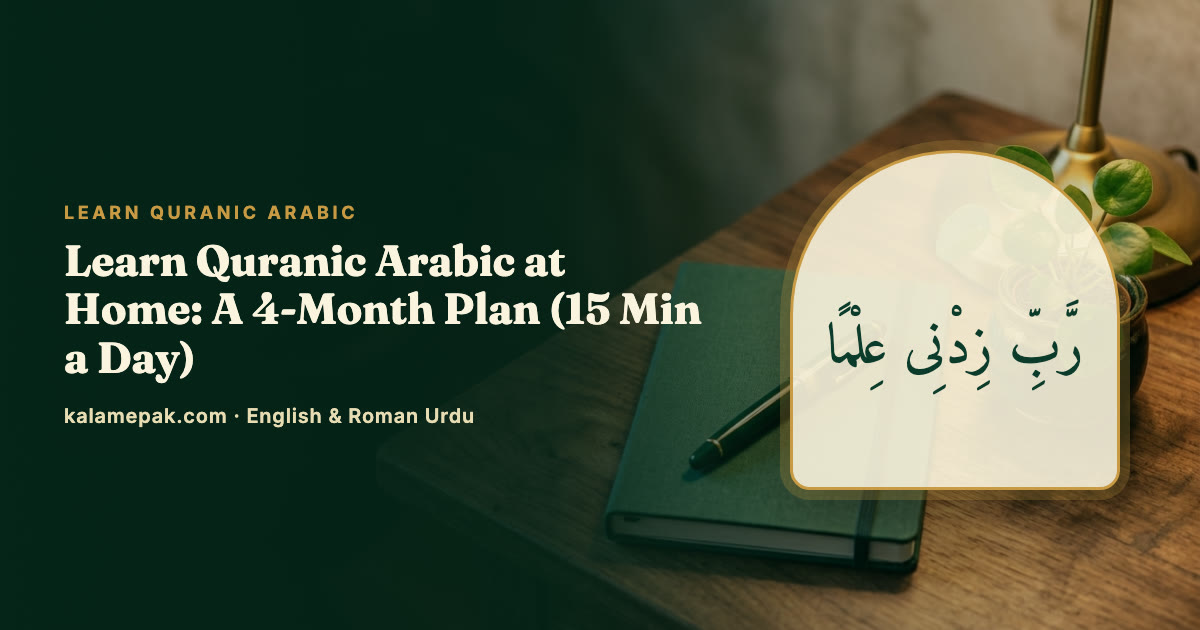
The Quran teaches a short dua for more knowledge. Many learners say it before each study session:
and say: My Lord! Increase me in knowledge.
Haan yeh dua kar ke Parwardigaar! Mera ilm badha
Surah Ta-Ha · 20:114 (end of the verse)
You already know two of its words: rabb ("Lord", word #12) and ʿilm ("knowledge", word #107, used 105 times). Zidnī — "increase me" — comes from zāda, "he increased" (word #62).
Keep going
If you want to understand the difference between the Arabic you're learning and the Arabic spoken today, read Quranic Arabic vs modern Arabic. If Hindi or Urdu is your first language, Quran word by word in Hindi shows how many Quran words you already know.
This whole plan is exactly how our book, 600 Words of the Quran, is laid out: 30 lessons, five words a day, with free flashcards, 30 lesson tests and a progress tracker as bonuses. But whether you use it or not — start today, with the five words above.
Frequently asked questions
Can I learn Quranic Arabic at home without a teacher?
You can learn the core vocabulary and basic patterns at home on your own, and that alone changes how you experience your recitation. For tafsir and deeper grammar, learning with a qualified teacher is still valuable.
How long does it take to learn Quranic Arabic?
Vocabulary first: at 5 words a day, the 600 most common Quran words take about four months. Grammar is a longer journey, but you can start it after the vocabulary with a big head start.
Should I learn grammar or vocabulary first?
For busy beginners, vocabulary first usually works better because every word learned shows up immediately in your namaz and recitation. Grammar then explains the patterns you have already been seeing.
Are there free resources to learn Quranic Arabic?
Yes. The Quranic Arabic Corpus (corpus.quran.com) gives free word-by-word meanings and grammar, and Tanzil (tanzil.net) has the Quran text with many translations. Our free sample also gives you the full first lesson of 25 words.