Arabic Root Words in the Quran: 6 Word Families Explained
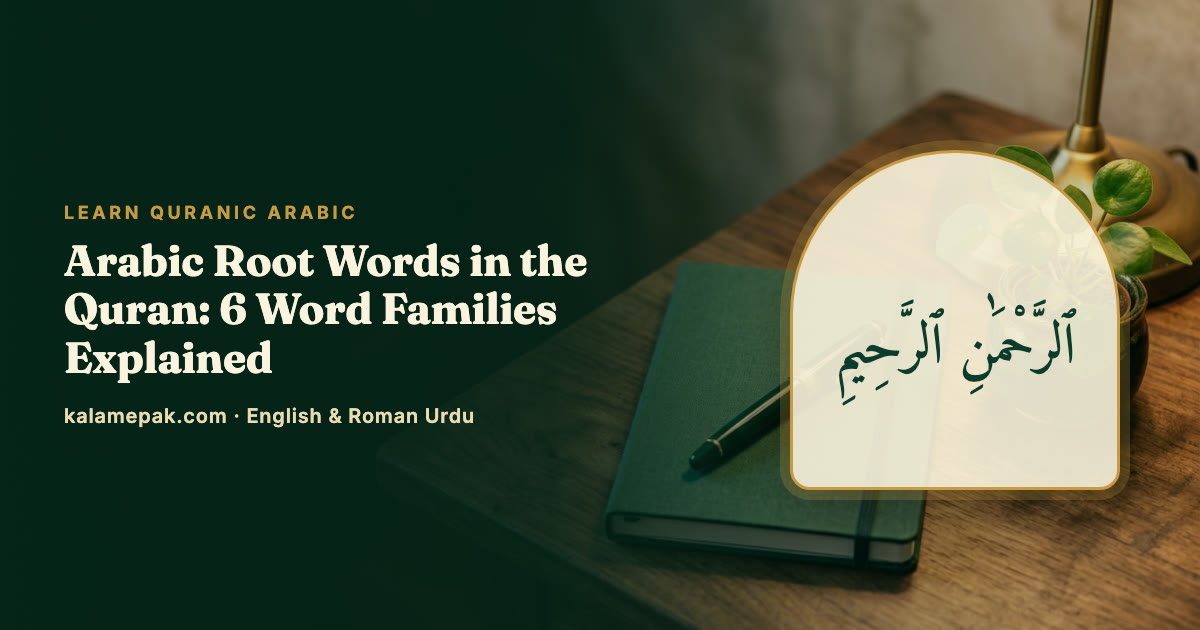
Almost every Arabic word in the Quran is built on a root: usually three consonants that carry one basic idea. The letters ʿ-l-m carry the idea of knowing, so from them come ʿalima "he knew", ʿilm "knowledge", ʿalīm "all-knowing" and ʿallama "he taught". Learn the root, and you get a head start on the whole family.
Below are six real word families from the 600 most common words of the Quran. Every word, root and count comes from the Quranic Arabic Corpus data used in our book, so you are seeing actual Quranic usage, not textbook examples.
How a root works, in one minute
Think of a root as a seed and the patterns as the ways it can grow. The same three letters, k-t-b, give:
- كَتَبَ kataba, "he wrote, decreed" (49 times)
- كِتاب kitāb, "book, scripture" (260 times)
The vowels and extra letters change; the root letters stay. When you see those three letters in that order, you know you are somewhere near the idea of writing.
Urdu speakers have a big advantage here. Ilm, aalim, imaan, momin, rahmat, salaam, kaafir, qaul: you already use members of these families every day.
Family 1: ʿ-l-m — knowing
The biggest family among the 600 words, with seven members:
| Arabic | Say it | Meaning | Roman Urdu | Times in the Quran |
|---|---|---|---|---|
| عَلِمَ | ʿalima | he knew | jaana | 382 |
| عَلِيم | ʿalīm | all-knowing | khoob jaanne wala | 163 |
| عِلْم | ʿilm | knowledge | ilm | 105 |
| أَعْلَم | aʿlam | knows best | sab se zyaada jaanne wala | 49 |
| عَلَّمَ | ʿallama | he taught | sikhaaya | 41 |
| عالِم | ʿālim | knower, knowing | jaanne wala | 18 |
| عالَم | ʿālam | world | jahaan, duniya | 73 |
One family, seven words. Notice ʿālam "world" at the end: the Quranic Arabic Corpus files it under the same root, but its meaning is quite different. That is a good reminder that the root is a clue, not a translation.
Teacheth man that which he knew not.
Jis ne insaan ko woh sikhaya jise woh nahi jaanta tha
Surah Al-ʿAlaq · 96:5
In this one verse you have two members of the family: ʿallama "he taught" and (lam) yaʿlam "(did not) know". The sentence is almost built out of one root.
Family 2: ʾ-m-n — faith and safety
| Arabic | Say it | Meaning | Roman Urdu | Times in the Quran |
|---|---|---|---|---|
| آمَنَ | āmana | he believed | imaan laaya | 537 |
| مُؤْمِن | muʾmin | believer | momin, imaan wala | 202 |
| إِيمان | īmān | faith, belief | imaan | 45 |
| مُؤْمِنَة | muʾminah | believing woman | momin aurat | 28 |
| أَمِنَ | amina | he felt safe, trusted | befikr hua, aitbaar kiya | 20 |
| آمِن | āmin | safe, secure | aman wala, mehfooz | 16 |
This root joins believing with feeling safe and trusting. Āmana is "he believed", amina is "he felt safe", and āmin is "secure". The same idea runs through them all: faith as a place of safety.
Successful indeed are the believers
Yaqeenan imaan walon ne falaah haasil kar li
Surah Al-Muʾminūn · 23:1
Family 3: r-ḥ-m — mercy
| Arabic | Say it | Meaning | Roman Urdu | Times in the Quran |
|---|---|---|---|---|
| رَحِيم | raḥīm | most merciful | nihaayat rahm karne wala | 116 |
| رَحْمَة | raḥma | mercy | rahmat | 114 |
| رَحْمٰن | raḥmān | the Most Gracious | bada meherbaan | 57 |
| رَحِمَ | raḥima | he had mercy | rahm kiya | 28 |
Two of these you say in every Bismillah: ar-Raḥmān and ar-Raḥīm. Our Bismillah meaning guide explains the difference between them.
The Beneficent, the Merciful.
Bada meherbaan nihaayat rahm karne wala
Surah Al-Fātiḥah · 1:3
Family 4: q-w-l — saying
| Arabic | Say it | Meaning | Roman Urdu | Times in the Quran |
|---|---|---|---|---|
| قالَ | qāla | he said | kaha | 1,618 |
| قَوْل | qawl | saying, word | baat | 92 |
A small family in this list, but a huge one in the Quran: qāla alone appears 1,618 times, more than any other verb. The noun qawl is Urdu's qaul, as in qaul-o-qaraar.
That they may understand my saying.
Taake log meri baat achchhi tarah samajh sakein
Surah Ṭā Hā · 20:28
Family 5: k-f-r — disbelief
| Arabic | Say it | Meaning | Roman Urdu | Times in the Quran |
|---|---|---|---|---|
| كَفَرَ | kafara | he disbelieved | inkaar kiya, kufr kiya | 289 |
| كافِر | kāfir | disbeliever | kaafir, inkaar karne wala | 156 |
| كُفْر | kufr | disbelief | kufr, inkaar | 37 |
The verb, the person and the idea: kafara "he disbelieved", kāfir "a disbeliever", kufr "disbelief". Once you see this pattern (verb, doer, thing) you will spot it in many families.
Say: O disbelievers!
Aap keh dijiye ke aey kaafiro!
Surah Al-Kāfirūn · 109:1
Family 6: s-l-m — peace and submission
| Arabic | Say it | Meaning | Roman Urdu | Times in the Quran |
|---|---|---|---|---|
| سَلام | salām | peace | salaam, salaamati | 42 |
| مُسْلِم | muslim | Muslim, one who submits | musalmaan, farmaanbardaar | 39 |
| أَسْلَمَ | aslama | he submitted | farmaanbardaar hua, Islam laaya | 22 |
Peace (salām), the one who submits (muslim), and the act of submitting (aslama). The greeting as-salāmu ʿalaykum and the word Muslim share their three root letters.
When his Lord said unto him: Surrender! he said: I have surrendered to the Lord of the Worlds.
Jab kabhi bhi unhein unke Rabb ne kaha, farmaanbardaar ho ja, unhon ne kaha, main ne Rabbul Aalameen ki farmaanbardaari ki
Surah Al-Baqarah · 2:131
Three patterns worth knowing
You do not need a grammar book to notice these. They appear across all six families.
| Pattern | What it usually means | Examples from above |
|---|---|---|
| fāʿil | the one who does it | kāfir, ʿālim |
| faʿīl | a strong, lasting quality | raḥīm, ʿalīm |
| mu-… | one who does it (from longer verbs) | muʾmin, muslim |
So when you meet a new word like ẓālim, you can guess: "one who does ẓ-l-m", which is wrongdoing. And you would be right: ẓālim means "wrongdoer" (129 times). Guessing like this is not a replacement for checking the meaning, but it makes new words far easier to remember.
How to use roots when you study
- Learn words in families, not alone. When you learn ʿilm, look at ʿalima and ʿalīm in the same sitting.
- Start from Urdu. Write the Urdu word you already know (ilm, imaan, rahmat) and add the Arabic family around it.
- Check, don't assume. Use the root as a memory hook, then confirm the meaning in the verse, as ʿālam showed.
If you want to see roots at work inside real verses, read our guide on how to understand the Quran word by word. For a daily routine that builds these families week by week, see learn Quranic Arabic at home, and for the most frequent words overall, the most common words in the Quran.
Our book 600 Words of the Quran shows the three-letter root on every word's page, along with its count and a real verse, so the families build up naturally as you go. You can see a sample page on the book page.
Frequently asked questions
What is a root word in Arabic?
Most Arabic words are built on a root of three consonants that carries a basic idea. For example, ʿ-l-m carries the idea of knowing, and gives ʿalima 'he knew', ʿilm 'knowledge' and ʿalīm 'all-knowing'.
How many roots are there in the Quran?
A great many. But a fairly small number of roots produce a large share of the Quran's most common words, so learning the big families first gives the fastest results.
Does knowing the root always tell me the meaning?
No. The root gives you a strong clue, but the exact meaning depends on the word's pattern and the verse. ʿĀlam 'world' shares the root of ʿilm 'knowledge', yet it means something quite different.
Do Urdu speakers have an advantage with Arabic roots?
Yes. Urdu has taken many words from Arabic, such as ilm, aalim, imaan, momin, rahmat and salaam, so Urdu speakers already know many members of these families.