How to Understand the Quran: A 5-Step Path for Busy People
You can start understanding the Quran without first becoming an Arabic scholar. What works for most busy people is five small habits: read a translation daily, study short passages word by word, learn about five common Quran words a day, begin with what you already recite in namaz, and review once a week. Each habit takes 10 to 15 minutes, and below is exactly how to do each one, with real examples.
Why the Quran feels hard to understand
Most of us in India and Pakistan learned to read the Quran as children — Qaida first, then nazra. We can recite fluently, sometimes beautifully. But reading and understanding were never taught together, so we pray five times a day without knowing what we are saying.
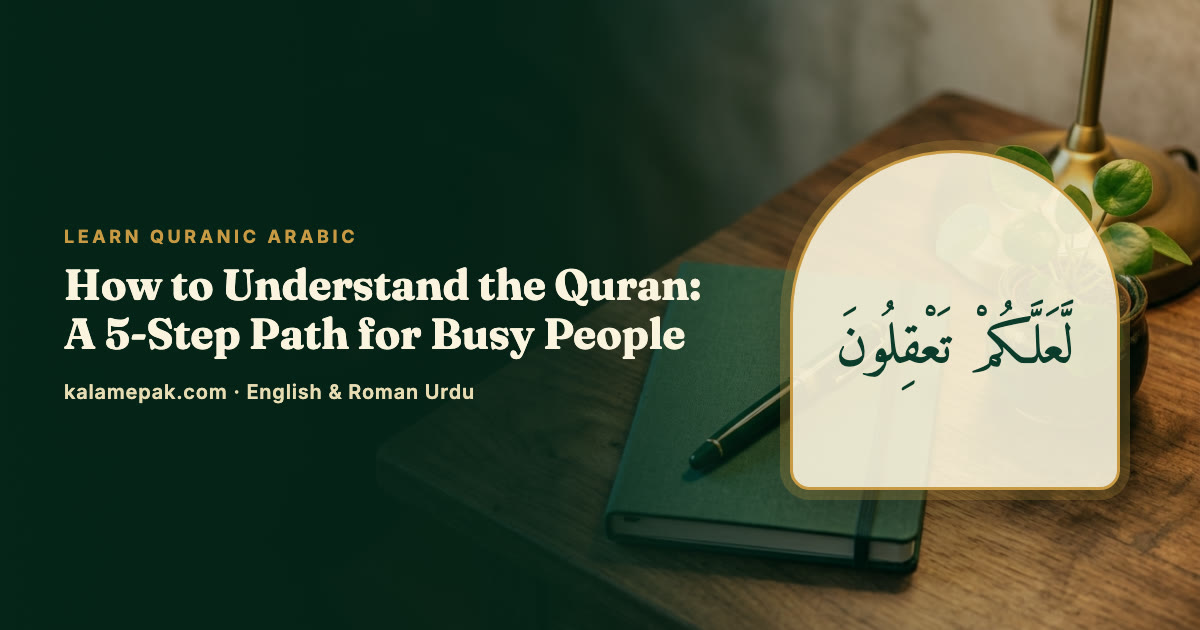
That is not a lack of ability. It is simply a gap in how we were taught, and it can be closed. The Quran itself says why it came in Arabic:
Lo! We have revealed it, a Lecture in Arabic, that ye may understand.
Yaqeenan hum ne is ko Quran Arabi naazil farmaaya hai ke tum samajh sako
Surah Yusuf · 12:2
The last word, taʿqilūn ("you may understand"), comes from عَقَلُ ʿaqala — word #111 in the book, used 49 times in the Quran. Understanding is the purpose. So let's work towards it, one step at a time.
Step 1: Read a translation you can actually follow
Pick a translation in the language you think in. For many of us that is Urdu, or Hindi written in Roman letters. If English is easier, use English. In our articles we quote Pickthall for English and Maulana Muhammad Junagarhi for Urdu.
How to make it stick:
- Small portions. One page a day is plenty. A page read with attention beats a juz read in a hurry.
- Arabic first, then meaning. Recite the verse, then read its translation. This keeps the Arabic and the meaning connected in your mind.
- One line in a notebook. Write down one verse or phrase that touched you. After a month you have 30 of them.
A translation gives you the meaning of the whole verse. What it doesn't tell you is which Arabic word means what — and that is what lets you understand while reciting. That is step 2.
Step 2: Go word by word on passages you already know
Choose a passage you know by heart. Surah Al-Fatiha is perfect. Here is verse 2, split into its words:
| Arabic | Say it | Meaning | In the book |
|---|---|---|---|
| ٱلْحَمْدُ | al-ḥamdu | the praise | ḥamd, word #218 (43 times) |
| لِلَّهِ | lillāhi | for Allah | Allah, word #2 (2,699 times) |
| رَبِّ | rabbi | Lord (of) | rabb, word #12 (975 times) |
| ٱلْعَٰلَمِينَ | al-ʿālamīn | the worlds | ʿālam, word #147 (73 times) |
Four words. Yet rabb alone appears 975 times in the Quran. Learn it here and you will meet it on almost every page.
Word by word works best with a few tricks — small letters like wa- ("and") and li- ("for") that stick to the front of words, and endings like -ka ("your") that stick to the back. We explain them step by step in how to understand the Quran word by word.
Step 3: Learn 5 common words a day
This is the step most people never hear about. The Quran uses a large vocabulary, but a relatively small set of words repeats again and again. The 600 words in the book are the main word in about 8 out of every 10 words of the Quran (79.8% of its 77,429 words — counting the core word, not small attached letters like wa-, bi- or pronoun endings).
That doesn't mean you will understand 80% of every verse — grammar and context still matter. It means that when you recite, most words will no longer be strangers.
The five most frequent words in the list:
| # | Arabic | Say it | Meaning | Times in the Quran |
|---|---|---|---|---|
| 1 | مِن | min | from, of | 3,226 |
| 2 | اللَّه | Allah | Allah | 2,699 |
| 3 | لا | lā | not, no | 1,742 |
| 4 | فِي | fī | in | 1,701 |
| 5 | إِنّ | inna | indeed, truly | 1,682 |
That's day one. At five words a day, 600 words take 120 days — about four months. See the most common words in the Quran for the top of the list, and a 4-month plan to learn Quranic Arabic at home if you want a full schedule.
Memory tip: tie each word to a line you already recite. Lā is in the last verse of Fatiha — wa lā ḍ-ḍāllīn, "nor of those who go astray". Min is in the taʿawwudh you say before reciting — aʿūdhu billāhi mina sh-shayṭān, "I seek refuge in Allah from Satan".
Step 4: Start with namaz — the Quran you already recite
In common practice Surah Al-Fatiha is recited in every rakʿah — that is 17 times a day in the fard prayers alone. If you understand it, every prayer turns into a revision lesson that you never have to schedule.
Take verse 5:
Thee (alone) we worship; Thee (alone) we ask for help.
Hum sirf teri hi ibaadat karte hain aur sirf tujh hi se madad chaahte hain
Surah Al-Fatiha · 1:5
Naʿbudu ("we worship") comes from عَبَدَ ʿabada, word #205, used 122 times. Its cousin عَبْد ʿabd ("servant"), word #221, is the Abd in names like Abdullah. Once you know this pair, you will hear it everywhere — including in the Attahiyat, where we call the Prophet Muhammad ﷺ Allah's ʿabd (servant).
For the full prayer with meanings, step by step, read namaz ka tarjuma.
Step 5: Review once a week
New words fade if you don't meet them again. Give one day a week to review only — no new words.
A simple 20-minute review:
- Read through the week's 35 words (5 × 7). Cover the meaning with your hand and say it.
- Mark the ones you missed. Do them once more tomorrow.
- Recite one short surah slowly and pause at every word you now know. That moment — "I know this word!" — is what keeps you going.
A realistic weekly routine
| Day | What to do (10–15 minutes) |
|---|---|
| Monday–Thursday | 5 new words + one page of translation |
| Friday | Review all the week's words |
| Saturday | Word by word on one short passage you recite in namaz |
| Sunday | Rest from study — just pray and notice the words you know |
If you miss a day, don't try to "catch up" with 15 words. Just continue. Consistency matters much more than speed.
Understanding the Quran in Hindi or Urdu
If you speak Hindi or Urdu, you are already ahead. Many Quran words live on in everyday speech: kitāb (book, word #65), insān (human, #228), dunyā (this world, #166), ḥaqq (truth, #181), ʿilm (knowledge, #107). You know these meanings already — now you only need to recognise them inside a verse.
If you can't read Urdu script, Roman Urdu meanings (Urdu written in English letters) are the bridge. We show how in Quran word by word in Hindi.
What "understanding" realistically means
Be honest with yourself about the goal. Words plus a translation let you follow what you recite and feel it. Deeper understanding — why a verse was revealed, how scholars explained it — comes from tafsir and from learning with people of knowledge. Word study is not a way to make religious rulings; it is a way to connect your heart to the words you already say.
Where our book fits
Steps 3 and 5 are exactly what 600 Words of the Quran is built for: the 600 most common words in 30 lessons, each word shown in a real verse with its meaning in English and Roman Urdu, plus flashcards and a progress tracker as free bonuses. You can see what's inside the book — or simply start today with the five words in the table above.
Frequently asked questions
Can I understand the Quran without learning full Arabic grammar?
You can understand a lot. A good translation gives you the meaning of each verse, and learning the most common words lets you follow the Arabic as you recite. Grammar adds precision later, but you do not need it to begin.
How long does it take to understand the Quran?
There is no fixed answer, and understanding keeps growing for life. As a practical target, learning 5 common words a day covers the 600 most frequent Quran words in about four months.
Where should a beginner start?
Start with what you already recite in namaz: Surah Al-Fatiha and one or two short surahs. You say them every day, so every prayer becomes revision.
Can I understand the Quran in Hindi or Urdu?
Yes. Read a translation in the language you think in, and use Roman Urdu meanings if you cannot read Urdu script. Many Quran words, like kitab, insaan and duniya, are already familiar to Hindi and Urdu speakers.