Surah Quraish Meaning in Urdu & English (Word by Word)
Two things most of us take for granted every day: a meal when we're hungry, and feeling safe when we lie down at night. Surah Quraish is about exactly these two gifts — and about who to thank for them.
Its meaning (Pickthall): "For the taming of Qureysh. For their taming (We cause) the caravans to set forth in winter and summer. So let them worship the Lord of this House, Who hath fed them against hunger and hath made them safe from fear."
In Roman Urdu: Quraish ke maanoos karne ke liye — unhein jaade aur garmi ke safar se maanoos karne ke liye — pas unhein chaahiye ke isi ghar ke Rabb ki ibaadat karte rahein, jis ne unhein bhook mein khaana diya aur dar mein amn diya.
Who were the Quraish?
The Quraish were the leading tribe of Makkah — the tribe of the Prophet Muhammad ﷺ — and the caretakers of the Kaaba. Verse 2 mentions their journeys in winter and summer — Pickthall calls them caravans.
This surah comes right after Surah Al-Fil, and the two are often read together. In Surah Al-Fil, Allah protected the Kaaba from an army. In Surah Quraish, the people who lived around that same House are reminded of the peace and provision they enjoyed because of it.
Surah Quraish meaning in Urdu and English (verse by verse)
For the taming of Qureysh.
Quraish ke maanoos aadi karne ke liye
Surah Quraish · 106:1
For their taming (We cause) the caravans to set forth in winter and summer.
(Yaani) unhein jaade aur garmi ke safar se maanoos karne ke liye. (Us ke shukriya mein)
Surah Quraish · 106:2
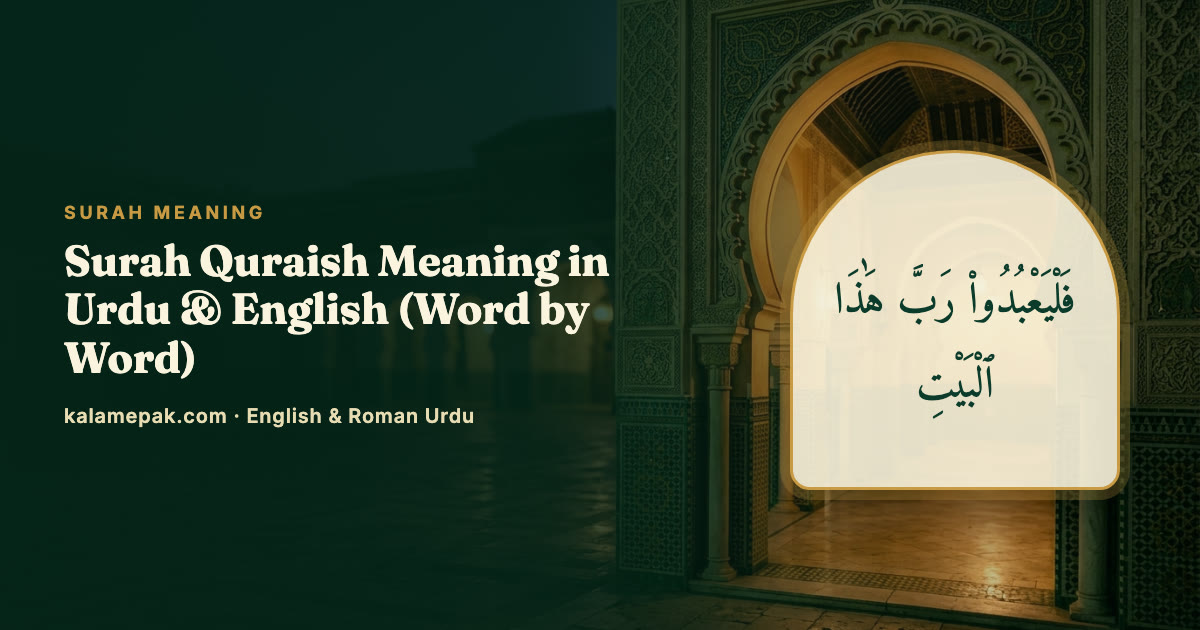
So let them worship the Lord of this House,
Pas unhein chaahiye ke isi ghar ke Rabb ki ibaadat karte rahein
Surah Quraish · 106:3
Who hath fed them against hunger and hath made them safe from fear.
Jis ne unhein bhook mein khaana diya aur dar (aur khauf) mein amn (wa amaan) diya
Surah Quraish · 106:4
A word on īlāf, the word Pickthall translates as "taming". Junagarhi's Urdu gives maanoos karna — making someone familiar and at ease with something.
Surah Quraish word by word
| Arabic | Say it | Meaning | In the book |
|---|---|---|---|
| لِإِيلَٰفِ | li-īlāfi | for the familiarity (of) | — |
| قُرَيْشٍ | Quraysh | Quraish (the tribe) | — |
| إِۦلَٰفِهِمْ | īlāfihim | their familiarity | — |
| رِحْلَةَ | riḥlata | journey (of) | — |
| ٱلشِّتَآءِ | ash-shitāʾ | the winter | — |
| وَٱلصَّيْفِ | waṣ-ṣayf | and the summer | — |
| فَلْيَعْبُدُوا۟ | fal-yaʿbudū | so let them worship | word #205 ʿabada — 122 times |
| رَبَّ | rabba | the Lord (of) | word #12 rabb — 975 times |
| هَٰذَا | hādhā | this | word #11 dhā — 1,058 times |
| ٱلْبَيْتِ | al-bayt | the House | word #213 bayt — 65 times |
| ٱلَّذِىٓ | alladhī | who | word #8 — 1,468 times |
| أَطْعَمَهُم | aṭʿamahum | fed them | root shared with #507 ṭaʿām (food) |
| مِّن | min | from, against | word #1 — 3,226 times |
| جُوعٍ | jūʿ | hunger | — |
| وَءَامَنَهُم | wa āmanahum | and made them safe | same verb as #19 āmana — 537 times |
| خَوْفٍۭ | khawf | fear | word #525 — 26 times |
The first half of the surah is full of new words — names, seasons, journeys. The second half is almost all from the book's list: worship, Lord, this, House, who, from, safe, fear. That's typical: the "story" words change from surah to surah, but the core words of meaning keep returning.
Urdu speakers will spot friends here too: bayt (as in Baitullah), ṭaʿām (taam, food), khauf (fear) and amn (peace).
The root that links safety and faith: a-m-n
Look closely at wa āmanahum in verse 4 — "and made them safe". It's the very same verb as آمَنَ āmana, word #19 in our book, which usually means "he believed". How can one verb mean both "believe" and "make safe"?
Because both come from the root a-m-n, whose core idea is safety, trust and peace of mind. Look at the family in the book:
- آمَنَ āmana — he believed — #19, 537 times
- مُؤْمِن muʾmin — believer — #122, 202 times
- إِيمان īmān — faith — #136, 45 times
- أَمِنَ amina — he felt safe, trusted — #428, 20 times
- آمِن āmin — safe, secure — #538, 16 times
In Urdu we say amn (peace), amaanat (a trust), imaan (faith) and momin (believer) — all the same family. It's a beautiful thought to carry: faith and safety share one root. In this surah, Allah gave the Quraish amn — safety from fear.
What Surah Quraish teaches
- Every blessing has a Giver. Food and safety — the two most basic needs — are named, and both are credited to Rabb hādhā l-bayt, the Lord of this House.
- Gratitude is shown through worship. The response asked for is simple: fal-yaʿbudū — "so let them worship".
- Don't let familiar blessings go unnoticed. A reflection for us: when we get used to a gift, it's easy to forget its Giver. This surah is a reminder.
When is Surah Quraish commonly recited?
It's a short, four-verse surah that many people recite in namaz after Surah Al-Fatiha, very often together with or right after Surah Al-Fil.
A namaz tip: two blessings, two pauses
When you reach the last verse in namaz — alladhī aṭʿamahum min jūʿ, wa āmanahum min khawf — think of two specific things: the last meal you ate, and the fact that you are safe right now. Two quick thoughts, and the verse is no longer about "them" in history — it's about you, today.
Read next
Read Surah Fil meaning for the story that comes just before this surah. The a-m-n family is one of many explored in Arabic root words in the Quran. For another surah where the word ʿabada (worship) is central, see Surah Kafirun meaning, and for a bigger picture of reading the Quran with understanding, try how to understand the Quran.
These repeating words — rabb, bayt, khawf, āmana and hundreds more — are taught one by one with real verses in 600 Words of the Quran. The 600 words in the book are the main word in about 8 out of every 10 words of the Quran (79.8% of its 77,429 words — counting the core word, not small attached letters like wa-, bi- or pronoun endings).
Frequently asked questions
What does 'Li ilafi Quraish' mean?
Pickthall translates it as 'For the taming of Qureysh'; Junagarhi's Urdu says 'Quraish ke maanoos karne ke liye' — for making Quraish familiar and at ease with their journeys.
Who were the Quraish?
The Quraish were the leading tribe of Makkah, the tribe of the Prophet Muhammad ﷺ, and the caretakers of the Kaaba.
What does 'Rabba hadhal bayt' mean?
It means 'the Lord of this House' — the House is the Kaaba in Makkah.
How many verses are in Surah Quraish?
Surah Quraish is the 106th surah of the Quran and has 4 verses.