Surah Kafirun Meaning in Hindi & Urdu (Word by Word)
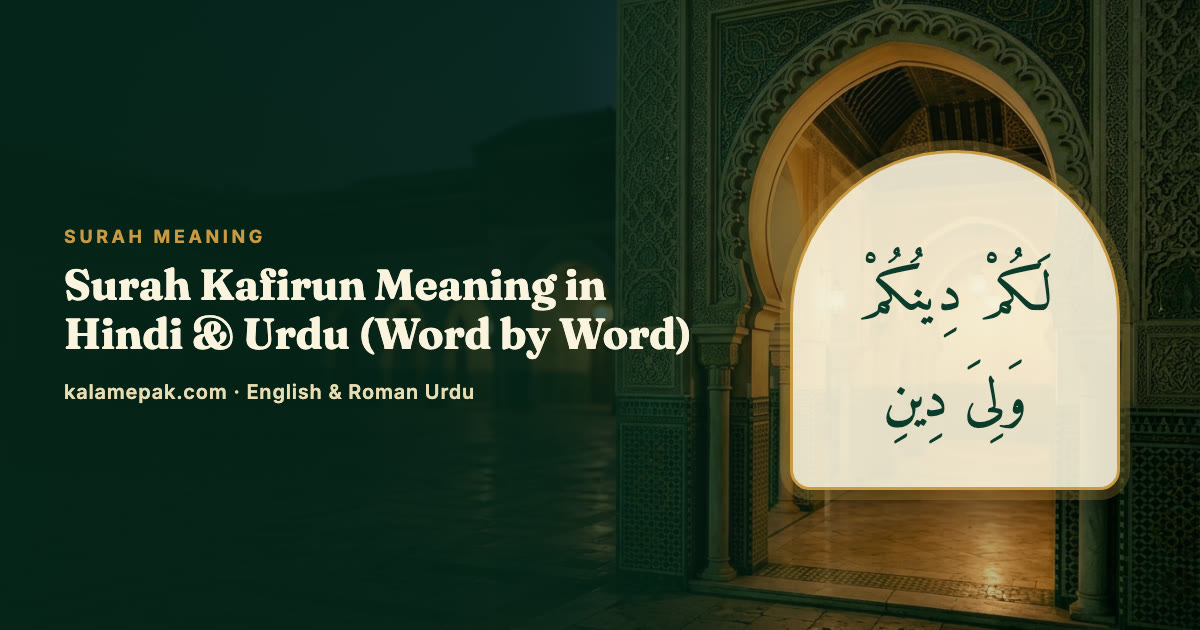
Surah Kafirun means: "Say: O disbelievers! I worship not that which ye worship; nor worship ye that which I worship. And I shall not worship that which ye worship. Nor will ye worship that which I worship. Unto you your religion, and unto me my religion."
In Urdu (Junagarhi): Aap keh dijiye ke aey kaafiro! Na main ibaadat karta hoon us ki jis ki tum ibaadat karte ho, na tum ibaadat karne wale ho us ki jis ki main ibaadat karta hoon… Tumhaare liye tumhaara deen hai aur mere liye mera deen hai.
Read the translation again and one word keeps coming back: worship. In the Arabic it is even more striking. Out of the 26 words in this surah, eight come from a single root — ʿ-b-d, "to worship". If you learn that one root, you will understand this surah by ear.
Surah Kafirun meaning in Urdu and English (verse by verse)
Say: O disbelievers!
Aap keh dijiye ke aey kaafiro!
Surah Al-Kafirun · 109:1
I worship not that which ye worship;
Na main ibaadat karta hoon us ki jis ki tum ibaadat karte ho
Surah Al-Kafirun · 109:2
Nor worship ye that which I worship.
Na tum ibaadat karne wale ho us ki jis ki main ibaadat karta hoon
Surah Al-Kafirun · 109:3
And I shall not worship that which ye worship.
Aur na main ibaadat karoonga jis ki tum ibaadat karte ho
Surah Al-Kafirun · 109:4
Nor will ye worship that which I worship.
Aur na tum us ki ibaadat karne wale ho jis ki main ibaadat kar raha hoon
Surah Al-Kafirun · 109:5
Unto you your religion, and unto me my religion.
Tumhaare liye tumhaara deen hai aur mere liye mera deen hai
Surah Al-Kafirun · 109:6
Surah Kafirun meaning in Hindi: the Roman Urdu above reads naturally in Hindi — "Kaho: aey kaafiro (inkaar karne walo)! Main uski ibaadat nahi karta jiski tum karte ho, aur na tum uski ibaadat karte ho jiski main karta hoon… Tumhare liye tumhara deen, aur mere liye mera deen."
One root, eight times: ʿ-b-d
Here are the worship words in the surah. They look different, but they all share the letters ʿayn–bā–dāl:
| Arabic | Say it | Meaning | Where |
|---|---|---|---|
| أَعْبُدُ | aʿbudu | I worship | verses 2, 3, 5 |
| تَعْبُدُونَ | taʿbudūna | you worship | verse 2 |
| عَٰبِدُونَ | ʿābidūna | worshippers (plural) | verses 3, 5 |
| عَابِدٌ | ʿābidun | a worshipper | verse 4 |
| عَبَدتُّمْ | ʿabadtum | you worshipped | verse 4 |
The verb is word #205 in our book, عَبَدَ ʿabada (he worshipped), which appears 122 times in the Quran. The same root gives عَبْد ʿabd (servant, slave), word #221 — 131 times — which you know from names like Abdullah and Abdur Rahman: servant of Allah, servant of the Most Merciful. And of course it gives the Urdu word ibaadat.
You say this root in every rakat of namaz, too: iyyāka naʿbudu, "You alone we worship", in Surah Al-Fatiha.
Surah Kafirun word by word
| Arabic | Say it | Meaning | In the book |
|---|---|---|---|
| قُلْ | qul | say | from word #6 qāla — 1,618 times |
| يَٰٓأَيُّهَا | yā ayyuhā | O you | yā + word #32 ayy |
| ٱلْكَٰفِرُونَ | al-kāfirūn | the disbelievers | word #125 kāfir — 156 times |
| لَآ | lā | not | word #3 — 1,742 times |
| أَعْبُدُ | aʿbudu | I worship | word #205 ʿabada — 122 times |
| مَا | mā | that which | word #7 mā — 1,592 times |
| تَعْبُدُونَ | taʿbudūna | you worship | word #205 |
| أَنتُمْ | antum | you (all) | pronoun |
| عَٰبِدُونَ | ʿābidūna | worshippers | root of word #205 |
| أَنَا۠ | anā | I | pronoun |
| عَبَدتُّمْ | ʿabadtum | you worshipped | word #205 |
| لَكُمْ | lakum | for you | la + kum |
| دِينُكُمْ | dīnukum | your religion | word #167 dīn — 92 times |
| وَلِىَ | wa liya | and for me | wa + li + ya |
| دِينِ | dīni | my religion | word #167 |
Look at mā here. The same little word can mean "not" in other places (that is word #13 in the book), but in this surah it means "that which" — mā taʿbudūn, "that which you worship". Context tells you which one it is; here it's always followed by a worship verb.
Dīn: judgment and religion
The last verse uses دِين dīn twice. The book gives two meanings for word #167: judgment; religion. You already know the first from Surah Al-Fatiha, Māliki yawmi d-dīn — "Master of the Day of Judgment". Here it means religion, way of life. Same word, and context decides — just like mā.
What Surah Kafirun teaches
The surah is a clear statement of tawḥīd in worship: worship belongs to Allah alone, and it is not mixed or shared. It draws that line calmly and without insult. There are no threats in it and no argument — only a plain declaration, repeated so that there is no confusion, ending with lakum dīnukum wa liya dīn.
For a Muslim reciting it today, the lesson is personal: my worship is for Allah alone. The surah is less about other people and more about being clear, in your own heart, about whom you worship.
When is Surah Kafirun commonly recited?
It is one of the well-known short surahs recited in namaz after Surah Al-Fatiha. It is often paired with Surah Al-Ikhlas — the two together cover tawḥīd from two sides: Al-Ikhlas describes who Allah is, and Al-Kafirun declares that He alone is worshipped.
A namaz tip: hear the mirror
Verses 2 to 5 are like a mirror: I don't worship what you worship — you don't worship what I worship — I won't worship what you worshipped — you won't worship what I worship. When you recite it in namaz, notice who is speaking in each line: I… you… I… you. Following the anā and antum keeps your mind with the meaning instead of drifting through the repeats.
A 1-minute exercise: say aʿbudu ("I worship"), taʿbudūn ("you worship") and ʿābid ("a worshipper") out loud with their meanings. Then read the surah once in Arabic. You'll hear the root come round again and again.
Read next
For the other half of the pair, read Surah Ikhlas meaning. To see how one root like ʿ-b-d builds a whole family of words, read Arabic root words in the Quran. Iyyāka naʿbudu is explained in Surah Fatiha meaning, and the Kalima's own statement of worship is in La ilaha illallah meaning.
Our book, 600 Words of the Quran, teaches ʿabada, dīn, mā and the other most common words one by one, each with a real verse.
Frequently asked questions
What does 'Lakum dinukum wa liya din' mean?
It means 'Unto you your religion, and unto me my religion.' Roman Urdu: Tumhaare liye tumhaara deen hai aur mere liye mera deen hai.
What does 'Qul ya ayyuhal kafirun' mean?
It means 'Say: O disbelievers!' Roman Urdu: Aap keh dijiye ke aey kaafiro!
Why are verses repeated in Surah Kafirun?
Verses 3 and 5 are identical in Arabic, and verses 2 and 4 are very close. The translations show slightly different tenses (Pickthall: 'nor worship ye' and 'nor will ye worship'), and the repetition makes the statement firm and final.
How many verses are in Surah Kafirun?
Surah Al-Kafirun is the 109th surah of the Quran and has 6 verses.