Surah Maun Meaning in English, Urdu & Hindi (Word by Word)
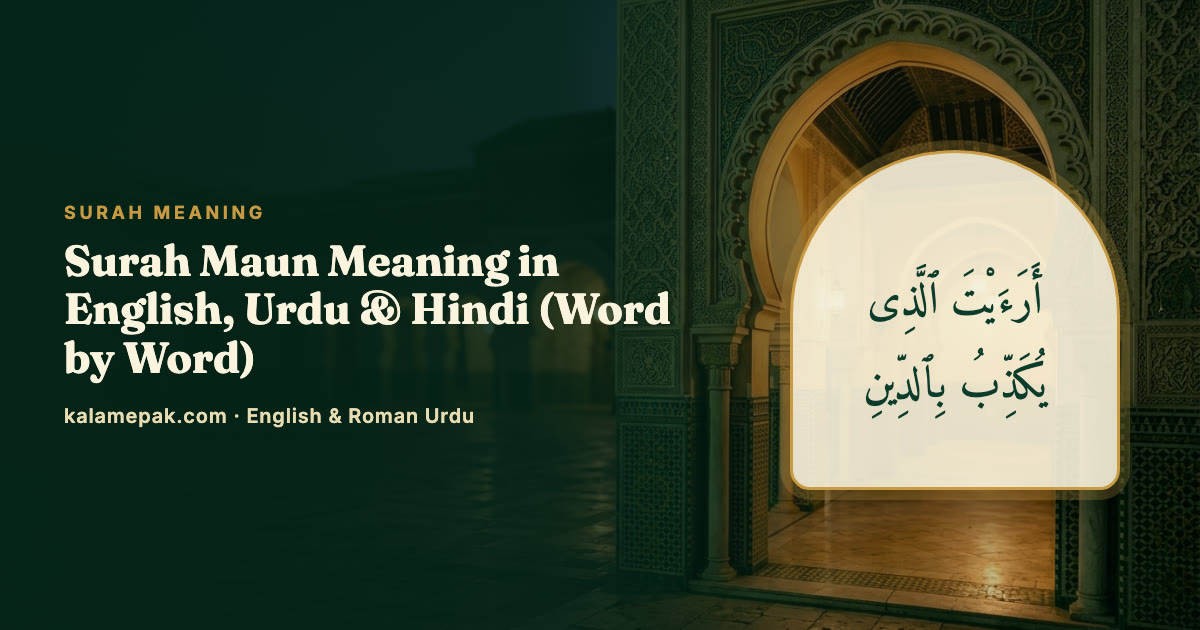
Surah Al-Ma'un (Surah 107) says, in short: Have you seen the person who denies the Day of Judgment? He is the one who pushes the orphan away and does not urge others to feed the poor. So woe to those who pray, yet are careless about their prayer, who pray only to be seen, and who refuse even small kindnesses.
That's the whole surah in plain words. Seven short verses, and it ties two things together that we often keep in separate boxes: how we pray, and how we treat people who need us.
Below you'll find every verse in Arabic with English (Pickthall) and Roman Urdu (from Maulana Junagarhi's Urdu), then a word-by-word breakdown, and a few notes on what makes this surah so sharp.
Surah Maun full text with meaning
Hast thou observed him who belieth religion?
Kya tu ne (use bhi) dekha jo (roz) jaza badla ko jhutlaata hai?
Surah Al-Ma'un · 107:1
That is he who repelleth the orphan,
Yahi woh hai jo yateem ko dhakke deta hai
Surah Al-Ma'un · 107:2
And urgeth not the feeding of the needy.
Aur miskeen gareeb ko khilaane ki targheeb shauq dilana nahi deta
Surah Al-Ma'un · 107:3
Ah, woe unto worshippers
Un namaaziyon ke liye afsos (aur wail naami Jahannam ki jagah) hai
Surah Al-Ma'un · 107:4
Who are heedless of their prayer;
Jo apni namaaz se ghaafil bekhabar hain
Surah Al-Ma'un · 107:5
Who would be seen (at worship)
Jo riyaakaari dikhawa karte hain
Surah Al-Ma'un · 107:6
Yet refuse small kindnesses!
Aur baratne istemaal karne ki cheez rokte hain
Surah Al-Ma'un · 107:7
The words in curly brackets are short explanations of harder Urdu words, so a Hindi speaker can follow along.
Surah Maun word by word — verses 1 to 3
"In the book" shows the word's number in 600 Words of the Quran and how many times that word appears in the whole Quran. Where it says "—", the word is not one of the 600, and we give its plain meaning.
| Arabic | Say it | Meaning | In the book |
|---|---|---|---|
| أَرَءَيْتَ | a-ra'ayta | have you seen? (a = question, ra'ā = saw, ta = you) | ra'ā is word #104 · 271 times |
| ٱلَّذِى | alladhī | the one who | word #8 · 1,468 times |
| يُكَذِّبُ | yukadhdhibu | denies, calls a lie | kadhdhaba, word #123 · 176 times |
| بِٱلدِّينِ | bi-d-dīn | the Judgment (Day of Recompense) | dīn, word #167 · 92 times |
| فَذَٰلِكَ | fa-dhālika | so that (is) | dhā, word #11 · 1,058 times |
| يَدُعُّ | yadu''u | pushes away roughly | — |
| ٱلْيَتِيمَ | al-yatīm | the orphan | word #455 · 23 times |
| وَلَا | wa lā | and (does) not | lā, word #3 · 1,742 times |
| يَحُضُّ | yaḥuḍḍu | urges, encourages | — |
| عَلَىٰ | ʿalā | on, towards | word #9 · 1,444 times |
| طَعَامِ | ṭaʿāmi | food, feeding | ṭaʿām, word #507 · 24 times |
| ٱلْمِسْكِينِ | al-miskīn | the poor, the needy | word #456 · 23 times |
Notice dīn in verse 1. Most of us know it as "religion" (deen), and Pickthall translates it that way here. Junagarhi takes it as roz-e-jaza, the Day of Recompense — the same dīn as in Māliki yawmi d-dīn in Surah Al-Fatiha. The book lists both meanings for word #167: "judgment; religion". Either way, the point is the same: someone who doesn't believe he will be asked about his deeds feels free to be harsh with the weak.
Word by word — verses 4 to 7
| Arabic | Say it | Meaning | In the book |
|---|---|---|---|
| فَوَيْلٌ | fa-waylun | so woe, ruin | wayl, word #177 · 40 times |
| لِّلْمُصَلِّينَ | lil-muṣallīn | for those who pray | — (same root as ṣalāh, #208) |
| ٱلَّذِينَ | alladhīna | those who | alladhī, word #8 |
| هُمْ | hum | they | pronoun |
| عَن | ʿan | about, from | word #21 · 465 times |
| صَلَاتِهِمْ | ṣalātihim | their prayer | ṣalāh, word #208 · 83 times |
| سَاهُونَ | sāhūn | heedless, careless | — |
| يُرَآءُونَ | yurā'ūn | they show off, do it to be seen | — (same root as ra'ā, #104) |
| وَيَمْنَعُونَ | wa yamnaʿūna | and they hold back, refuse | — |
| ٱلْمَاعُونَ | al-māʿūn | small kindnesses, everyday items | — |
A nice detail: yurā'ūn (showing off) comes from the same root as ra'ā, "he saw" — the very word the surah opened with. The showing-off person wants to be seen. Once you know word #104, you start spotting this family everywhere.
What Surah Maun teaches, verse by verse
Verses 1–3: belief shows in how you treat the weak. The surah doesn't describe the denier by what he says about religion. It describes him by what he does: he pushes the orphan away and doesn't even encourage others to feed the poor. The word yaḥuḍḍu means "urges". So it's not only about feeding the poor yourself — it's about not even caring enough to push others to do it.
Verse 4: the surprise. After describing a denier, you'd expect "woe to the deniers". Instead it says fa-waylun lil-muṣallīn — woe to those who pray. That's the moment the surah turns towards us.
Verse 5: "about their prayer", not "in their prayer". The Arabic says ʿan ṣalātihim — heedless about their prayer. Pickthall's "heedless of their prayer" and Junagarhi's "apni namaaz se ghaafil" both carry this. Many teachers point out the comfort in this wording: the warning is about being careless towards the prayer itself, which is different from a mind that wanders for a moment and is brought back.
Verse 6: praying to be seen. Riya (dikhawa) is when the audience matters more than Allah. A useful self-check: would I pray the same way if nobody were watching?
Verse 7: even small things. Al-māʿūn are small, ordinary kindnesses — Junagarhi calls it "baratne ki cheez", the everyday things people use and lend each other. Things that cost you almost nothing. The surah ends by saying: these people hold back even that.
So the surah draws a circle. It starts with people (the orphan, the poor), moves to prayer, and ends with people again. Prayer that doesn't soften how we treat others is exactly what it warns about.
Words you already know from other surahs
This short surah is a good example of how the same words keep coming back:
- alladhī / alladhīna (who) appears three times here. It is word #8 in the book and one of the most frequent words in the whole Quran.
- ṣalāh (prayer, #208) — the same word as in aqīmu ṣ-ṣalāh, "establish prayer".
- ra'ā (saw, #104) also appears in Surah At-Takathur: la-tarawunna l-jaḥīm, "you will surely see hellfire". See our Surah Takasur meaning article.
- dīn (#167) is the same word you say in every rakʿah in Al-Fatiha — see Surah Fatiha meaning.
When you learn a word once and then meet it again in your own namaz, it sticks. That's the whole idea behind learning the most frequent words first. The 600 words in the book are the main word in about 8 out of every 10 words of the Quran (79.8% of its 77,429 words — counting the core word, not small attached letters like wa-, bi- or pronoun endings).
A 1-minute exercise for your next namaz
- Before you start, read verses 4–7 in Roman Urdu once.
- Recite Surah Maun after Al-Fatiha.
- When you say ʿan ṣalātihim sāhūn, remind yourself: "Main is waqt namaz mein hoon — ghaafil nahi."
- After salaam, think of one māʿūn — one small kindness — you can do today for someone at home or at work.
That's it. The surah becomes a mirror instead of just sounds.
Where Surah Maun sits
Surah Al-Ma'un comes right after Surah Quraish and right before Surah Kausar. Kausar is about giving and praying (fa-ṣalli li-rabbika wa-nḥar), so reading the two together is a nice contrast: one describes people who hold back, the next describes the gift Allah gave and the response of prayer and sacrifice.
If you want to understand all the short surahs you recite in namaz, the book 600 Words of the Quran teaches the words that keep repeating in them, with a real verse for each word and meanings in English and Roman Urdu. Start with the free first lesson above.
Frequently asked questions
What is the meaning of Surah Al-Maun?
It asks: have you seen the one who denies the Day of Judgment? He pushes the orphan away and does not encourage feeding the poor. Then it warns those who pray but are heedless of their prayer, pray to be seen, and hold back even small kindnesses.
What does the word Maun mean?
Pickthall translates al-maun as 'small kindnesses'. Junagarhi's Urdu says 'baratne ki cheez' — ordinary things of daily use that people lend each other. The surah is named after this last word.
How many verses are in Surah Maun?
Seven verses. It is Surah number 107, the one right after Surah Quraish and before Surah Kausar.
Can I read Surah Maun in namaz?
Yes, it is one of the short surahs many people recite after Al-Fatiha. Knowing its meaning makes verses 4–6 hit very differently when you are standing in prayer yourself.