Surah Nas Meaning in English, Hindi & Roman Urdu (Word by Word)
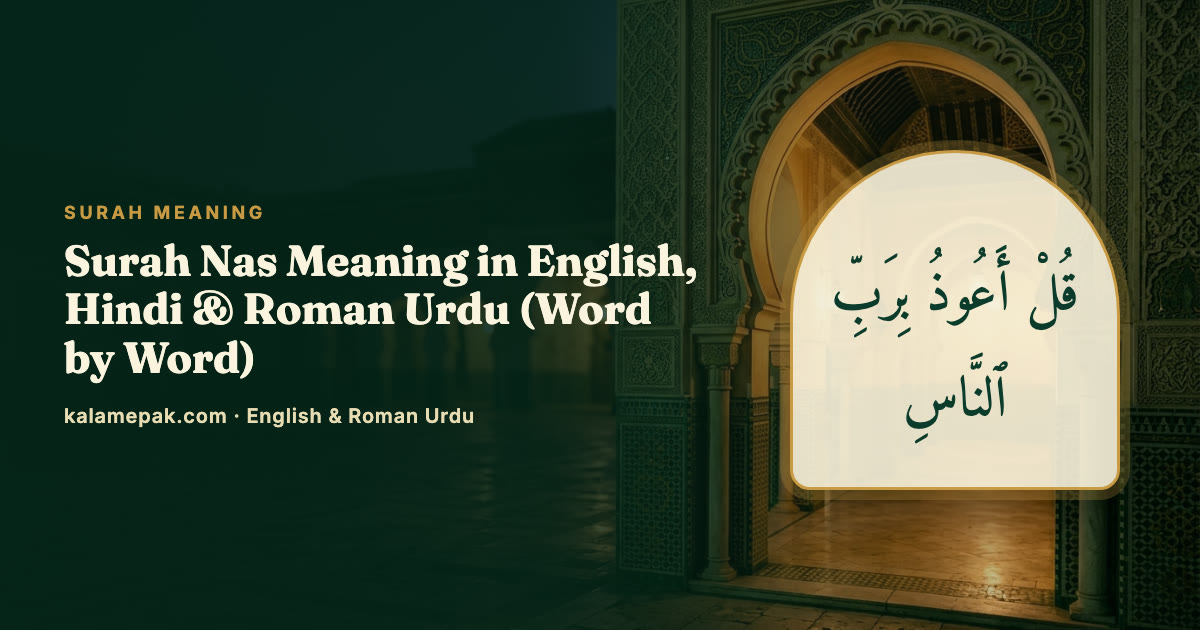
Surah Nas, the last surah of the Quran, means: "Say: I seek refuge in the Lord of mankind, the King of mankind, the God of mankind, from the evil of the sneaking whisperer, who whispers in the hearts of mankind, of the jinn and of mankind."
Notice how often "mankind" appears in that sentence? That's not the translator's style — it is the Arabic itself. The word an-nās (mankind, people) comes five times in six short verses. Learn that one word and you can already follow half of this surah by ear.
Surah Nas meaning in Roman English and English (verse by verse)
Each verse below has the Arabic, Pickthall's English, and the Roman Urdu (Roman English letters) from the book. The Roman Urdu is also how the meaning reads in Hindi.
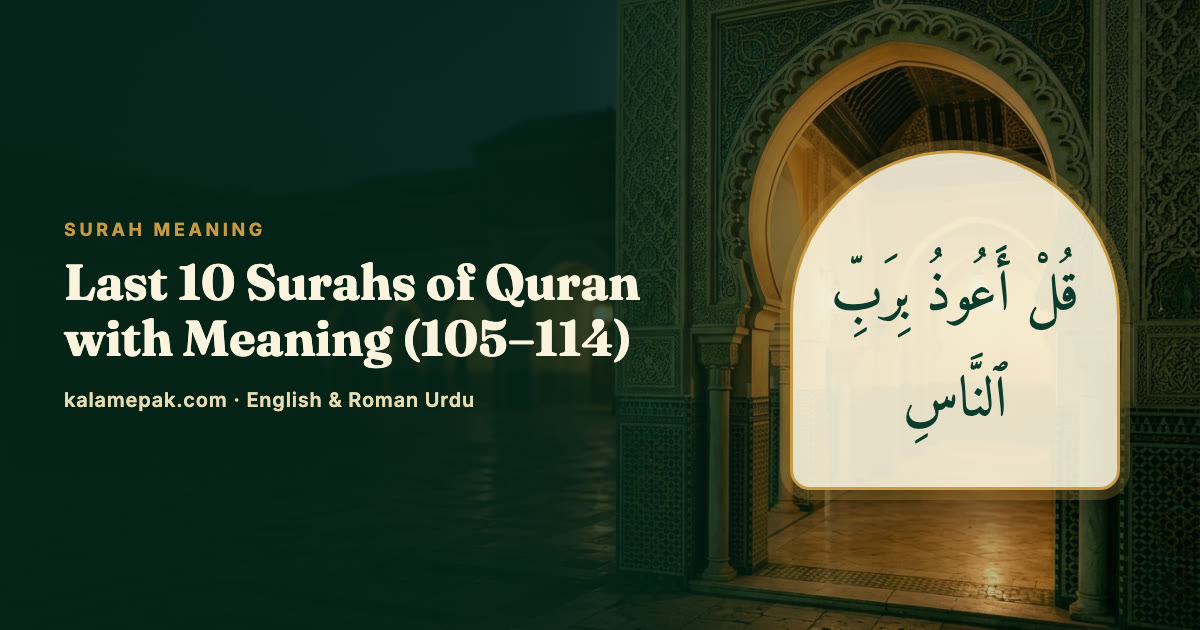
Say: I seek refuge in the Lord of mankind,
Aap keh dijiye! ke main logon ke Parwardigar paalne wale ki panaah mein aata hoon
Surah An-Nas · 114:1
The King of mankind,
Logon ke maalik ki (aur)
Surah An-Nas · 114:2
The god of mankind,
Logon ke maabood jis ki ibaadat ho ki (panaah mein)
Surah An-Nas · 114:3
From the evil of the sneaking whisperer,
Waswasa bura khayaal daalne wale peechhe hat jaane wale ke shar se
Surah An-Nas · 114:4
Who whispereth in the hearts of mankind,
Jo logon ke seenon mein waswasa daalta hai
Surah An-Nas · 114:5
Of the jinn and of mankind.
(Khwaah chaahe) woh jinn mein se ho ya insaan mein se
Surah An-Nas · 114:6
Three names in a row: Rabb, Malik, Ilah
The first three verses are a staircase. Each one calls Allah by a different title, and each ends with an-nās:
- رَبّ Rabb — Lord, the One who creates, raises and looks after (Roman Urdu: Parwardigar, paalne wala). Word #12 in the book, 975 times in the Quran.
- مَلِكِ Malik — King, the One who owns and rules (Roman Urdu: maalik).
- إِلَٰهِ Ilāh — God, the One who alone deserves worship (Roman Urdu: maabood). Word #283 in the book, 147 times in the Quran.
You already say two of these in every rakat. In Surah Al-Fatiha you praise Allah as Rabb:
Praise be to Allah, Lord of the Worlds,
Sab taareef Allah Ta'ala ke liye hai jo tamaam jahaanon ka paalne wala hai
Surah Al-Fatiha · 1:2
...and you call Him Māliki yawmi d-dīn, from the same root (m-l-k) as Malik:
Master of the Day of Judgment,
Badle ke din (yaani Qayamat) ka maalik hai
Surah Al-Fatiha · 1:4
And ilāh is the word inside the Kalima, lā ilāha illallāh — "there is no god except Allah". The same opening words also begin Ayat al-Kursi (2:255). Here they are in Surah Al-Imran:
Allah! There is no god save Him, the Alive, the Eternal.
Allah Ta'ala woh hai jis ke siwa koi maabood ibaadat ke laayaq nahi, jo zinda aur sab ka nigehbaan hifaazat karne wala hai
Surah Al-Imran · 3:2
So in Surah Nas you are not learning three new words. You are recognising three old friends, standing side by side.
Surah Nas word by word
| Arabic | Say it | Meaning | In the book |
|---|---|---|---|
| قُلْ | qul | say | from word #6 qāla — 1,618 times |
| أَعُوذُ | aʿūdhu | I seek refuge | — |
| بِرَبِّ | bi-rabbi | in the Lord (of) | bi + word #12 rabb |
| ٱلنَّاسِ | an-nās | mankind, people | word #220 — 241 times |
| مَلِكِ | maliki | the King (of) | — |
| إِلَٰهِ | ilāhi | the God (of) | word #283 — 147 times |
| مِن | min | from | word #1 — 3,226 times |
| شَرِّ | sharri | the evil (of) | word #363 — 30 times |
| ٱلْوَسْوَاسِ | al-waswās | the whisperer | — |
| ٱلْخَنَّاسِ | al-khannās | the one who slips back | — |
| ٱلَّذِى | alladhī | who | word #8 — 1,468 times |
| يُوَسْوِسُ | yuwaswisu | whispers | — |
| فِى | fī | in | word #4 — 1,701 times |
| صُدُورِ | ṣudūri | the chests / hearts (of) | plural of word #156 ṣadr — 44 times |
| ٱلْجِنَّةِ | al-jinnah | the jinn | — (don't confuse with janna, garden) |
| وَٱلنَّاسِ | wa-n-nās | and mankind | wa (and) + word #220 |
Two Urdu words hide in this table. Waswasa (an unwanted, nagging thought) comes straight from al-waswās and yuwaswisu. And ṣadr is the chest — Pickthall translates ṣudūr here as "hearts", Junagarhi as seenon (chests).
What Surah Nas teaches
Surah Al-Falaq, just before it, asks for protection from harms outside you: the dark night, magic, envy. Surah An-Nas turns inward. It asks for protection from the whisper that reaches inside — into the chest.
- The whisperer "slips back". That is the sense of al-khannās. It whispers, then retreats — especially, many scholars explain, when Allah is remembered.
- Whispers can come from jinn or from people. The last verse says so plainly: mina l-jinnati wa n-nās. A bad suggestion from a friend is also a kind of waswasa.
- Three titles for one need. You call on Allah as the One who cares for you, the One who rules over you, and the One you worship — the strongest possible refuge, for the hardest enemy to see.
When is Surah Nas commonly recited?
Together with Surah Al-Falaq it forms al-Muʿawwidhatayn, "the two surahs of seeking refuge". Many Muslims recite them, along with Surah Ikhlas, in the morning and evening, before sleeping and after namaz. It is also very common in namaz itself, after Surah Al-Fatiha, because it is short and well known.
A namaz tip: use it when your mind wanders
Almost everyone gets distracted in namaz — a bill, a message, a thought about dinner. That stray thought is exactly what this surah describes. Next time it happens, and you are reciting Surah An-Nas, let the words alladhī yuwaswisu fī ṣudūri n-nās — "who whispers in the hearts of mankind" — be your reminder. You are asking to be protected from the very thing that is distracting you.
A small exercise: count the five an-nās on your fingers the next time you recite this surah. One finger for each verse that ends with it — verses 1, 2, 3, 5 and 6.
Read next
Read this surah together with Surah Falaq meaning — they share the same opening, qul aʿūdhu bi-rabbi. The three names in this surah also appear in Allah's names in Quran words, and the Kalima line is explained in La ilaha illallah meaning. For the whole of your prayer word by word, see namaz ka tarjuma.
Rabb, nās, ilāh, ṣadr and hundreds of other repeating words are taught with real verses in 600 Words of the Quran.
Frequently asked questions
What is the meaning of Surah Nas?
Say: I seek refuge in the Lord of mankind, the King of mankind, the God of mankind, from the evil of the sneaking whisperer, who whispers in the hearts of mankind, of the jinn and of mankind.
What does 'an-nas' mean?
An-nas means 'mankind' or 'people' (Roman Urdu: log, insaan). It is word #220 in the book and appears 241 times in the Quran.
What is 'al-waswas al-khannas'?
Pickthall translates it as 'the sneaking whisperer'. Junagarhi explains it as the one who puts evil thoughts (waswasa) into the heart and then slips back.
How many verses are in Surah Nas?
Surah An-Nas is the 114th and last surah of the Quran and has 6 verses.