Inna Lillahi wa Inna Ilayhi Rajiun Meaning in Hindi & English
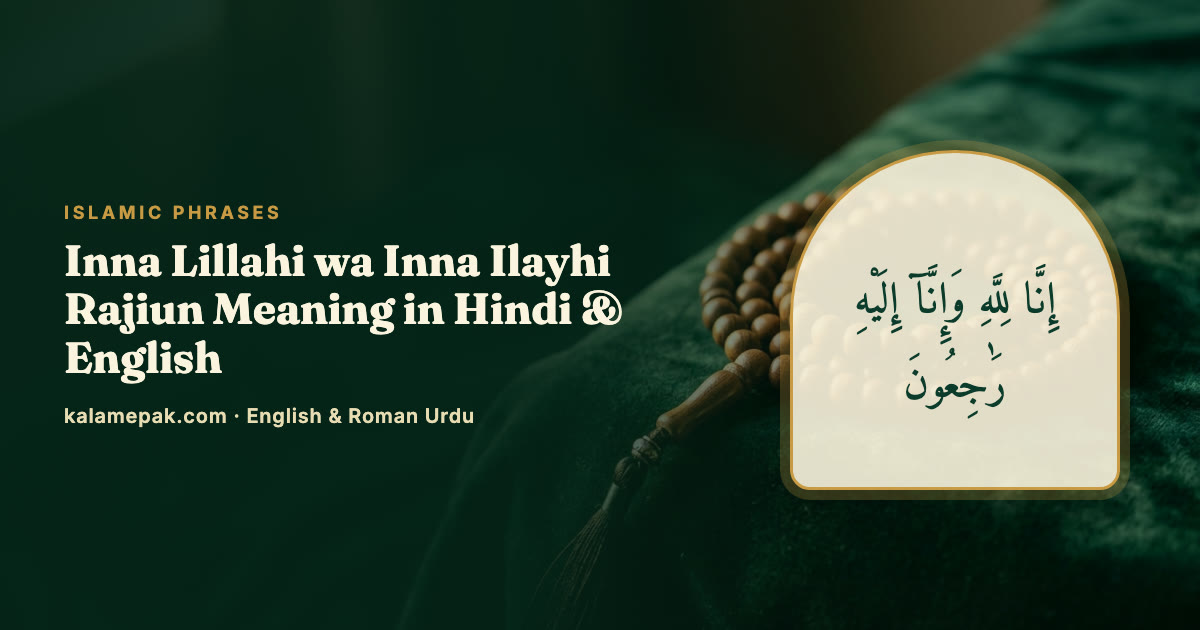
When someone hears that a person has passed away, the first words on a Muslim's tongue are usually these:
Lo! we are Allah's and lo! unto Him we are returning.
Hum to khud Allah Ta'ala ki milkiyat maal hain aur hum isi ki taraf lautne wale hain
Surah Al-Baqarah · 2:156
Inna lillahi wa inna ilayhi rajiun means: "Surely we belong to Allah, and surely to Him we will return." In simple Hindi/Urdu: "Hum Allah hi ke hain, aur usi ki taraf laut kar jaane wale hain."
It is not a hadith or a later saying — it's a line of the Quran, and the verses around it explain exactly why these words are so powerful at a moment of loss.
Inna lillahi word by word
| Arabic | Say it | Meaning | In the book |
|---|---|---|---|
| إِنَّا | innā | surely we (inna + nā "we") | inna, word #5 · 1,682 times |
| لِلَّهِ | lillāhi | belong to Allah (li = for, belonging to) | Allah, word #2 · 2,699 times |
| وَإِنَّآ | wa innā | and surely we | inna, word #5 |
| إِلَيْهِ | ilayhi | to Him (ilā + hi) | ilā, word #15 · 742 times |
| رَٰجِعُونَ | rājiʿūn | (are) returning, those who return | — (same root as rajaʿa, #262) |
Five words, and they fall into two matching halves:
- Innā lillāhi — "We belong to Allah." Our life, our family, our health, our wealth — none of it was ever truly ours. It was His, lent to us.
- wa innā ilayhi rājiʿūn — "and to Him we are returning." What was taken has gone back to its Owner — and we are on the same road.
Look at the little word li- in lillāhi. It's the same li- as in al-ḥamdu lillāh — "praise belongs to Allah." Here, we belong to Allah. That one letter carries the whole meaning of ownership. Junagarhi's Urdu makes it very clear: "hum to khud Allah Ta'ala ki milkiyat hain" — we ourselves are Allah's property.
The root of "rajiun": r-j-ʿ, to return
Rājiʿūn comes from the root r-j-ʿ, "to return". The book has two words from this family:
| Arabic | Say it | Meaning | In the book |
|---|---|---|---|
| رَجَعَ | rajaʿa | he returned | word #262 · 79 times |
| مَرْجِع | marjiʿ | return, place of return | word #501 · 16 times |
Urdu speakers know this root too: rujoo karna means to turn back to someone. And the Quran speaks of this return with great tenderness:
Return unto thy Lord, content in His good pleasure!
Tu apne Rabb ki taraf laut chal is tarah ke tu us se raazi woh tujh se khush
Surah Al-Fajr · 89:28
The same "returning" we mention in our grief is the returning that, for a soul at peace, is a welcome home.
The full context: Surah Al-Baqarah 2:155–157
Verse 156 doesn't stand alone. Read the three verses together:
And surely We shall try you with something of fear and hunger, and loss of wealth and lives and crops; but give glad tidings to the steadfast,
Aur hum kisi na kisi tarah tumhari aazmaaish zaroor karenge, dushman ke dar se, bhook pyaas se, maal-o-jaan aur phalon ki kami se aur un sabr karne walon ko khushkhabri de dijiye
Surah Al-Baqarah · 2:155
Who say, when a misfortune striketh them: Lo! we are Allah's and lo! unto Him we are returning.
Jinhein, jab kabhi koi museebat aati hai to keh diya karte hain ke hum to khud Allah Ta'ala ki milkiyat maal hain aur hum isi ki taraf lautne wale hain
Surah Al-Baqarah · 2:156
Such are they on whom are blessings from their Lord, and mercy. Such are the rightly guided.
Un par un ke Rabb ki nawaazishein mehrbaaniyaan aur rahmatein hain aur yahi log hidaayat yaafta hidaayat paaye hue hain
Surah Al-Baqarah · 2:157
So the flow is:
- 155 — the test. Fear, hunger, loss of wealth, lives and fruits. Not "if" — "We shall test you." And then: give good news to the patient.
- 156 — who the patient are. Those who, when muṣība (misfortune) hits, say innā lillāhi wa innā ilayhi rājiʿūn.
- 157 — their reward. Ṣalawāt (blessings) from their Lord, raḥma (mercy), and they are the muhtadūn — the rightly guided.
Some of the key words from these verses, all in the book:
| Arabic | Say it | Meaning | In the book |
|---|---|---|---|
| ٱلصَّٰبِرِينَ | aṣ-ṣābirīn | the patient, the steadfast | ṣābir, word #532 · 20 times |
| أَصَٰبَتْهُم | aṣābathum | (it) struck them | aṣāba, word #265 · 64 times |
| صَلَوَٰتٌ | ṣalawātun | blessings | ṣalāh, word #208 · 83 times |
| وَرَحْمَةٌ | wa raḥmatun | and mercy | raḥma, word #285 · 114 times |
| ٱلْمُهْتَدُونَ | al-muhtadūn | the rightly guided | muhtadī, word #590 · 17 times |
Notice that muṣība (misfortune — Urdu museebat) and aṣābat (it struck) come from the same root. The word museebat that we use in daily Urdu is literally "something that strikes".
When do Muslims say Inna lillahi?
- On hearing of a death — the most common use, in person, on the phone, or in a WhatsApp message.
- On any loss or hardship. The verse says "when a misfortune strikes them" — it doesn't limit it to death. A lost job, an illness, a broken plan, even a lost phone: these are all museebat, small or large, and many Muslims say it for these too.
- When remembering a loss — grief comes back in waves; the words can be said again.
It isn't a formula that stops you from feeling sad. Tears and grief are human. What the words do is place the loss in the right frame: it belonged to Allah, it has returned to Him, and so will we.
Inna lillahi meaning in Hindi and Urdu
"Inna lillahi ka matlab kya hai?"
Hum Allah hi ke hain, aur hum usi ki taraf lautne wale hain. (हम अल्लाह ही के हैं, और हम उसी की तरफ़ लौटने वाले हैं।)
When someone shares sad news, you can write the phrase and then add a short dua for the person or family in your own words.
Spelling variants people search
The same phrase is written many ways in English letters: Inna lillahi wa inna ilayhi rajiun, Inna lillahi wa inna ilaihi raji'un, Innalillahi wa inna ilaihi rojiun, Inna lillahi wa inna ilayhi raji'oon, or just Inna lillah. They are all the same Quran words. If you want to write it in Arabic, copy it from the Quran (2:156) as above.
A reflection for the next time you say it
Next time you say it — even for something small — pause on each half:
- Innā lillāhi — "this was never mine; it was His."
- wa innā ilayhi rājiʿūn — "and I'm going back to Him too."
Then remember verse 157: for those who say this with patience, there are blessings, mercy and guidance.
And one more verse to hold on to:
Lo! unto thy Lord is the return.
Yaqeenan lautna tere Rabb ki taraf hai
Surah Al-Alaq · 96:8
Learn the words behind the words
Inna, Allāh, ilā, ṣābir, raḥma, ṣalāh — almost every word in these three verses is among the most common in the Quran. The book 600 Words of the Quran teaches them one by one, each with a real verse and meanings in English and Roman Urdu. You might also find comfort in Astaghfirullah meaning, La ilaha illallah meaning and Alhamdulillah meaning.
Frequently asked questions
What is the meaning of Inna lillahi wa inna ilayhi rajiun?
It means 'Surely we belong to Allah, and surely to Him we are returning.' In Roman Urdu (from Junagarhi): 'Hum to khud Allah Ta'ala ki milkiyat hain aur hum isi ki taraf lautne wale hain.'
Where is Inna lillahi in the Quran?
Surah Al-Baqarah 2:156. Verse 155 speaks of being tested with fear, hunger and loss, verse 156 gives these words to the patient, and verse 157 promises them blessings, mercy and guidance.
Is Inna lillahi only said when someone dies?
No. It is most commonly said on hearing of a death, but the verse itself says it is what the patient say 'when a misfortune strikes them' — so it fits any loss or hardship, big or small.
What does 'rajiun' mean?
Rājiʿūn means 'those who return' or 'returning'. It comes from the root r-j-ʿ, the same root as rajaʿa (he returned), word #262 in the book, which appears 79 times in the Quran.