Rabbir Hamhuma Kama Rabbayani Sagheera Meaning: Dua for Parents (17:24)
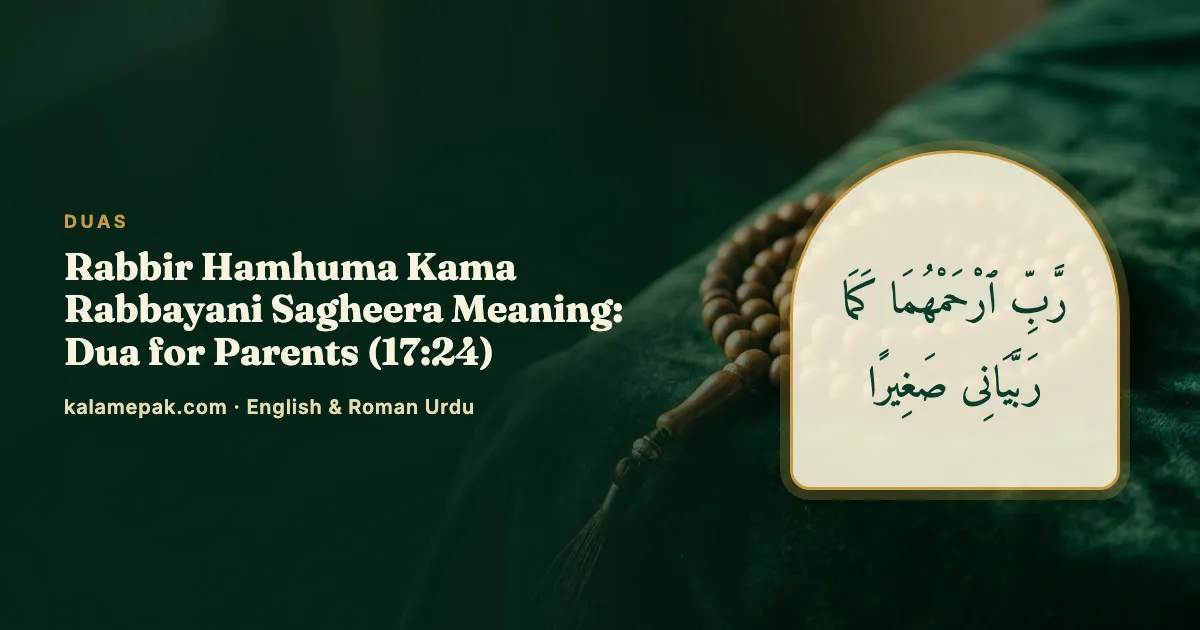
Rabbir hamhuma kama rabbayani sagheera is the dua for parents that Allah Himself puts in our mouths: Rabbir-ḥamhumā kamā rabbayānī ṣaghīrā, "My Lord, have mercy on them both as they brought me up when I was small" (Quran 17:24). Five Arabic words, and one of them, rabbayānī, carries a whole childhood: every feed, every night awake, every fever. Here is the verse with its meaning in English, Urdu, Roman Urdu and Hindi, each word, the verse before it that explains why Allah asks this of us, and the two other duas for parents in the Quran.
The ayat with meaning
And lower unto them the wing of submission through mercy, and say: My Lord! Have mercy on them both as they did care for me when I was little.
Aur aajizi aur mohabbat ke saath un ke saamne tawaazu ka baazu jhukaye rakho, aur dua karte raho ke aey mere Rabb! In dono par waisa hi rahm kar jaisa inhon ne mere bachpan mein meri parwarish ki.
Surah al-Isra · 17:24 · English: Pickthall
اور عاجزی اور محبت کے ساتھ ان کے سامنے تواضع کا بازو پست رکھے رکھنا اور دعا کرتے رہنا کہ اے میرے پروردگار! ان پر ویسا ہی رحم کر جیسا انہوں نے میرے بچپن میں میری پرورش کی ہے
और आजिज़ी और मोहब्बत के साथ उनके सामने तवाज़ो का बाज़ू झुकाए रखो, और दुआ करते रहो कि ऐ मेरे रब! इन दोनों पर वैसा ही रहम कर जैसा इन्होंने मेरे बचपन में मेरी परवरिश की।
Roman English (the dua): Rabbir-ḥamhumā kamā rabbayānī ṣaghīrā.
The English is Pickthall's and the Urdu is Muhammad Junagarhi's, both from quran.com; the Roman Urdu and Hindi are our plain rendering of the Urdu.
Word by word
The number in the last column is the word's place in 600 Words of the Quran.
| Arabic | Say it | Meaning | In the book |
|---|---|---|---|
| وَٱخْفِضْ | wakhfiḍ | and lower | |
| لَهُمَا | lahumā | for them both | |
| جَنَاحَ | janāḥa | the wing | |
| ٱلذُّلِّ | adh-dhulli | of humility | |
| مِنَ ٱلرَّحْمَةِ | minar-raḥmati | out of mercy | raḥma #285 |
| وَقُل | wa qul | and say | qāla #6 |
| رَّبِّ | Rabbi | my Lord | rabb #12 |
| ٱرْحَمْهُمَا | irḥamhumā | have mercy on them both | raḥima #298 |
| كَمَا | kamā | as, just as | mā #7 |
| رَبَّيَانِى | rabbayānī | they two brought me up | rabb #12 |
| صَغِيرًا | ṣaghīrā | small, little |
Look at Rabbi and rabbayānī side by side. Both come from the same root, r-b-b: a rabb is the one who owns, sustains and brings something to its full growth, and rabbā is to raise a child. So the dua says: O my Rabb, they were my rabb in small, do for them what they did for me. The suffix -humā on irḥamhumā and lahumā is the dual, "the two of them"; Arabic has a special form for exactly two, and the Quran uses it here so that neither parent is left out of the dua.
The verse before it (17:23)
Thy Lord hath decreed, that ye worship none save Him, and (that ye show) kindness to parents. If one of them or both of them attain old age with thee, say not "Fie" unto them nor repulse them, but speak unto them a gracious word.
Aur tere Rabb ne saaf hukm de diya hai ke us ke siwa kisi ki ibadat na karo aur maa baap ke saath ehsaan karo. Agar teri maujoodgi mein un mein se ek ya dono budhaape ko pahunch jaayen to unhen "uff" tak na kaho, na unhen jhidko, balke un se adab aur ehteram se baat karo.
Surah al-Isra · 17:23 · English: Pickthall
اور تیرا پروردگار صاف صاف حکم دے چکا ہے کہ تم اس کے سوا کسی اور کی عبادت نہ کرنا اور ماں باپ کے ساتھ احسان کرنا۔ اگر تیری موجودگی میں ان میں سے ایک یا یہ دونوں بڑھاپے کو پہنچ جائیں تو ان کے آگے اف تک نہ کہنا، نہ انہیں ڈانٹ ڈپٹ کرنا بلکہ ان کے ساتھ ادب و احترام سے بات چیت کرنا
The order matters. Allah puts bil-wālidayni iḥsānā, kindness to parents, in the same sentence as worshipping Him alone, and then forbids even uff, the smallest sound of irritation. The dua in 17:24 comes right after, as the thing you say instead of uff. Iḥsān (#254 aḥsan, #563 aḥsana in the book) is not just good treatment; it is doing a thing beautifully.
Two more duas for parents in the Quran
Our Lord! Forgive me and my parents and believers on the day when the account is cast.
Aey hamare Rabb! Mujhe bakhsh de aur mere maa baap ko bhi, aur tamaam momino ko bhi, jis din hisaab qaayam hoga.
Ibrahim's dua · Surah Ibrahim · 14:41 · English: Pickthall
My Lord! Forgive me and my parents and him who entereth my house believing, and believing men and believing women.
Aey mere Rabb! Mujhe aur mere maa baap ko bakhsh de, aur jo bhi imaan ki haalat mein mere ghar mein aaye use, aur tamaam momin mardon aur momin auraton ko.
Nuh's dua · Surah Nuh · 71:28 (first part) · English: Pickthall
17:24 asks raḥma (mercy); 14:41 and 71:28 ask maghfira (forgiveness, from ghafara #130). Many people read all three together after namaz, mercy first, then forgiveness. Wālidayya, "my two parents", is again the dual. The ten Rabbana duas, 14:41 among them, are on Rabbana duas from the Quran.
For parents who have passed away
The verse says nothing about living or dead, so the dua is for both. The Prophet ﷺ said that when a person dies his deeds end except three, and one of them is a righteous child who prays for him (Sahih Muslim 1631). So Rabbir-ḥamhumā is one of the few things you can still do for a parent after the janaza. Read it after every namaz; it takes four seconds.
Other short "Rabbi" duas
The Quran has several duas that begin Rabbi, "my Lord", in this same short shape: Rabbi zidni ilma (increase me in knowledge, 20:114), Rabbish rahli sadri (Musa's dua, 20:25) and Rabbi inni lima anzalta (28:24). Learn the word Rabb once and all of them open.
Sources: Quran text from the Quranic Arabic Corpus and Tanzil · verse meanings in English from Marmaduke Pickthall and in Urdu from Maulana Muhammad Junagarhi · meanings of duas and phrases in Roman Urdu, Urdu and Hindi are our own plain renderings · hadith with collection and number, linked to sunnah.com. How we check every article →
Frequently asked questions
What does Rabbir hamhuma kama rabbayani sagheera mean?
My Lord, have mercy on them both as they brought me up when I was small. It is the end of Quran 17:24 (Surah al-Isra), and Allah tells us to say it for our parents.
Rabbir hamhuma meaning in Urdu?
اے میرے رب! ان دونوں پر رحم فرما جیسے انہوں نے بچپن میں میری پرورش کی۔ Junagarhi: اے میرے پروردگار! ان پر ویسا ہی رحم کر جیسا انہوں نے میرے بچپن میں میری پرورش کی ہے۔
Rabbir hamhuma meaning in Hindi?
ऐ मेरे रब! इन दोनों पर रहम फ़रमा जैसे इन्होंने बचपन में मेरी परवरिश की। Read the Arabic; this is its meaning.
Can I read this dua for parents who have passed away?
Yes. The verse does not limit it to living parents, and the Prophet ﷺ said a righteous child's dua continues to benefit a parent after death (Sahih Muslim 1631). For the dead, 14:41 and 71:28 (forgive me and my parents) are also read.
Which other duas for parents are in the Quran?
Rabbanaghfirli wa liwalidayya wa lil-mu'minina yawma yaqumul hisab, Ibrahim's dua (14:41), and Rabbighfirli wa liwalidayya wa liman dakhala baytiya mu'minan, Nuh's dua (71:28). Both ask forgiveness for the parents; 17:24 asks mercy.