Rabbish Rahli Sadri Meaning in Urdu, Hindi & English (Word by Word)
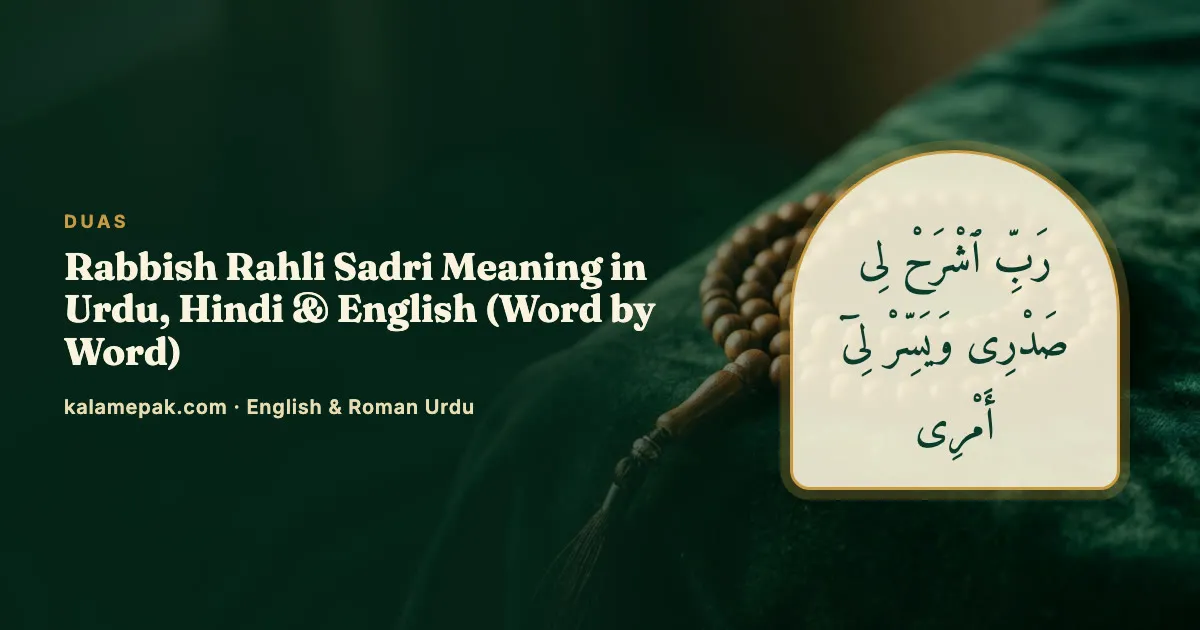
Rabbish rahli sadri wa yassirli amri is the dua of Musa (AS) at the hardest moment of his life: Allah has just told him to go to Firaun. He does not ask for an army. He asks for an open chest, an easy task, and a tongue that people can understand. In English: "My Lord! Relieve my mind, and ease my task for me, and loose a knot from my tongue, that they may understand my saying" (Quran 20:25–28). It is four short verses, and it is the dua for anyone who has to speak and is afraid. Here are all four in Arabic with English, Urdu, Roman Urdu and Hindi, then every word.
Rabbish rahli sadri in Arabic with meaning
(Moses) said: My Lord! relieve my mind
Musa (AS) ne kaha: Aey mere parwardigar! Mera seena mere liye khol de
Surah Taha · 20:25
And ease my task for me;
Aur mere kaam ko mujh par aasaan kar de
Surah Taha · 20:26
And loose a knot from my tongue,
Aur meri zabaan ki girah bhi khol de
Surah Taha · 20:27
That they may understand my saying.
Taake log meri baat achhi tarah samajh sakein
Surah Taha · 20:28
Meaning in Urdu
موسیٰ (علیہ السلام) نے کہا اے میرے پروردگار! میرا سینہ میرے لئے کھول دے.
اور میرے کام کو مجھ پر آسان کر دے.
اور میری زبان کی گره بھی کھول دے.
تاکہ لوگ میری بات اچھی طرح سمجھ سکیں.
Meaning in Hindi
मूसा (अलैहिस्सलाम) ने कहा: ऐ मेरे परवरदिगार! मेरा सीना मेरे लिए खोल दे।
और मेरे काम को मुझ पर आसान कर दे।
और मेरी ज़बान की गिरह भी खोल दे।
ताकि लोग मेरी बात अच्छी तरह समझ सकें।
The English is Pickthall's translation, the Urdu is Maulana Muhammad Junagarhi's, and the Roman Urdu and Hindi are that Urdu line in English and Devanagari letters.
Roman English: Rabbi-shraḥ lī ṣadrī. Wa yassir lī amrī. Wa-ḥlul ʿuqdatan min lisānī. Yafqahū qawlī.
Word by word
| Arabic | Say it | Meaning | In the book |
|---|---|---|---|
| رَبِّ | rabbi | my Lord | rabb #12 |
| ٱشْرَحْ | ishraḥ | open, expand | |
| لِي | lī | for me | |
| صَدْرِي | ṣadrī | my chest | ṣadr #156 |
| وَيَسِّرْ | wa yassir | and make easy | |
| أَمْرِي | amrī | my task, my matter | amr #83 |
| وَٱحْلُلْ | wa-ḥlul | and untie, loosen | |
| عُقْدَةً | ʿuqdatan | a knot | |
| مِّن لِّسَانِي | min lisānī | from my tongue | lisān #320 |
| يَفْقَهُوا۟ | yafqahū | (so that) they understand | faqiha #547 |
| قَوْلِي | qawlī | my speech, my words | qawl #307 |
Ishraḥ ṣadrī, "open my chest", is the same root as the name of Surah 94, Alam Nashrah ("Have We not opened your chest?"), where Allah tells the Prophet ﷺ that He has already done for him what Musa (AS) asked for. Read the two together: Surah Alam Nashrah meaning.
The four requests, one by one
- An open chest (ishraḥ lī ṣadrī). Not courage from outside, but room inside: no tightness, no panic. This is the first thing you need before a hard conversation.
- An easy task (yassir lī amrī). Amr is "matter, affair, command"; it is the same word as in Dua e Istikhara (hādhā l-amr, "this matter").
- A loosened tongue (wa-ḥlul ʿuqdatan min lisānī). Many commentators mention that Musa (AS) had difficulty in speech; whatever its cause, he names it honestly and asks Allah to untie it.
- Being understood (yafqahū qawlī). The goal is not to sound good; it is that they understand. Yafqahū is from the same root as fiqh, deep understanding.
When people read this dua
- Before a presentation, interview, viva, speech or khutbah.
- Before teaching, or before reciting the Quran in front of others.
- By those who stammer or find speaking difficult, and by parents on behalf of children who are learning to speak.
- Before a difficult conversation with someone you fear.
The Quran gives no fixed count. Musa (AS) said it once, and then he went. Read it with the meaning in mind, then do the thing you were afraid of. For the dua he said later, when he had nothing and no one, read Rabbi inni lima anzalta.
The Rabbi dua that Allah Himself tells us to say, for our parents, is Rabbir hamhuma kama rabbayani sagheera (17:24).
Sources: Quran text from the Quranic Arabic Corpus and Tanzil · verse meanings in English from Marmaduke Pickthall and in Urdu from Maulana Muhammad Junagarhi · meanings of duas and phrases in Roman Urdu, Urdu and Hindi are our own plain renderings · hadith with collection and number, linked to sunnah.com. How we check every article →
Frequently asked questions
What does Rabbish rahli sadri mean?
My Lord! Relieve my mind (open my chest for me), and ease my task for me, and loose a knot from my tongue, that they may understand my saying (Quran 20:25–28, Pickthall).
Who said this dua?
Musa (AS), when Allah commanded him to go to Firaun (Pharaoh). It is in Surah Taha, verses 25 to 28, right after the command in verse 24.
When should I read Rabbish rahli sadri?
Before anything where you must speak or be understood: a presentation, an interview, a class, a difficult conversation, or before reciting in front of people. It is also read by those who find speaking hard.
Is it four verses or one dua?
Both. Verses 25, 26, 27 and 28 of Surah Taha are each one short line, and together they make one dua. Most people learn all four together.