Hasbunallahu Wa Ni'mal Wakeel Meaning in Urdu (Quran 3:173)
Reviewed by Abrar Iqbal, Islamic scholar (PhD in Islamic research)
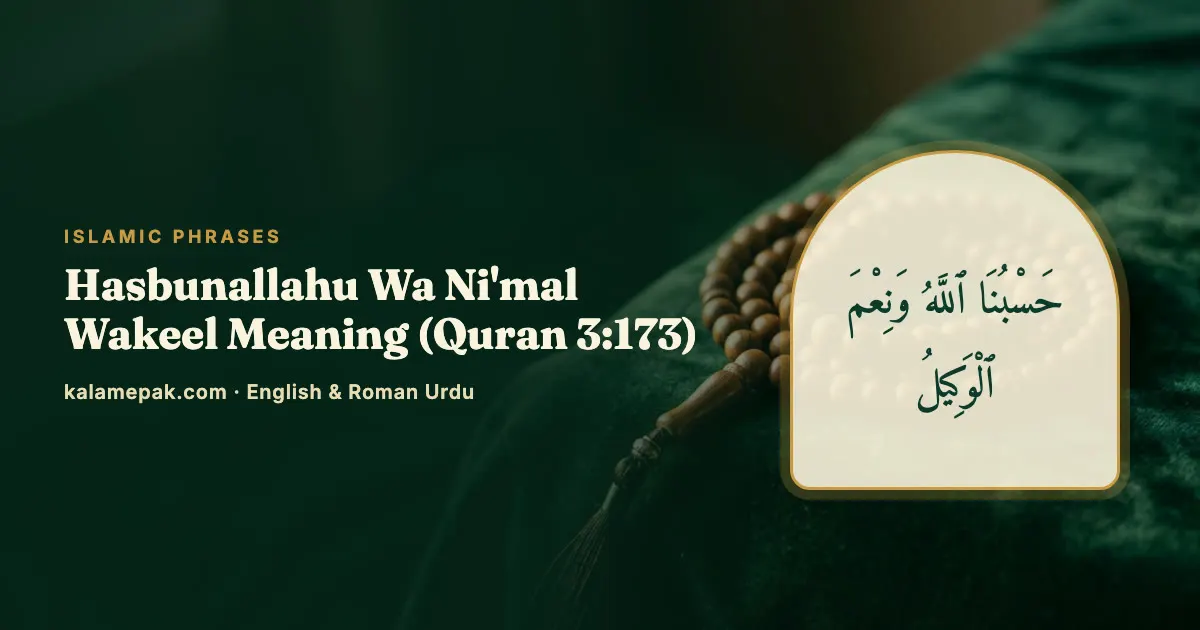
Hasbunallahu wa ni'mal wakeel means "Allah is sufficient for us, and He is the best One to trust." In Pickthall's translation: "Allah is Sufficient for us! Most Excellent is He in Whom we trust!" In Urdu, Maulana Junagarhi translates it: Humein Allah kaafi hai aur woh bahut achha kaarsaaz hai.
It is not only a dua. It is a verse of the Quran (3:173), and it was said at two of the hardest moments in the lives of two prophets.
Allah is Sufficient for us! Most Excellent is He in Whom we trust!
Humein Allah kaafi hai aur woh bahut achha kaarsaaz hai
Surah Al Imran · 3:173 (part)
How to say it: Ḥasbunallāhu wa niʿmal-wakīl. Common spellings: Hasbunallah wa nimal wakeel, Hasbunallahu wa ni'mal wakil, Hasbunallah wa ni'mal wakeel.
Hasbunallah in Urdu and Hindi
ہمیں اللہ کافی ہے اور وہ بہت اچھا کارساز ہے
हमें अल्लाह काफ़ी है और वो बहुत अच्छा कारसाज़ है
Urdu: Maulana Junagarhi (3:173) · Hindi: the same words in Devanagari
In Hindi script the Arabic is read: हस्बुनल्लाहु व निअ्मल वकील. Kaarsaaz (कारसाज़) means the one who arranges and takes care of your affairs.
Word by word
| Arabic | Say it | Meaning | In the book |
|---|---|---|---|
| حَسْبُنَا | ḥasbunā | (is) enough for us | root of #114 ḥasiba |
| ٱللَّهُ | Allāhu | Allah | #2 · 2,699× |
| وَنِعْمَ | wa niʿma | and how excellent | #535 niʿma · 18× |
| ٱلْوَكِيلُ | al-wakīlu | the One trusted (with our affairs) | #301 wakīl · 24× |
"In the book" is the word's number in 600 Words of the Quran and how many times it appears in the Quran.
- Ḥasb means "enough, sufficient". Ḥasbunā = "our sufficiency", "enough for us". It shares a root with ḥasiba (he thought, reckoned) and ḥisāb (account).
- Wakīl is the one you hand your affairs to and trust completely. Urdu uses the same word: a wakeel is the lawyer you trust to speak for you. The Quran uses it for Allah: the One you can leave everything with.
The verse it comes from
Those unto whom men said: Lo! the people have gathered against you, therefor fear them. (The threat of danger) but increased the faith of them and they cried: Allah is Sufficient for us! Most Excellent is He in Whom we trust!
Woh log ke jab un se logon ne kaha ke kaafiron ne tumhaare muqaable par lashkar jama kar liye hain, tum un se khauf khaao, to is baat ne unhein imaan mein aur badha diya aur kehne lage: humein Allah kaafi hai aur woh bahut achha kaarsaaz hai
Surah Al Imran · 3:173
Look at what happened: they were told to be afraid, and the news increased their faith (fa-zādahum īmānan). Fear pushed them closer to Allah, not away from Him. Both zāda (he increased, #62) and īmān (faith, #136) are in our 600-word list.
Who said it: two prophets
Ibn Abbas explained: "'Allah is Sufficient for us and He is the Best Disposer of affairs' was said by Abraham when he was thrown into the fire; and it was said by Muhammad when they (…) said, 'A great army is gathering against you, therefore, fear them'" (Sahih al-Bukhari 4563, English from sunnah.com).
Ibrahim (peace be upon him) facing the fire, and the Prophet Muhammad ﷺ facing an army: the same words. If those words were enough for them in those moments, they are enough for our smaller fears too.
Hasbiyallah: "Allah is enough for me"
The singular form is also in the Quran, at the end of Surah At-Tawbah:
Now, if they turn away (O Muhammad) say: Allah sufficeth me. There is no God save Him. In Him have I put my trust, and He is Lord of the Tremendous Throne.
Phir agar ro-gardaani karein to aap keh dijiye ke mere liye Allah kaafi hai, us ke siwa koi maabood nahin. Main ne usi par bharosa kiya aur woh bade arsh ka maalik hai
Surah At-Tawbah · 9:129
| Hasbunallah | Hasbiyallah | |
|---|---|---|
| Arabic | حَسْبُنَا ٱللَّهُ | حَسْبِىَ ٱللَّهُ |
| Means | Allah is enough for us | Allah is enough for me |
| In the Quran | 3:173, said by the believers together | 9:129, taught to the Prophet ﷺ: "say…" |
A promise in the Quran
Saying ḥasbunallāh is trust. The Quran also tells us what Allah does for the one who trusts Him:
And whosoever putteth his trust in Allah, He will suffice him.
Aur jo shakhs Allah par tawakkul karega Allah use kaafi hoga
Surah At-Talaq · 65:3 (part)
The same word, ḥasb, again: fa-huwa ḥasbuh, "He is enough for him."
When to say Hasbunallahu wa ni'mal wakeel
- When you are afraid, of people, of news, of what might happen. That is the setting of 3:173.
- When you have done what you can and the result is out of your hands: an interview, an illness, a court case.
- When someone wrongs you and you cannot fix it yourself. You hand the matter to the best wakīl.
You may see messages online saying to read it a certain number of times. The verse and the hadith above do not set a number; what they show is the trust behind the words.
For other words of trust and reliance, see La hawla wala quwwata illa billah, Inna lillahi wa inna ilayhi rajiun and the names of Allah used most in the Quran. The words wakīl, niʿma, īmān and zāda from this verse are all taught in 600 Words of the Quran, each with a real verse in English and Roman Urdu.
Sources: Quran text from the Quranic Arabic Corpus and Tanzil · verse meanings in English from Marmaduke Pickthall and in Urdu from Maulana Muhammad Junagarhi · meanings of duas and phrases in Roman Urdu, Urdu and Hindi are our own plain renderings · hadith with collection and number, linked to sunnah.com. How we check every article →
Frequently asked questions
What does Hasbunallahu wa ni'mal wakeel mean?
Allah is sufficient for us, and He is the best One to trust. Pickthall translates it: 'Allah is Sufficient for us! Most Excellent is He in Whom we trust!' In Urdu (Junagarhi): 'Humein Allah kaafi hai aur woh bahut achha kaarsaaz hai.'
Where is Hasbunallahu wa ni'mal wakeel in the Quran?
In Surah Al Imran, verse 173 (3:173).
Who said Hasbunallahu wa ni'mal wakeel?
Ibn Abbas said that Ibrahim (peace be upon him) said it when he was thrown into the fire, and the Prophet Muhammad ﷺ said it when he was told, 'A great army is gathering against you' (Sahih al-Bukhari 4563).
What is the difference between Hasbunallah and Hasbiyallah?
Hasbuna means 'sufficient for us'; hasbi means 'sufficient for me'. Hasbiyallah is in the Quran in 9:129: 'Allah sufficeth me. There is no God save Him.'