Inshallah Meaning in Hindi, Urdu & English (In sha Allah)
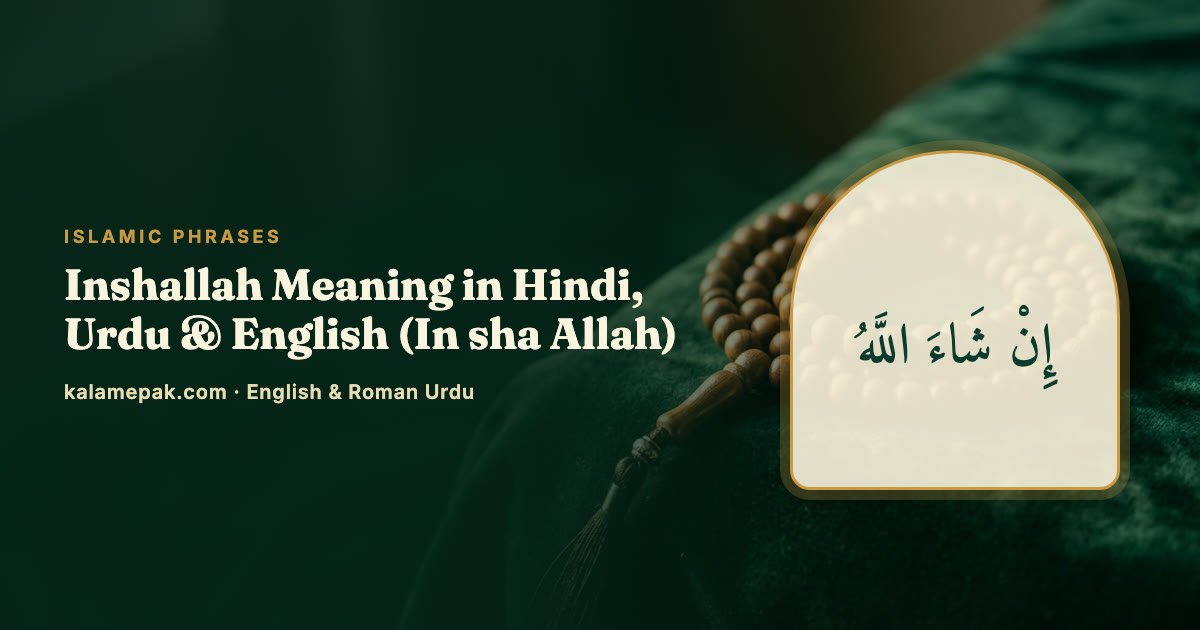
Inshallah means "if Allah wills." In Hindi and Urdu: "agar Allah ne chaha." Muslims say it whenever they talk about something they plan to do in the future — "I'll come tomorrow, inshallah" — as a reminder that nothing happens unless Allah wills it.
If Allah wills
Agar Allah ne chaha
In shāʾa llāh
It's probably the most-used Islamic phrase in everyday speech in India and Pakistan — even non-Muslims pick it up. But it comes from a specific instruction in the Quran, and the three little words inside it are worth knowing.
Inshallah word by word
| Arabic | Say it | Meaning | In the book |
|---|---|---|---|
| إِنْ | in | if | in, word #16 · 703 times |
| شَاءَ | shā'a | (He) willed, wished | shā'a, word #105 · 236 times |
| اللَّهُ | Allāhu | Allah | Allah, word #2 · 2,699 times |
Three words, all from the list of the most common words of the Quran. Literally: "if willed Allah" → "if Allah wills".
A detail Urdu speakers will enjoy: shā'a (to will) and shay' (thing, Urdu shai) come from the same root, sh-y-'. In the book, shay' is word #143 and appears 283 times. You'll see both in the Quran verse below — one right after the other.
Inshallah meaning in Hindi
"Inshallah ka matlab kya hai?" — the direct answer:
Inshallah = agar Allah ne chaha (अगर अल्लाह ने चाहा).
It's used for the future: "Main kal aaunga, inshallah" — I'll come tomorrow, if Allah wills. It's not a way to say "maybe" or a polite "no". Saying it means: I intend to do this, and I know it happens only if Allah wills.
The Quran verse behind Inshallah (Surah Al-Kahf 18:23–24)
This is where the practice comes from. In Surah Al-Kahf, Allah says:
And say not of anything: Lo! I shall do that tomorrow,
Aur hargiz hargiz kisi kaam par yun na kehna ke main ise kal karunga
Surah Al-Kahf · 18:23
Except if Allah will. And remember thy Lord when thou forgettest, and say: It may be that my Lord guideth me unto a nearer way of truth than this.
Magar saath hi InshaAllah keh lena. Aur jab bhi bhoole, apne Parwardigar ki yaad kar liya karna aur kehte rehna ke mujhe poori ummeed hai ke mera Rabb mujhe is se bhi zyaada hidaayat ke qareeb ki baat ki rehbari kare
Surah Al-Kahf · 18:24
Look at the words of verse 24 more closely:
| Arabic | Say it | Meaning | In the book |
|---|---|---|---|
| إِلَّآ | illā | except | word #17 · 659 times |
| أَن | an | that | word #18 · 616 times |
| يَشَآءَ | yashā'a | (He) wills | shā'a, word #105 |
| ٱللَّهُ | Allāhu | Allah | word #2 |
| وَٱذْكُر | wa-dhkur | and remember | dhakara, word #207 · 84 times |
| رَّبَّكَ | rabbaka | your Lord | rabb, word #12 · 975 times |
| نَسِيتَ | nasīta | you forgot | nasiya, word #117 · 35 times |
Notice that the Quran's wording here is illā an yashā'a llāh — "except that Allah wills". The everyday formula in shā'a llāh ("if Allah wills") carries exactly that meaning, and Junagarhi's Urdu translation simply renders it as "InshaAllah keh lena".
And there's mercy in the next line: wa-dhkur rabbaka idhā nasīta — "remember your Lord when you forget." If you forgot to say it, remember Allah when you realise.
"In sha Allah" in the words of the prophets
The exact phrase in shā'a llāh is spoken in the Quran by prophets and righteous people, always about the future. The most moving is the reply of Prophet Ibrahim's son when told of the dream of sacrifice:
Allah willing, thou shalt find me of the steadfast.
InshaAllah aap mujhe sabr karne walon mein se paayenge
Surah As-Saffat · 37:102
Even at that moment, he didn't say "I will be patient" — he said "you will find me patient, if Allah wills." Prophet Musa uses almost the same words to the knowledgeable servant of Allah he travels with (known as Khidr) in Surah Al-Kahf (18:69), and Prophet Yusuf says it when welcoming his family into Egypt (12:99). The Quran also uses it in 48:27 about the believers entering Masjid al-Haram.
Inshallah spelling: Inshallah, In sha Allah or InshaAllah?
This is one of the most-searched questions about the phrase. Here's the calm version:
- In English letters, Inshallah, InshaAllah, Insha'Allah and In sha Allah all mean the same thing, and everyone understands them.
- In sha Allah (three parts) shows the real structure best: in (if) + shā'a (willed) + Allāh. That's why many teachers prefer it.
- In Arabic script, it should always be written as three separate words: إِنْ شَاءَ اللَّهُ. Joining them into one Arabic word changes the spelling into a different word, so avoid that when writing in Arabic.
For Hindi writing, इंशाअल्लाह or इन शा अल्लाह are both common.
Inshallah vs Mashallah
People mix these up, so here's a simple rule:
| Inshallah | Mashallah | |
|---|---|---|
| Arabic | إِنْ شَاءَ اللَّهُ | مَا شَاءَ اللَّهُ |
| Meaning | If Allah wills | What Allah has willed |
| Roman Urdu | Agar Allah ne chaha | Jo Allah ne chaha |
| Time | Future | Something already here |
| Example | "Exam kal hai, inshallah achha hoga." | "Aapka beta bahut samajhdaar hai, mashallah." |
The only difference in Arabic is the first word: in (if) versus mā (what). Both share shā'a and Allāh. Read more in our Mashallah meaning article.
When to say Inshallah
- Making plans: "I'll call you tonight, inshallah."
- Hopes: "Inshallah, next year we'll go for Umrah."
- Promises: say it and try your best to keep the promise. The verse is about relying on Allah, not about avoiding commitment.
A small habit to build
For one week, notice every time you say "kal", "tomorrow", "next week" or "I will". Add inshallah — and in that second, think the Urdu: agar Allah ne chaha. That's 18:23–24 put into practice, in your own words.
The words inside this phrase — in, shā'a, Allāh, illā, an — are among the most common in the entire Quran. The book 600 Words of the Quran teaches them with a real verse each and Roman Urdu meaning. Other everyday phrases worth knowing next: SubhanAllah, Alhamdulillah and Bismillah.
Frequently asked questions
What does Inshallah mean?
Inshallah (in shāʾa llāh) means 'if Allah wills'. In Hindi and Urdu: 'agar Allah ne chaha'. Muslims say it when talking about something they plan or hope to do in the future.
Is it Inshallah or In sha Allah?
In English letters both are understood and used. The phrase is three Arabic words — in (if), shāʾa (willed) and Allāh — so 'In sha Allah' shows the structure more clearly. In Arabic script it is written as three separate words.
Where is Inshallah in the Quran?
Surah Al-Kahf 18:23–24 teaches not to say 'I will do that tomorrow' without adding 'except if Allah wills'. The exact words in shāʾa llāh are also spoken by prophets in verses like 12:99, 18:69 and 37:102.
What is the difference between Inshallah and Mashallah?
Inshallah looks forward — 'if Allah wills', about the future. Mashallah looks at what has already happened — 'what Allah has willed', said when you see something good.