Surah Alam Nashrah Meaning in English, Roman Urdu, Urdu & Hindi (Word by Word)
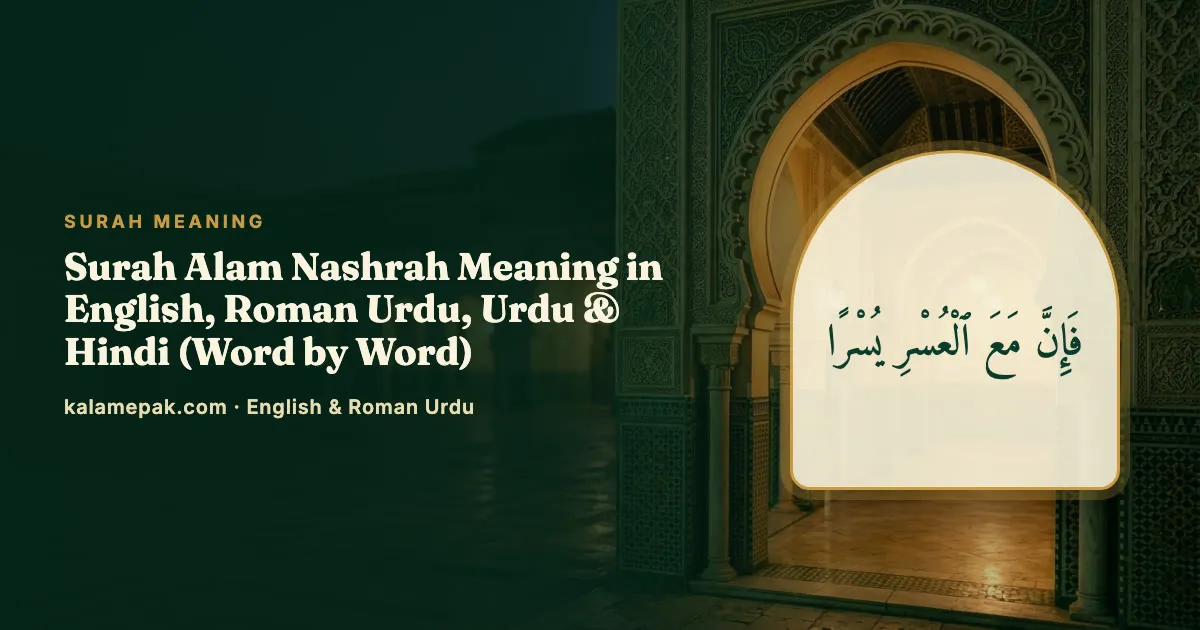
Surah Alam Nashrah (surah 94, also called Al-Inshirah or Ash-Sharh, "The Opening of the Chest") is eight verses that answer a tired heart. Allah reminds the Prophet ﷺ: did We not open your chest, lift your burden, raise your name? Then the line everyone knows, said twice: "Lo! with hardship goeth ease." It continues the subject of Surah Duha, and many people recite the two together. Below are all eight verses in Arabic with English (Pickthall), Roman Urdu, Urdu (Maulana Junagarhi) and Hindi, then the words.
Surah Alam Nashrah with meaning, verse by verse
Have We not caused thy bosom to dilate,
Kya hum ne tera seena nahin khol diya?
Surah Al-Inshirah (Alam Nashrah) · 94:1
And eased thee of the burden
Aur tujh par se tera bojh hum ne utaar diya
Surah Al-Inshirah (Alam Nashrah) · 94:2
Which weighed down thy back;
Jis ne teri peeth tod di thi
Surah Al-Inshirah (Alam Nashrah) · 94:3
And exalted thy fame?
Aur hum ne tera zikr buland kar diya
Surah Al-Inshirah (Alam Nashrah) · 94:4
But lo! with hardship goeth ease,
Pas yaqeenan mushkil ke saath aasaani hai
Surah Al-Inshirah (Alam Nashrah) · 94:5
Lo! with hardship goeth ease;
Beshak mushkil ke saath aasaani hai
Surah Al-Inshirah (Alam Nashrah) · 94:6
So when thou art relieved, still toil
Pas jab tu faarigh ho to ibaadat mein mehnat kar
Surah Al-Inshirah (Alam Nashrah) · 94:7
And strive to please thy Lord.
Aur apne parwardigar hi ki taraf dil laga
Surah Al-Inshirah (Alam Nashrah) · 94:8
Surah Alam Nashrah meaning in Urdu
کیا ہم نے تیرا سینہ نہیں کھول دیا.
اور تجھ پر سے تیرا بوجھ ہم نے اتار دیا.
جس نے تیری پیٹھ توڑ دی تھی.
اور ہم نے تیرا ذکر بلند کر دیا.
پس یقیناً مشکل کے ساتھ آسانی ہے.
بیشک مشکل کے ساتھ آسانی ہے.
پس جب تو فارغ ہو تو عبادت میں محنت کر.
اور اپنے پروردگار ہی کی طرف دل لگا.
Surah Alam Nashrah meaning in Hindi
क्या हमने तेरा सीना नहीं खोल दिया?
और तुझ पर से तेरा बोझ हमने उतार दिया
जिसने तेरी पीठ तोड़ दी थी
और हमने तेरा ज़िक्र बुलंद कर दिया
पस यक़ीनन मुश्किल के साथ आसानी है
बेशक मुश्किल के साथ आसानी है
पस जब तू फ़ारिग़ हो तो इबादत में मेहनत कर
और अपने परवरदिगार ही की तरफ़ दिल लगा
The Urdu is Maulana Muhammad Junagarhi's translation; the Roman Urdu and Hindi are the same line in English and Devanagari letters.
Word by word
The number in the last column is the word's place in 600 Words of the Quran.
| Arabic | Say it | Meaning | In the book |
|---|---|---|---|
| أَلَمْ نَشْرَحْ | alam nashraḥ | did We not open | |
| لَكَ صَدْرَكَ | laka ṣadrak | for you your chest | ṣadr #156 |
| وَضَعْنَا | waḍaʿnā | We removed, put down | waḍaʿa #564 |
| عَنكَ وِزْرَكَ | ʿanka wizrak | from you your burden | |
| أَنقَضَ ظَهْرَكَ | anqaḍa ẓahrak | weighed down your back | |
| رَفَعْنَا | rafaʿnā | We raised | rafaʿa #349 |
| ذِكْرَكَ | dhikrak | your mention, your name | dhikr #209 |
| فَإِنَّ | fa-inna | so indeed | inna #5 |
| مَعَ | maʿa | with | maʿa #35 |
| ٱلْعُسْرِ | al-ʿusr | the hardship | |
| يُسْرًا | yusran | ease | |
| فَرَغْتَ | faraghta | you are free, finished | |
| فَٱنصَبْ | fa-nṣab | then work hard, toil | |
| إِلَىٰ رَبِّكَ | ilā rabbik | to your Lord | ilā #15, rabb #12 |
| فَٱرْغَب | fa-rghab | turn with longing |
The shape of the surah
- Verses 1–4: three things already done. The chest opened, the burden lifted, the name raised. The surah starts with proof, not with promise, the same way Surah Duha does.
- Verses 5–6: the promise, twice. Fa-inna maʿa l-ʿusri yusrā. Inna maʿa l-ʿusri yusrā. Note the word is maʿa, "with", not "after": the ease is already alongside the hardship, not waiting at the end of it.
- Verses 7–8: what to do with it. When you are free from one task, work hard at the next (fa-nṣab), and turn your longing to your Lord alone (fa-rghab). Comfort is not a holiday; it is strength for the next thing.
A link to the dua of Musa (AS)
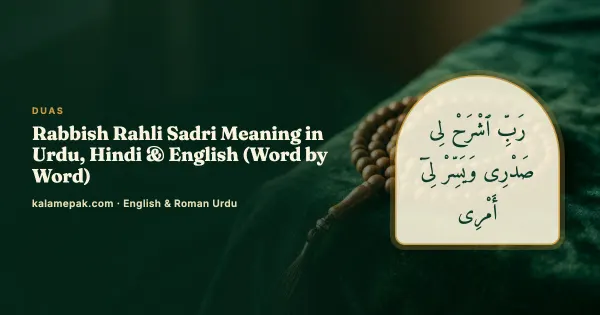
Alam nashraḥ laka ṣadrak, "did We not open your chest", uses the same root as Musa's (AS) dua Rabbi-shraḥ lī ṣadrī, "my Lord, open my chest" (20:25). Musa asked; the Prophet ﷺ is told it has already been given. If you learn the surah, read Rabbish rahli sadri too; the two share the word ṣadr (#156 in the book), and together they are the Quran's own vocabulary for a heart under pressure.
Surah Alam Nashrah in namaz
Eight short verses with easy rhymes (ṣadrak, wizrak, ẓahrak, dhikrak), so it is one of the first surahs after the last 10 surahs that people learn for namaz. Surah Al-Fatiha comes before it in every rakʿah.
The surah after it, Surah Teen (95), is usually the next one people learn.
Sources: Quran text from the Quranic Arabic Corpus and Tanzil · verse meanings in English from Marmaduke Pickthall and in Urdu from Maulana Muhammad Junagarhi · meanings of duas and phrases in Roman Urdu, Urdu and Hindi are our own plain renderings · hadith with collection and number, linked to sunnah.com. How we check every article →
Frequently asked questions
What is Surah Alam Nashrah about?
Allah reminds the Prophet ﷺ of three things He did for him: opened his chest, removed the burden that weighed on his back, and raised his name. Then the promise, twice: with hardship there is ease. Then two commands: when you are free, work hard in worship, and turn to your Lord.
Why is 'with hardship comes ease' repeated twice?
Verses 5 and 6 say the same thing. Many scholars note that 'the hardship' has 'al' (the one hardship) while 'ease' has no 'al' (an ease, any ease), and read the repetition as: one hardship, two eases. At the least, the repetition is emphasis: the promise is certain.
Is it Surah Alam Nashrah, Al-Inshirah or Ash-Sharh?
All three names are used for surah 94. Alam Nashrah are its first two words; Al-Inshirah and Ash-Sharh both mean 'the opening (of the chest)'.
How many verses does Surah Alam Nashrah have?
Eight verses, revealed in Makkah. It is often read in namaz right after Surah Duha (93), which it continues in subject.