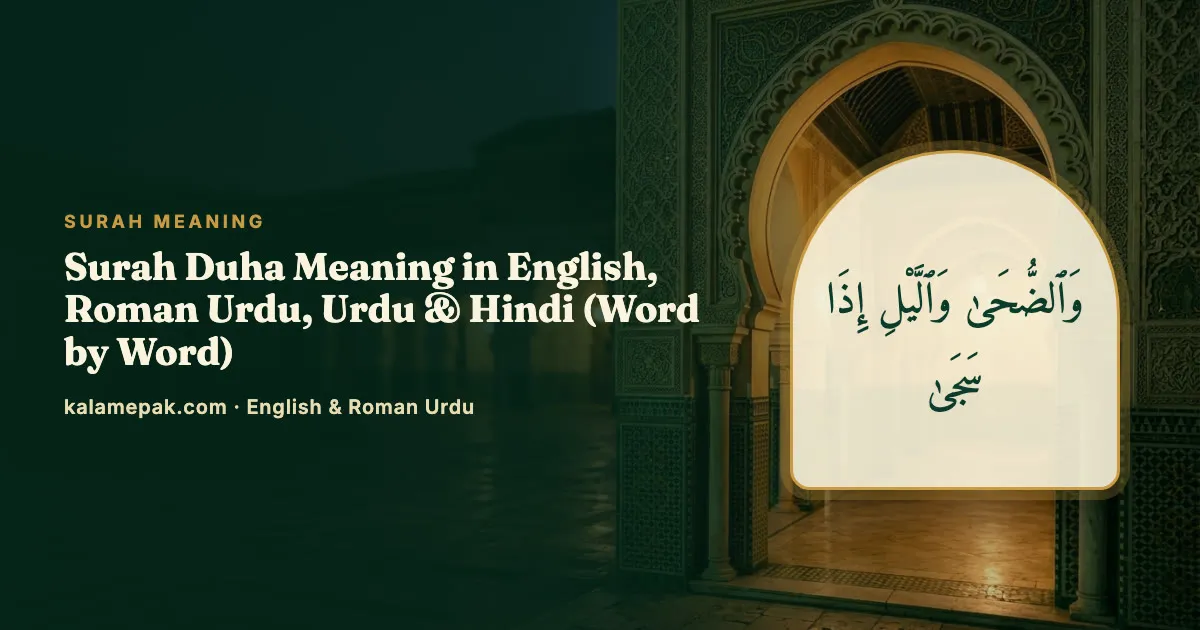
Surah Duha Meaning in English, Roman Urdu, Urdu & Hindi (Word by Word)
Surah Ad-Duha (surah 93, "The Morning Hours") was sent down after the Prophet ﷺ had been ill and had not got up for his night prayer for two or three nights, and a woman taunted him that his shaitan had left him (Sahih al-Bukhari 4950). Its answer is in the third verse: "Thy Lord hath not forsaken thee nor doth He hate thee." Eleven short verses, three questions and three commands, and the promise that the end will be better than the beginning. Below is every verse in Arabic with English (Pickthall), Roman Urdu and Urdu (Maulana Junagarhi) and Hindi, then the words you need to understand it.
Surah Duha with meaning, verse by verse
And by the night when it is stillest,
Aur qasam hai raat ki jab chha jaaye
Surah Ad-Duha · 93:2
Thy Lord hath not forsaken thee nor doth He hate thee,
Na to tere Rab ne tujhe chhoda hai aur na woh bezaar ho gaya hai
Surah Ad-Duha · 93:3
And verily the latter portion will be better for thee than the former,
Yaqeenan tere liye anjaam aaghaaz se behtar hoga
Surah Ad-Duha · 93:4
And verily thy Lord will give unto thee so that thou wilt be content.
Tujhe tera Rab bahut jald (inaam) dega aur tu raazi (o khush) ho jaayega
Surah Ad-Duha · 93:5
Did He not find thee an orphan and protect (thee)?
Kya us ne tujhe yateem paa kar jagah nahin di?
Surah Ad-Duha · 93:6
Did He not find thee wandering and direct (thee)?
Aur tujhe raah bhoola paa kar hidaayat nahin di?
Surah Ad-Duha · 93:7
Did He not find thee destitute and enrich (thee)?
Aur tujhe naadaar paa kar tawangar nahin bana diya?
Surah Ad-Duha · 93:8
Therefor the orphan oppress not,
Pas yateem par tu bhi sakhti na kiya kar
Surah Ad-Duha · 93:9
Therefor the beggar drive not away,
Aur na sawaal karne wale ko daant dapat
Surah Ad-Duha · 93:10
Therefor of the bounty of thy Lord be thy discourse.
Aur apne Rab ki naimaton ko bayaan karta reh
Surah Ad-Duha · 93:11
Surah Duha meaning in Urdu
قسم ہے چاشت کے وقت کی
اور قسم ہے رات کی جب چھا جائے
نہ تو تیرے رب نے تجھے چھوڑا ہے اور نہ وه بیزار ہو گیا ہے
یقیناً تیرے لئے انجام آغاز سے بہتر ہوگا
تجھے تیرا رب بہت جلد (انعام) دے گا اور تو راضی (وخوش) ہو جائے گا
کیا اس نے تجھے یتیم پا کر جگہ نہیں دی
اور تجھے راه بھوﻻ پا کر ہدایت نہیں دی
اور تجھے نادار پاکر تونگر نہیں بنا دیا؟
پس یتیم پر تو بھی سختی نہ کیا کر
اور نہ سوال کرنے والے کو ڈانٹ ڈپٹ
اور اپنے رب کی نعمتوں کو بیان کرتا ره
Surah Duha meaning in Hindi
क़सम है चाश्त के वक़्त की
और क़सम है रात की जब छा जाए
न तो तेरे रब ने तुझे छोड़ा है और न वह बेज़ार हो गया है
यक़ीनन तेरे लिए अंजाम आग़ाज़ से बेहतर होगा
तुझे तेरा रब बहुत जल्द (इनाम) देगा और तू राज़ी (व ख़ुश) हो जाएगा
क्या उसने तुझे यतीम पाकर जगह नहीं दी?
और तुझे राह भूला पाकर हिदायत नहीं दी?
और तुझे नादार पाकर तवंगर नहीं बना दिया?
पस यतीम पर तू भी सख़्ती न किया कर
और न सवाल करने वाले को डाँट डपट
और अपने रब की नेमतों को बयान करता रह
The Urdu is Maulana Muhammad Junagarhi's translation; the Roman Urdu and Hindi above are the same Urdu line written in English and Devanagari letters.
Word by word
The number in the last column is the word's place in 600 Words of the Quran.
| Arabic | Say it | Meaning | In the book |
|---|---|---|---|
| ٱلضُّحَىٰ | aḍ-ḍuḥā | the morning brightness, forenoon | |
| ٱلَّيْلِ | al-layl | the night | layl #54 |
| سَجَىٰ | sajā | it grew still, covered over | |
| وَدَّعَكَ | waddaʿaka | He bade you farewell, left you | |
| رَبُّكَ | rabbuka | your Lord | rabb #12 |
| قَلَىٰ | qalā | He hated, detested | |
| ٱلْءَاخِرَةُ | al-ākhirah | the later (life / part) | |
| خَيْرٌ لَّكَ | khayrun laka | better for you | khayr #182 |
| ٱلْأُولَىٰ | al-ūlā | the first, the former | |
| يُعْطِيكَ | yuʿṭīka | He will give you | |
| فَتَرْضَىٰ | fa-tarḍā | so that you are content | raḍiya #414 |
| يَجِدْكَ | yajidka | He found you | wajada #86 |
| يَتِيمًا | yatīman | an orphan | yatīm #455 |
| فَـَٔاوَىٰ | fa-āwā | and He gave shelter | |
| ضَآلًّا | ḍāllan | wandering, unaware of the way | |
| فَهَدَىٰ | fa-hadā | and He guided | hadā #184 |
| عَآئِلًا | ʿāʾilan | in need, poor | |
| فَأَغْنَىٰ | fa-aghnā | and He made free of need | |
| فَلَا تَقْهَرْ | fa-lā taqhar | so do not oppress | |
| ٱلسَّآئِلَ | as-sāʾil | the one who asks | |
| فَلَا تَنْهَرْ | fa-lā tanhar | do not drive away, do not scold | |
| بِنِعْمَةِ رَبِّكَ | bi-niʿmati rabbika | of the favour of your Lord | rabb #12 |
| فَحَدِّثْ | fa-ḥaddith | speak, tell |
The shape of the surah
- Verses 1–2: two oaths. The bright morning and the still night. Day and night both come from Allah; one is not a sign that the other has been withdrawn.
- Verse 3: the answer. Mā waddaʿaka rabbuka wa mā qalā: He has not left you, He does not hate you. This is the verse people hold on to when they feel Allah is far.
- Verses 4–5: the promise. What is coming is better than what has been, and your Lord will give until you are content.
- Verses 6–8: three memories. Orphan, and He sheltered you. Unaware, and He guided you. In need, and He enriched you. Three things that already happened, as proof for the promise.
- Verses 9–11: three duties. Because you were an orphan, do not oppress the orphan. Because you asked, do not turn away the one who asks. Because you were given, speak of your Lord's favour.
The pattern is simple: what Allah did for you becomes what you do for others. That is why the surah is read so often to people in grief; it does not deny the night, it says the morning is on its way.
Surah Duha in namaz
It is one of the short surahs of Juz Amma that many people learn after Surah Ikhlas and the last 10 surahs. Eleven verses, easy rhymes (ḍuḥā, sajā, qalā, ūlā, tarḍā), and a meaning you will not forget once you have read it this way. If you recite it in the first rakʿah, Surah Al-Fatiha comes before it as in every rakʿah.
The surah that follows it, Surah Alam Nashrah (94), continues the same subject and is usually learnt next.
Sources: Quran text from the Quranic Arabic Corpus and Tanzil · verse meanings in English from Marmaduke Pickthall and in Urdu from Maulana Muhammad Junagarhi · meanings of duas and phrases in Roman Urdu, Urdu and Hindi are our own plain renderings · hadith with collection and number, linked to sunnah.com. How we check every article →
Frequently asked questions
What is Surah Duha about?
Jundub ibn Sufyan narrates that the Prophet ﷺ was ill and did not get up for night prayer for two or three nights; a woman said that his shaitan had left him, and then these verses were revealed (Sahih al-Bukhari 4950). The surah answers: your Lord has not forsaken you nor does He hate you; what comes later is better than what came before; and it reminds him of three times Allah cared for him, then asks three things of him in return.
How many verses does Surah Duha have?
Eleven verses. It is surah 93, revealed in Makkah, and it is read in the first rakʿah by many people who then read Surah Alam Nashrah (94) in the second.
What does 'wad duha' mean?
'By the morning hours' (Pickthall) or 'by the forenoon', the bright time of the morning after sunrise. Allah swears by it, and by the night when it settles, before giving the good news in verse 3.
What are the three questions in Surah Duha?
Did He not find you an orphan and give you shelter? Did He not find you unaware and guide you? Did He not find you in need and make you free of need? (93:6–8). Each one is followed by a command: do not oppress the orphan, do not turn away the one who asks, and speak of your Lord's favour.