Safar ki Dua (सफ़र की दुआ): Full Dua in Hindi, Urdu & English
Reviewed by Abrar Iqbal, Islamic scholar (PhD in Islamic research) · 14 Nov 2026

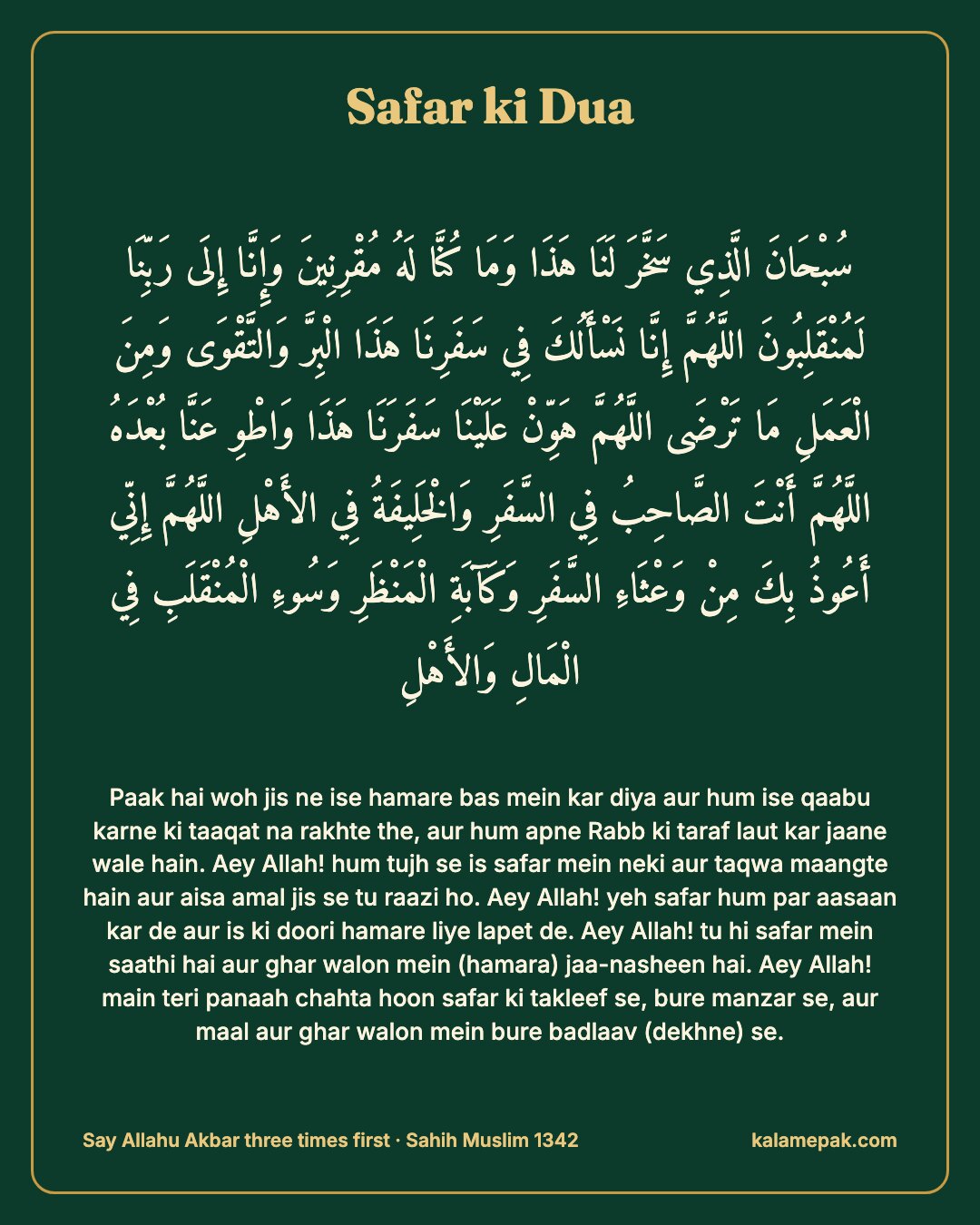
Safar ki dua (سفر کی دعا · सफ़र की दुआ) is what the Prophet Muhammad ﷺ said when he set out on a journey. Once he was settled on his camel he said Allāhu akbar three times, and then this dua (Sahih Muslim 1342). It asks Allah for goodness on the road, an easy journey, and safety for the family left behind.
Safar ki dua in Arabic with translation
Hallowed is He Who subdued for us this (ride) and we were not ourselves powerful enough to use It as a ride, and we are going to return to our Lord. O Allah, we seek virtue and piety from Thee in this journey of ours and the act which pleaseth Thee. O Allah, lighten this journey of ours, and make its distance easy for us. O Allah, Thou art (our) companion during the journey, and guardian of (our) family. O Allah, I seek refuge with Thee from hardships of the journey, gloominess of the sights, and finding of evil changes in property and family on return.
Paak hai woh jis ne ise hamare bas mein kar diya aur hum ise qaabu karne ki taaqat na rakhte the, aur hum apne Rabb ki taraf laut kar jaane wale hain. Aey Allah! hum tujh se is safar mein neki aur taqwa maangte hain aur aisa amal jis se tu raazi ho. Aey Allah! yeh safar hum par aasaan kar de aur is ki doori hamare liye lapet de. Aey Allah! tu hi safar mein saathi hai aur ghar walon mein (hamara) jaa-nasheen peechhe hifazat karne wala hai. Aey Allah! main teri panaah chahta hoon safar ki takleef se, bure manzar se, aur maal aur ghar walon mein bure badlaav (dekhne) se.
Sahih Muslim 1342 · English from sunnah.com
Safar ki dua in Roman English
Subhanallazi sakhkhara lana haza wa ma kunna lahu muqrinin, wa inna ila rabbina lamunqalibun. Allahumma inna nas'aluka fi safarina hazal birra wat-taqwa, wa minal amali ma tarda. Allahumma hawwin alaina safarana haza watwi anna bu'dah. Allahumma antas-sahibu fis-safari wal-khalifatu fil-ahl. Allahumma inni a'uzu bika min wa'sa'is-safari wa ka'abatil-manzari wa su'il-munqalabi fil-mali wal-ahl.
People also search for it as dua for travelling or safar ki duaa.
सफ़र की दुआ हिंदी में
सफ़र की दुआ वो दुआ है जो नबी ﷺ सफ़र पर निकलते वक़्त सवारी पर बैठ कर पढ़ते थे: पहले तीन बार अल्लाहु अकबर, फिर ये दुआ (सहीह मुस्लिम 1342)।
तर्जुमा: पाक है वो जिस ने इसे हमारे बस में कर दिया और हम इसे क़ाबू करने की ताक़त न रखते थे, और हम अपने रब की तरफ़ लौट कर जाने वाले हैं। ऐ अल्लाह! हम तुझ से इस सफ़र में नेकी और तक़वा माँगते हैं और ऐसा अमल जिस से तू राज़ी हो। ऐ अल्लाह! ये सफ़र हम पर आसान कर दे और इस की दूरी हमारे लिए लपेट दे। ऐ अल्लाह! तू ही सफ़र में साथी है और घर वालों में हमारा जानशीन है। ऐ अल्लाह! मैं तेरी पनाह चाहता हूँ सफ़र की तकलीफ़ से, बुरे मंज़र से, और माल और घर वालों में बुरे बदलाव से।
Safar ki dua in Hindi · Sahih Muslim 1342
अरबी दुआ हिंदी में ऐसे पढ़ें:
सुब्हानल्लज़ी सख़्ख़रा लना हाज़ा व मा कुन्ना लहू मुक़रिनीन, व इन्ना इला रब्बिना लमुन्क़लिबून। अल्लाहुम्मा इन्ना नसअलुका फ़ी सफ़रिना हाज़ल बिर्रा वत्तक़वा, व मिनल अमलि मा तरज़ा। अल्लाहुम्मा हव्विन अलैना सफ़रना हाज़ा वतवि अन्ना बुअदह। अल्लाहुम्मा अन्तस्साहिबु फ़िस्सफ़रि वल ख़लीफ़तु फ़िल अहल। अल्लाहुम्मा इन्नी अऊज़ु बिका मिन वअसाइस्सफ़रि व कआबतिल मंज़रि व सूइल मुन्क़लबि फ़िल मालि वल अहल।
سفر کی دعا اردو میں
سفر کی دعا وہ دعا ہے جو نبی ﷺ سفر پر نکلتے وقت سواری پر بیٹھ کر پڑھتے تھے: پہلے تین بار اللہ اکبر، پھر یہ دعا (صحیح مسلم 1342)۔
ترجمہ: پاک ہے وہ جس نے اسے ہمارے بس میں کر دیا اور ہم اسے قابو کرنے کی طاقت نہ رکھتے تھے، اور ہم اپنے رب کی طرف لوٹ کر جانے والے ہیں۔ اے اللہ! ہم تجھ سے اس سفر میں نیکی اور تقویٰ مانگتے ہیں اور ایسا عمل جس سے تو راضی ہو۔ اے اللہ! یہ سفر ہم پر آسان کر دے اور اس کی دوری ہمارے لیے لپیٹ دے۔ اے اللہ! تو ہی سفر میں ساتھی ہے اور گھر والوں میں ہمارا جانشین ہے۔ اے اللہ! میں تیری پناہ چاہتا ہوں سفر کی تکلیف سے، برے منظر سے، اور مال اور گھر والوں میں برے بدلاؤ سے۔
Safar ki dua in Urdu · Sahih Muslim 1342
Line by line
| Arabic | Say it | Meaning |
|---|---|---|
| سُبْحَانَ الَّذِي سَخَّرَ لَنَا هَذَا | subḥānal-ladhī sakhkhara lanā hādhā | Glory be to the One who made this serve us |
| وَمَا كُنَّا لَهُ مُقْرِنِينَ | wa mā kunnā lahū muqrinīn | and we could not have managed it ourselves |
| وَإِنَّا إِلَى رَبِّنَا لَمُنْقَلِبُونَ | wa innā ilā rabbinā lamunqalibūn | and to our Lord we will return |
| اللَّهُمَّ إِنَّا نَسْأَلُكَ فِي سَفَرِنَا هَذَا | Allāhumma innā nasʾaluka fī safarinā hādhā | O Allah, we ask You on this journey of ours |
| الْبِرَّ وَالتَّقْوَى | al-birra wat-taqwā | for goodness and piety |
| وَمِنَ الْعَمَلِ مَا تَرْضَى | wa minal-ʿamali mā tarḍā | and deeds that please You |
| اللَّهُمَّ هَوِّنْ عَلَيْنَا سَفَرَنَا هَذَا | Allāhumma hawwin ʿalaynā safaranā hādhā | O Allah, make this journey easy for us |
| وَاطْوِ عَنَّا بُعْدَهُ | waṭwi ʿannā buʿdah | and fold up its distance for us |
| اللَّهُمَّ أَنْتَ الصَّاحِبُ فِي السَّفَرِ | Allāhumma antaṣ-ṣāḥibu fis-safar | O Allah, You are the companion on the journey |
| وَالْخَلِيفَةُ فِي الأَهْلِ | wal-khalīfatu fil-ahl | and the guardian of the family |
| اللَّهُمَّ إِنِّي أَعُوذُ بِكَ مِنْ وَعْثَاءِ السَّفَرِ | Allāhumma innī aʿūdhu bika min waʿthāʾis-safar | O Allah, I seek refuge in You from the hardship of the journey |
| وَكَآبَةِ الْمَنْظَرِ | wa kaʾābatil-manẓar | and from a saddening sight |
| وَسُوءِ الْمُنْقَلَبِ فِي الْمَالِ وَالأَهْلِ | wa sūʾil-munqalabi fil-māli wal-ahl | and from a bad return to our wealth and family |
Look at what this dua cares about. It begins by remembering that no vehicle is under our control without Allah's help, and that every journey ends with the return to Him. Only then does it ask for an easy road. And the person who is leaving asks Allah to look after the people at home, the very thing a traveller worries about most.
How to say it, step by step
- Sit down and settle in. The Quran says "when ye mount thereon" (43:13), and the hadith says when he had mounted his camel.
- Say Allāhu akbar three times. See Allahu Akbar meaning.
- Say the dua above, or as much of it as you have learned.
Safar ki dua for car, bus, train and plane
Today people say it in a car, a bus, a train or a plane, once they are settled in. The hadith mentions a camel and the verse mentions ships and cattle, because those were the rides of that time.
The short dua is in the Quran (43:13–14)
You may have seen only the first two lines on a poster or a car sticker. Those lines are real, and they are in the Quran. Allah mentions ships and cattle as rides, and teaches what to say on them:
Glorified be He Who hath subdued these unto us, and we were not capable (of subduing them); And lo! unto our Lord we are returning.
Paak zaat hai us ki jis ne ise hamare bas mein kar diya haalaanke humein ise qaabu karne ki taaqat na thi. Aur bil-yaqeen pakke yaqeen se hum apne Rabb ki taraf laut kar jaane wale hain
Surah Az-Zukhruf · 43:13–14 (part)
In Sahih Muslim, the Prophet ﷺ said these words and then carried on with the rest. If you are still learning, start with the Quran part and add a line at a time.
Coming back: safar se wapsi ki dua
When the Prophet ﷺ returned he said the same dua and added these words (Sahih Muslim 1342):
We are returning, repentant, worshipping our Lord, and praising Him.
Hum lautne wale hain, tauba karne wale hain, ibaadat karne wale hain, apne Rabb ki taareef karne wale hain.
Sahih Muslim 1342 · English from sunnah.com
Āyibūna tāʾibūna ʿābidūna li-rabbinā ḥāmidūn. Say it on your way back.
What Ali did, and why he laughed
Ali ibn Abi Talib was once brought an animal to ride, and Ali ibn Rabi'ah watched what he did (Abu Dawud 2602, graded Sahih by al-Albani on sunnah.com):
- With his foot in the stirrup he said بِسْمِ اللَّهِ, Bismillāh.
- Sitting on its back he said الْحَمْدُ لِلَّهِ, Alḥamdulillāh, then the two Quran lines above.
- Then Alḥamdulillāh three times and Allāhu akbar three times.
- Then: سُبْحَانَكَ إِنِّي ظَلَمْتُ نَفْسِي فَاغْفِرْ لِي فَإِنَّهُ لاَ يَغْفِرُ الذُّنُوبَ إِلاَّ أَنْتَ, "glory be to Thee, I have wronged myself, so forgive me, for only Thou forgivest sins."
Then he laughed. He said he had seen the Prophet ﷺ do the same and laugh, and had asked him why. The Prophet ﷺ replied that your Lord is pleased with His servant when he says "Forgive me my sins", knowing that no one forgives sins except Him.
If those words sound familiar, they are close to the dua many people read at the end of namaz: see dua after Durood.
Words of this dua you will meet in the Quran
| Word | Meaning | In the book |
|---|---|---|
| subḥān | glory be to | #398 · 41× |
| sakhkhara | he subjected, made to serve | #561 · 22× |
| rabb | Lord | #12 · 975× |
| taqwā | piety | #431 · 17× |
| ʿamal | deed | #211 · 71× |
| raḍiya | he was pleased | #414 · 38× |
| sūʾ | evil, harm | #195 · 50× |
| māl | wealth | #90 · 86× |
| ahl | people, family | #222 · 127× |
"In the book" is the word's number in 600 Words of the Quran and how many times it appears in the whole Quran. The next time you hear sakhkhara in a recitation, you will know it speaks of what Allah has made to serve us.
Try this on your next trip. Before the car moves, say the first two lines slowly and think of the last words: to our Lord we will return. Then add one new line each time you travel. The full dua, with the meaning of every Quran word, is in Quran ki Duaein, and 600 Words of the Quran teaches the words above with a real verse for each.
For the meals on the way there is khane ki dua, and for the night, sone ki dua.
Sources: Quran text from the Quranic Arabic Corpus and Tanzil · verse meanings in English from Marmaduke Pickthall and in Urdu from Maulana Muhammad Junagarhi · meanings of duas and phrases in Roman Urdu, Urdu and Hindi are our own plain renderings · hadith with collection and number, linked to sunnah.com. How we check every article →
Frequently asked questions
What is the safar ki dua?
It is the dua the Prophet ﷺ said when setting out on a journey: three times Allahu Akbar, then 'Subhanal-ladhi sakhkhara lana hadha…' with the lines that follow (Sahih Muslim 1342). The first two lines are also in the Quran (43:13-14).
When should I read safar ki dua?
The hadith says the Prophet ﷺ said it when he had mounted his camel while setting out on a journey. Today people say it once they are settled in their car, bus, train or plane.
Is there a short safar ki dua?
The first two lines are the part from the Quran: 'Subhanal-ladhi sakhkhara lana hadha wa ma kunna lahu muqrinin, wa inna ila rabbina lamunqalibun.' Many posters show only these. The full wording in Sahih Muslim continues with the lines on this page.
What do I say when coming back from a journey?
The same dua, with this added: 'Ayibuna ta'ibuna abiduna li-rabbina hamidun': we are returning, repentant, worshipping our Lord, and praising Him (Sahih Muslim 1342).