Surah Adiyat Meaning in English, Roman Urdu, Urdu & Hindi (Word by Word)
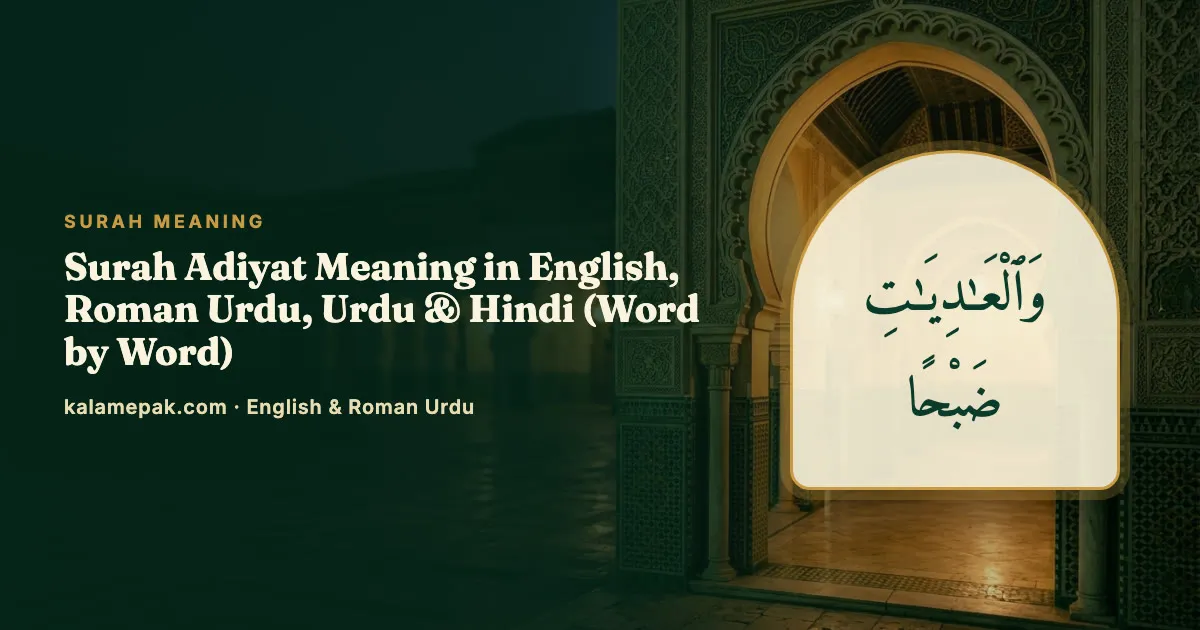
Surah Al-Adiyat (surah 100, "The Chargers") begins at a gallop. Five verses of oath: horses panting, hooves striking sparks on stone, a raid at first light, dust rising, the riders cutting into the middle of the enemy. All of it to say one thing in verse 6: inna l-insāna li-rabbihī la-kanūd, man is ungrateful to his Lord. Then the surah slows down and turns the gallop into a question about the grave. Here is the whole surah in Arabic with Pickthall's English, Junagarhi's Urdu, Roman Urdu and Hindi, every word with its number in the book, and the shape of the surah.
Surah Adiyat with meaning, verse by verse
By the snorting courses,
Haanpte hue daudne wale ghodon ki qasam!
Surah Al-Adiyat · 100:1
Striking sparks of fire
Phir taap maar kar aag jhaadne waalon ki qasam!
Surah Al-Adiyat · 100:2
And scouring to the raid at dawn,
Phir subah ke waqt dhaawa bolne waalon ki qasam
Surah Al-Adiyat · 100:3
Then, therewith, with their trail of dust,
Pas us waqt gard-o-ghubaar udaate hain
Surah Al-Adiyat · 100:4
Cleaving, as one, the centre (of the foe),
Phir usi ke saath faujiyon ke darmiyan ghus jaate hain
Surah Al-Adiyat · 100:5
Lo! man is an ingrate unto his Lord
Yaqeenan insaan apne Rabb ka bada na-shukra hai
Surah Al-Adiyat · 100:6
And lo! he is a witness unto that;
Aur yaqeenan woh khud bhi is par gawaah hai
Surah Al-Adiyat · 100:7
And lo! in the love of wealth he is violent.
Yeh maal ki mohabbat mein bhi bada sakht hai
Surah Al-Adiyat · 100:8
Knoweth he not that, when the contents of the graves are poured forth
Kya use woh waqt maloom nahin jab qabron mein jo kuch hai nikaal liya jaayega
Surah Al-Adiyat · 100:9
And the secrets of the breasts are made known,
Aur seenon ki posheeda baatein zaahir kar di jaayengi
Surah Al-Adiyat · 100:10
On that day will their Lord be perfectly informed concerning them.
Beshak un ka Rabb us din un ke haal se poora ba-khabar hoga
Surah Al-Adiyat · 100:11
The English is Marmaduke Pickthall's and the Urdu below is Muhammad Junagarhi's, both from quran.com; the Roman Urdu and Hindi are our plain rendering of the Urdu.
Surah Adiyat meaning in Urdu
ہانپتے ہوئے دوڑنے والے گھوڑوں کی قسم!
پھر ٹاپ مار کر آگ جھاڑنے والوں کی قسم!
پھر صبح کے وقت دھاوا بولنے والوں کی قسم.
پس اس وقت گرد وغبار اڑاتے ہیں.
پھر اسی کے ساتھ فوجیوں کے درمیان گھس جاتے ہیں.
یقیناً انسان اپنے رب کا بڑا ناشکرا ہے.
اور یقیناً وه خود بھی اس پر گواه ہے.
یہ مال کی محبت میں بھی بڑا سخت ہے.
کیا اسے وه وقت معلوم نہیں جب قبروں میں جو (کچھ) ہے نکال لیا جائے گا.
اور سینوں کی پوشیده باتیں ظاہر کر دی جائیں گی.
بیشک ان کا رب اس دن ان کے حال سے پورا باخبر ہوگا.
Surah Adiyat meaning in Hindi
हाँपते हुए दौड़ने वाले घोड़ों की क़सम!
फिर टाप मारकर आग झाड़ने वालों की क़सम!
फिर सुबह के वक़्त धावा बोलने वालों की क़सम
पस उस वक़्त गर्द-ओ-ग़ुबार उड़ाते हैं
फिर उसी के साथ फ़ौजियों के दरमियान घुस जाते हैं
यक़ीनन इंसान अपने रब का बड़ा नाशुक्रा है
और यक़ीनन वह ख़ुद भी इस पर गवाह है
यह माल की मोहब्बत में भी बड़ा सख़्त है
क्या उसे वह वक़्त मालूम नहीं जब क़ब्रों में जो कुछ है निकाल लिया जाएगा
और सीनों की पोशीदा बातें ज़ाहिर कर दी जाएँगी
बेशक उनका रब उस दिन उनके हाल से पूरा बाख़बर होगा
Word by word
The number in the last column is the word's place in 600 Words of the Quran.
| Arabic | Say it | Meaning | In the book |
|---|---|---|---|
| وَٱلْعَـٰدِيَـٰتِ | wa-l-ʿādiyāt | by the runners (horses) | |
| ضَبْحًا | ḍabḥan | panting | |
| فَٱلْمُورِيَـٰتِ قَدْحًا | fa-l-mūriyāti qadḥan | then the strikers of sparks | |
| فَٱلْمُغِيرَٰتِ صُبْحًا | fa-l-mughīrāti ṣubḥan | then the raiders at dawn | |
| فَأَثَرْنَ بِهِۦ نَقْعًا | fa-atharna bihī naqʿan | then they raise dust with it | |
| فَوَسَطْنَ بِهِۦ جَمْعًا | fa-wasaṭna bihī jamʿan | then they cut into the middle of a gathering | jamaʿa #560 |
| إِنَّ ٱلْإِنسَـٰنَ | inna l-insāna | surely man | insān #228 |
| لِرَبِّهِۦ | li-rabbihī | to his Lord | rabb #12 |
| لَكَنُودٌ | la-kanūd | surely ungrateful | |
| عَلَىٰ ذَٰلِكَ | ʿalā dhālika | to that | ʿalā #9 |
| لَشَهِيدٌ | la-shahīd | surely a witness | shahīd #235 |
| لِحُبِّ ٱلْخَيْرِ | li-ḥubbi l-khayr | in the love of wealth | aḥabba #231 · khayr #182 |
| لَشَدِيدٌ | la-shadīd | surely intense | shadīd #250 |
| أَفَلَا يَعْلَمُ | a-fa-lā yaʿlamu | does he not know | ʿalima #103 |
| بُعْثِرَ | buʿthira | is turned out, scattered | |
| مَا فِى ٱلْقُبُورِ | mā fi l-qubūr | what is in the graves | mā #7 |
| وَحُصِّلَ | wa ḥuṣṣila | and is brought out | |
| مَا فِى ٱلصُّدُورِ | mā fi ṣ-ṣudūr | what is in the chests | ṣadr #156 |
| رَبَّهُم | rabbahum | their Lord | rabb #12 |
| يَوْمَئِذٍ | yawmaʾidhin | on that day | yawm #20 |
| لَّخَبِيرٌ | la-khabīr | surely all-aware | khabīr #294 |
Khayr (#182) normally means "good", and here it means wealth, the good things of this world; the Quran uses it the same way in 2:180, "if he leaves khayr" (property). Shadīd (#250), fierce, usually describes punishment; here it describes a man's love of money. Ṣadr (#156) is the chest, and mā fi ṣ-ṣudūr is what you keep there and show no one. Khabīr (#294), the all-aware, is the last word: whatever was hidden in the chest, the Lord was khabīr of it all along.
The shape of the surah
- Verses 1–5: the oath. Horses that pant, strike sparks, raid at dawn, raise dust and plunge into the enemy's middle.
- Verse 6: the claim. Man is kanūd, ungrateful to his Lord.
- Verses 7–8: the proof. He is a witness to it himself, and his love of wealth is fierce.
- Verses 9–11: the end. The graves emptied, the chests opened; on that Day his Lord knows him through and through.
Why swear by war horses to say that man is ungrateful? The horse gives everything to its master, panting, bleeding, charging at dawn, and asks nothing. Man, who is given everything by his Lord, counts his troubles instead. The surah between this and Surah Zilzal in the mushaf tells what comes out of the ground that Day, and Surah Qariah, the next surah, weighs what came out of the chests.
Surah Adiyat in namaz
Eleven verses in two sounds: the first five end in -an (ḍabḥan, qadḥan, ṣubḥan, naqʿan, jamʿan) and the rest in -īd/-ūr. The first half is fast, the way horses are, so read it with its meaning and your recitation will naturally quicken and then slow at verse 6. Most people learn it after Surah Zilzal and before Surah Qariah, in the order of the mushaf; all three are in the last 10 surahs neighbourhood that fills the second rak'ah of most namaz.
Sources: Quran text from the Quranic Arabic Corpus and Tanzil · verse meanings in English from Marmaduke Pickthall and in Urdu from Maulana Muhammad Junagarhi · meanings of duas and phrases in Roman Urdu, Urdu and Hindi are our own plain renderings · hadith with collection and number, linked to sunnah.com. How we check every article →
Frequently asked questions
What is Surah Adiyat about?
It opens with an oath by the war horses (al-adiyat) that gallop panting, strike sparks with their hooves, raid at dawn, raise dust and cut into the enemy. The oath is for one statement: man is ungrateful (kanud) to his Lord. He knows it himself, and he is fierce in his love of wealth. The surah ends with the graves emptied and the secrets of the chests brought out; on that Day his Lord knows everything about him.
What does al-Adiyat mean?
From ada, to run: the runners, the chargers. With dabhan, panting, it is the war horses galloping. Pickthall: 'the snorting courses'; Junagarhi: 'hanpte hue daudne wale ghode'.
What does kanud mean?
Deeply ungrateful: one who counts the hardships and forgets the blessings. Verse 6 says inna l-insana li-rabbihi la-kanud, man is surely ungrateful to his Lord, and verse 7 adds that he himself is a witness to it.
How many verses does Surah Adiyat have?
Eleven verses. It is surah 100, Al-Adiyat, between Surah Zilzal (99) and Surah Qariah (101).
Surah Adiyat in Hindi?
हाँपते हुए दौड़ने वाले घोड़ों की क़सम… the full Hindi of all 11 verses is on this page under 'Surah Adiyat meaning in Hindi'. Read the Arabic; the Hindi is its meaning.