Azan ke Baad ki Dua (अज़ान के बाद की दुआ): Arabic, Hindi, Urdu
Reviewed by Abrar Iqbal, Islamic scholar (PhD in Islamic research) · 14 Nov 2026
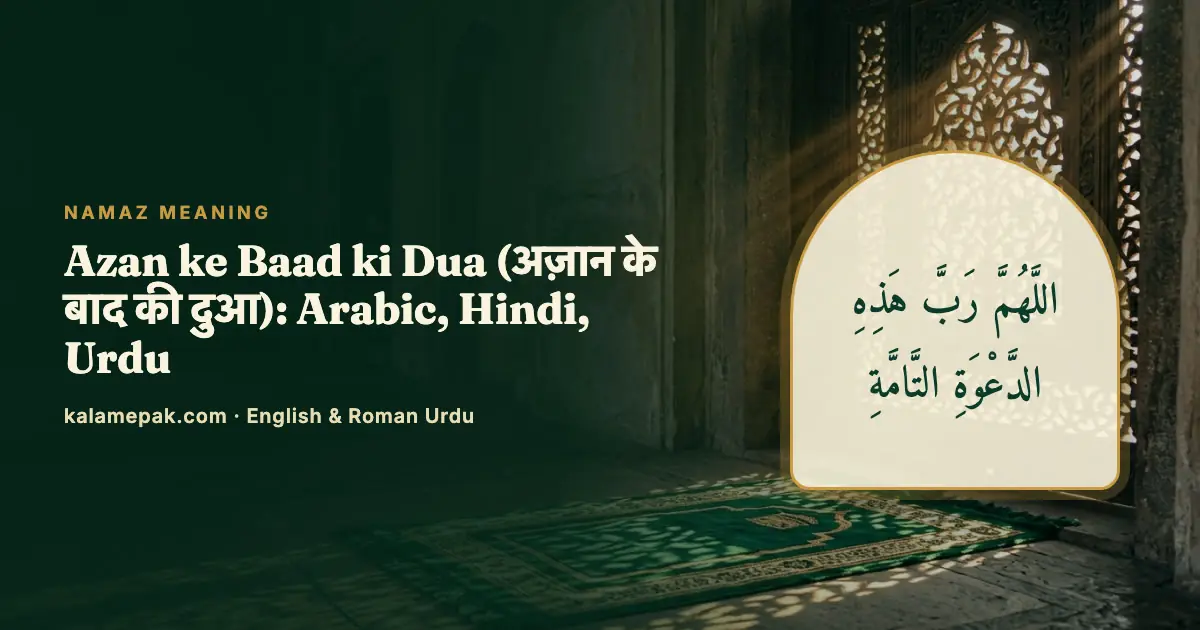
Azan ke baad ki dua (اذان کے بعد کی دعا · अज़ान के बाद की दुआ) is the dua the Prophet Muhammad ﷺ taught for when you have heard the call to prayer. He said that whoever says it, "my intercession for him will be allowed on the Day of Resurrection" (Sahih al-Bukhari 614).
Azan ke baad ki dua in Arabic with translation
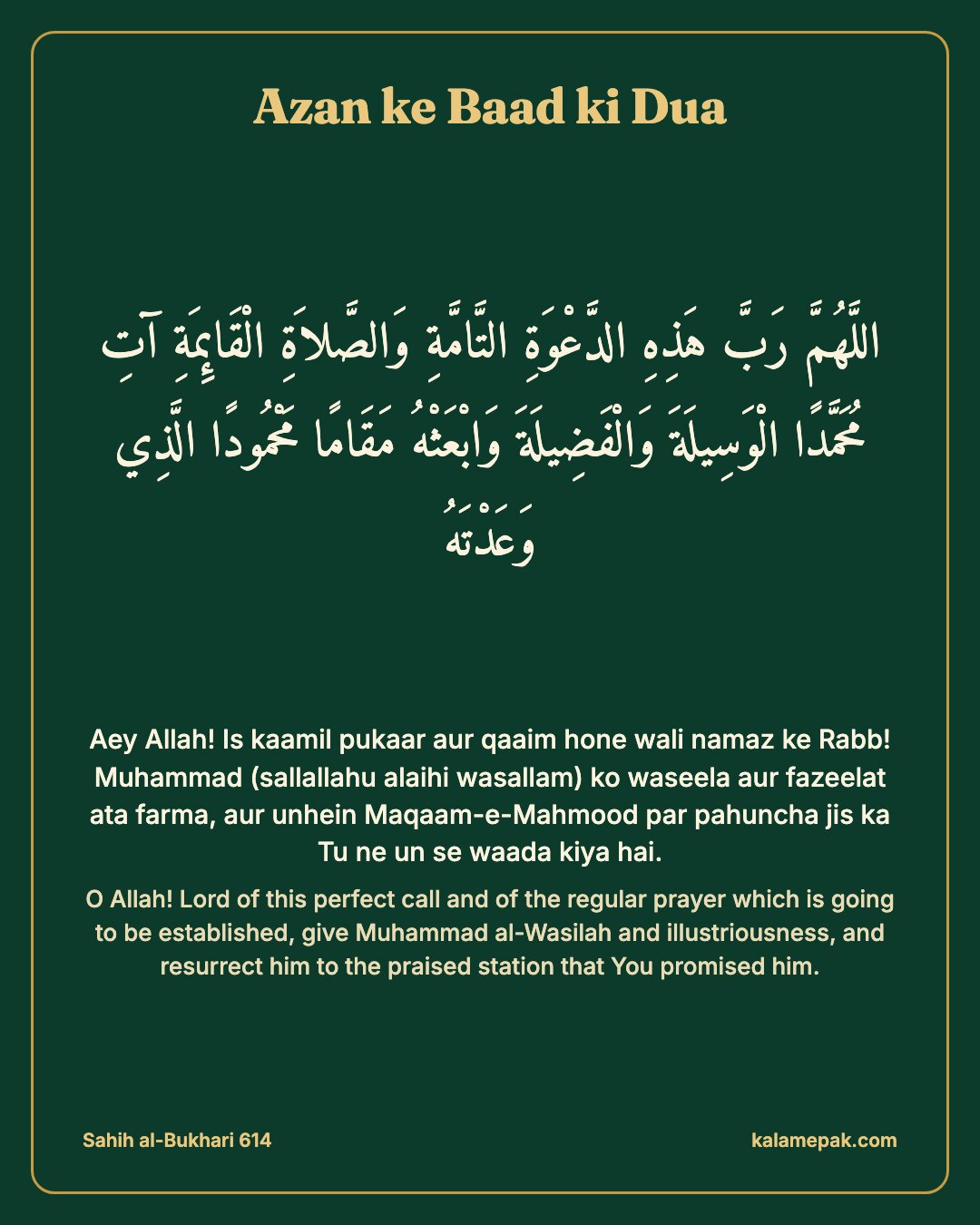
O Allah! Lord of this perfect call and of the regular prayer which is going to be established, give Muhammad al-Wasilah (a rank in Paradise) and illustriousness, and resurrect him to the praised station (al-Maqam al-Mahmud) that You promised him.
Aey Allah! Is kaamil poori pukaar aur qaaim hone wali namaz ke Rabb! Muhammad (sallallahu alaihi wasallam) ko waseela aur fazeelat buzurgi ata farma, aur unhein Maqaam-e-Mahmood taareef wala maqaam par pahuncha jis ka Tu ne un se waada kiya hai.
Sahih al-Bukhari 614 · English adapted from sunnah.com
Azan ke baad ki dua in Roman English
Allahumma rabba hazihid da'watit tammah, was salatil qa'imah, ati Muhammadanil wasilata wal fazilah, wab'as-hu maqamam mahmudanillazi wa'adtah.
People also write it as azaan ke baad ki dua, azan ki dua, dua after azan or dua after adhan.
अज़ान के बाद की दुआ हिंदी में
अज़ान के बाद की दुआ सहीह बुख़ारी 614 में है। नबी ﷺ ने फ़रमाया कि जो अज़ान सुन कर ये दुआ पढ़े, क़ियामत के दिन उस के लिए मेरी शफ़ाअत हलाल हो गई।
तर्जुमा: ऐ अल्लाह! इस कामिल पुकार और क़ायम होने वाली नमाज़ के रब! मुहम्मद (सल्लल्लाहु अलैहि वसल्लम) को वसीला और फ़ज़ीलत अता फ़रमा, और उन्हें मक़ाम-ए-महमूद पर पहुँचा जिस का तू ने उन से वादा किया है
Azan ke baad ki dua in Hindi · Sahih al-Bukhari 614
अरबी दुआ हिंदी में ऐसे पढ़ें:
अल्लाहुम्मा रब्बा हाज़िहिद्दअवतित्ताम्मह, वस्सलातिल क़ाइमह, आति मुहम्मदनिल वसीलता वल फ़ज़ीलह, वबअस्हु मक़ामम महमूदनिल्लज़ी वअत्तह।
اذان کے بعد کی دعا اردو میں
اذان کے بعد کی دعا صحیح بخاری 614 میں ہے۔ نبی ﷺ نے فرمایا کہ جو اذان سن کر یہ دعا پڑھے، قیامت کے دن اس کے لیے میری شفاعت حلال ہو گئی۔
ترجمہ: اے اللہ! اس کامل پکار اور قائم ہونے والی نماز کے رب! محمد (صلی اللہ علیہ وسلم) کو وسیلہ اور فضیلت عطا فرما، اور انہیں مقام محمود پر پہنچا جس کا تو نے ان سے وعدہ کیا ہے
Azan ke baad ki dua in Urdu · Sahih al-Bukhari 614
Azan ka jawab: how to answer the azan
The Prophet ﷺ laid out the order: "When you hear the Mu'adhdhin, repeat what he says, then invoke a blessing on me... then beg from Allah al-Wasila for me" (Sahih Muslim 384).
Step 1: Repeat after the muazzin. You say what he says, with one change, shown in this table from Sahih Muslim 385:
| When the muazzin says | You say |
|---|---|
| اللَّهُ أَكْبَرُ اللَّهُ أَكْبَرُ Allahu akbar, Allahu akbar |
the same |
| أَشْهَدُ أَنْ لاَ إِلَهَ إِلاَّ اللَّهُ Ashhadu an la ilaha illallah |
the same |
| أَشْهَدُ أَنَّ مُحَمَّدًا رَسُولُ اللَّهِ Ashhadu anna Muhammadan rasulullah |
the same |
| حَىَّ عَلَى الصَّلاَةِ Hayya alas-salah |
لاَ حَوْلَ وَلاَ قُوَّةَ إِلاَّ بِاللَّهِ La hawla wa la quwwata illa billah |
| حَىَّ عَلَى الْفَلاَحِ Hayya alal-falah |
لاَ حَوْلَ وَلاَ قُوَّةَ إِلاَّ بِاللَّهِ La hawla wa la quwwata illa billah |
| اللَّهُ أَكْبَرُ اللَّهُ أَكْبَرُ Allahu akbar, Allahu akbar |
the same |
| لاَ إِلَهَ إِلاَّ اللَّهُ La ilaha illallah |
the same |
When he calls you to prayer, you answer: there is no might and no power except with Allah. Getting up to pray is itself something you do with His help. See La hawla meaning.
Step 2: Send blessings on the Prophet ﷺ. Hadith: "everyone who invokes a blessing on me will receive ten blessings from Allah" (Sahih Muslim 384). Durood Ibrahim, the one you read in namaz, is the best known: see Durood Ibrahim meaning.
Step 3: Say the dua at the top of this page.
Step 4: Make your own dua. The Prophet ﷺ said: "The supplication made between the Adhan and Iqamah is not rejected" (Tirmidhi 212, Abu Dawud 521, both graded Sahih on sunnah.com). Most of us let this time pass. Those few minutes before the jamaat are a time to ask Allah for what you need.
Word by word
| Arabic | Say it | Meaning | In the book |
|---|---|---|---|
| اللَّهُمَّ | Allāhumma | O Allah | |
| رَبَّ | rabba | Lord | #12 rabb · 975× |
| هَذِهِ | hādhihi | of this | #11 dhā · 1,058× |
| الدَّعْوَةِ | ad-daʿwati | call | |
| التَّامَّةِ | at-tāmmati | perfect | |
| وَالصَّلاَةِ | waṣ-ṣalāti | and of the prayer | #208 ṣalāh · 83× |
| الْقَائِمَةِ | al-qāʾimati | about to be established | |
| آتِ | āti | give | #82 ātā · 271× |
| مُحَمَّدًا | Muḥammadan | Muhammad ﷺ | name |
| الْوَسِيلَةَ | al-wasīlata | al-Wasilah, a rank in Paradise | |
| وَالْفَضِيلَةَ | wal-faḍīlata | and excellence | |
| وَابْعَثْهُ | wabʿath-hu | and raise him | #171 baʿatha · 52× |
| مَقَامًا | maqāman | to a station | |
| مَحْمُودًا | maḥmūdan | praised | |
| الَّذِي | alladhī | which | #8 · 1,468× |
| وَعَدْتَهُ | waʿadtah | You promised him | #310 waʿada · 70× |
"In the book" is the word's number in 600 Words of the Quran and how many times it appears in the whole Quran.
What are Wasilah and Maqam Mahmud?
Al-Wasilah. The Prophet ﷺ explained it himself: "beg from Allah al-Wasila for me, which is a rank in Paradise fitting for only one of Allah's servants, and I hope that I may be that one. If anyone who asks that I be given the Wasila, he will be assured of my intercession" (Sahih Muslim 384).
Al-Maqam al-Mahmud, the "praised station", comes from the Quran, where Allah says to the Prophet ﷺ:
It may be that thy Lord will raise thee to a praised estate.
Anqareeb aap ka Rabb aap ko Maqaam-e-Mahmood mein khada karega
Surah Al-Isra · 17:79 (part)
So in this short dua you are asking Allah to give the Prophet ﷺ what He promised him. That is why the words alladhī waʿadtah, "that You promised him", close it.
Another thing to say on hearing the azan
Sa'd ibn Abi Waqqas narrated that the Prophet ﷺ said that whoever says this on hearing the muazzin, "his sins would be forgiven" (Sahih Muslim 386):
I testify that there is no god but Allah alone, Who has no partner, and that Muhammad is His servant and His Messenger. I am satisfied with Allah as my Lord, with Muhammad as Messenger, and with Islam as din.
Main gawahi deta hoon ke Allah ke siwa koi maabood nahi, woh akela hai, us ka koi shareek nahi, aur Muhammad (sallallahu alaihi wasallam) us ke bande aur us ke Rasool hain. Main Allah ke Rabb hone par, Muhammad (sallallahu alaihi wasallam) ke Rasool hone par aur Islam ke deen hone par raazi hoon.
Sahih Muslim 386 · English adapted from sunnah.com
Its first part is the same testimony as Kalma Shahadat.
Why your prayer book may look different
Many prayer books, calendars and wall charts print a longer azan ki dua, with extra words such as wad-darajatar-rafīʿah or innaka lā tukhliful-mīʿād at the end. Those words are not in this narration of Sahih al-Bukhari, which stops at alladhī waʿadtah. This page gives the wording of Bukhari 614, so you can see exactly what it says. If you learned a longer version from your teacher, ask them for its source.
Try this at the next azan. Put your phone down and answer it line by line. Then say the dua, even if you have to read it from this page. In a few days you will know it by heart, and it will take less than a minute of your day.
Every word you say in namaz, from the first takbir to the salam, is explained in Poori Namaz, Lafz ba Lafz. And words like rabb, ṣalāh and baʿatha are taught in 600 Words of the Quran, each with a real verse in English and Roman Urdu.
Sources: Quran text from the Quranic Arabic Corpus and Tanzil · verse meanings in English from Marmaduke Pickthall and in Urdu from Maulana Muhammad Junagarhi · meanings of duas and phrases in Roman Urdu, Urdu and Hindi are our own plain renderings · hadith with collection and number, linked to sunnah.com. How we check every article →
Frequently asked questions
What is the dua after azan?
'Allahumma rabba hadhihid-da'watit-tammah, was-salatil-qa'imah, ati Muhammadanil-wasilata wal-fadilah, wab'ath-hu maqamam-mahmudanil-ladhi wa'adtah' (Sahih al-Bukhari 614).
What is the reward of azan ke baad ki dua?
The Prophet ﷺ said that whoever says it on hearing the call, 'my intercession for him will be allowed on the Day of Resurrection' (Sahih al-Bukhari 614).
What is the difference between azan ki dua and azan ke baad ki dua?
They are usually the same dua. People use both names for the dua said after the azan.
Why do some prayer books show a longer azan ki dua?
Some printed versions add more words at the end. The wording of Sahih al-Bukhari 614, given on this page, stops at 'alladhi wa'adtah'.
Can I make my own dua after azan?
Yes. The Prophet ﷺ said: 'The supplication made between the Adhan and Iqamah is not rejected' (Tirmidhi 212, Abu Dawud 521).