Dusra Kalma (Kalma Shahadat) in Urdu, Hindi & English
Reviewed by Abrar Iqbal, Islamic scholar (PhD in Islamic research)
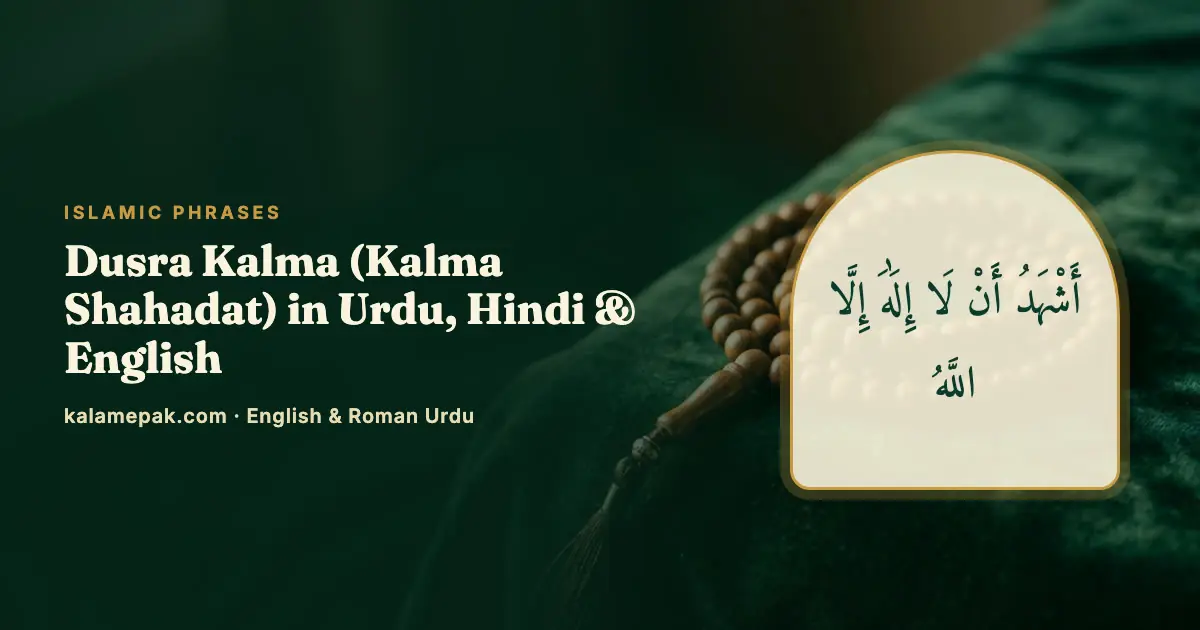
Kalma Shahadat means: "I bear witness that there is no god but Allah, He is One and has no partner, and I bear witness that Muhammad is His servant and His Messenger." In Urdu: Main gawahi deta hoon ke Allah ke siwa koi maabood nahin, woh akela hai, us ka koi shareek nahin, aur main gawahi deta hoon ke Muhammad (sallallahu alaihi wa sallam) us ke bande aur us ke Rasool hain.
It is the second kalma (dusra kalma). The first kalma states the truth; this one makes you a witness to it.
I bear witness that there is no god but Allah, He is One and has no partner, and I bear witness that Muhammad is His servant and His Messenger.
Main gawahi deta hoon ke Allah ke siwa koi maabood nahin, woh akela hai, us ka koi shareek nahin, aur main gawahi deta hoon ke Muhammad (sallallahu alaihi wa sallam) us ke bande aur us ke Rasool hain.
Kalma Shahadat · the same words are in Sahih Muslim 234b
In Roman Urdu (how to say it): Ashhadu allā ilāha illallāhu waḥdahū lā sharīka lahū, wa ashhadu anna Muḥammadan ʿabduhū wa rasūluh.
Kalma Shahadat in Urdu and Hindi
میں گواہی دیتا ہوں کہ اللہ کے سوا کوئی معبود نہیں، وہ اکیلا ہے، اس کا کوئی شریک نہیں، اور میں گواہی دیتا ہوں کہ محمد (صلی اللہ علیہ وسلم) اس کے بندے اور اس کے رسول ہیں
मैं गवाही देता हूँ कि अल्लाह के सिवा कोई माबूद नहीं, वो अकेला है, उस का कोई शरीक नहीं, और मैं गवाही देता हूँ कि मुहम्मद (सल्लल्लाहु अलैहि वसल्लम) उस के बंदे और उस के रसूल हैं
Kalma Shahadat ka tarjuma · Urdu and Hindi
In Hindi script the Arabic is read: अश्हदु अल्ला इलाहा इल्लल्लाहु वहदहू ला शरीका लहू, व अश्हदु अन्ना मुहम्मदन अब्दुहू व रसूलुह. A woman says gawahi deti hoon (गवाही देती हूँ); the Arabic ashhadu is the same for both.
Kalma Shahadat word by word
| Arabic | Say it | Meaning | In the book |
|---|---|---|---|
| أَشْهَدُ | ashhadu | I bear witness | #313 shahida · 44× |
| أَنْ لَا | an lā | that (there is) no | #3 lā · 1,742× |
| إِلَٰهَ | ilāha | god, one worthy of worship | #283 ilāh · 147× |
| إِلَّا | illā | except | #17 · 659× |
| اللَّهُ | Allāhu | Allah | #2 · 2,699× |
| وَحْدَهُ | waḥdahū | He alone, He is One | same root as wāḥid (#434, "one") |
| لَا شَرِيكَ لَهُ | lā sharīka lahū | He has no partner | #141 sharīk · 40× |
| وَأَشْهَدُ أَنَّ | wa ashhadu anna | and I bear witness that | |
| مُحَمَّدًا | Muḥammadan | Muhammad ﷺ | name |
| عَبْدُهُ | ʿabduhū | His servant | #221 ʿabd · 131× |
| وَرَسُولُهُ | wa rasūluhū | and His Messenger | #64 rasūl · 332× |
"In the book" is the word's number in 600 Words of the Quran and how many times it appears in the whole Quran. Every main word of this kalma is in the book's list.
Where Kalma Shahadat comes from
These words are not a later invention. In a hadith narrated by Uqba ibn Amir, Umar ibn al-Khattab reported that the Prophet ﷺ said: whoever makes wudu well and then says the testimony, the eight gates of Paradise are opened for him and he may enter by whichever he wishes (Sahih Muslim 234a). Another narration of the same hadith gives the wording exactly as in the second kalma: "Ashhadu an lā ilāha illallāhu waḥdahū lā sharīka lahū wa ashhadu anna Muḥammadan ʿabduhū wa rasūluh" (Sahih Muslim 234b).
So every time you finish wudu, you have a ready-made dua that is also the second kalma.
Allah Himself bears witness
The word shahida, "he bore witness", is used in the Quran for Allah Himself:
Allah (Himself) is Witness that there is no God save Him. And the angels and the men of learning (too are witness).
Allah Ta'ala, farishte aur ahl-e-ilm is baat ki gawahi dete hain ke Allah ke siwa koi maabood nahin
Surah Al Imran · 3:18 (part)
When you say ashhadu, you join that line of witnesses: Allah, the angels, and the people of knowledge.
The Quran also shows that the words must come from the heart. In Surah Al-Munafiqun the hypocrites came to the Prophet ﷺ and said nashhadu innaka la-rasūlu llāh, "we bear witness that you are Allah's messenger", and Allah answered that He knows he is His messenger, and that the hypocrites were lying (63:1). The same words, said without belief, were not a testimony at all.
"His servant" before "His Messenger"
Look at the order at the end: ʿabduhū wa rasūluhū, His servant and His Messenger. The highest of all people is described first as a servant of Allah.
This protects belief from two mistakes at once. He is Allah's servant (ʿabd), never to be worshipped, and he is Allah's Messenger (rasūl), whose words we follow. The word ʿabd is the same word as in names like Abdullah and Abdur Rahman: "servant of Allah", "servant of the Most Merciful".
You say it in every namaz
If you pray, you already say a testimony like this in every sitting. Attahiyat ends with:
Ashhadu an lā ilāha illallāh, wa ashhadu anna Muḥammadan ʿabduhū wa rasūluh (Sahih al-Bukhari 831)
That is Kalma Shahadat without the words waḥdahū lā sharīka lah. In a four-rak'ah prayer you say it twice; across the five daily prayers, many times a day. See the full Attahiyat meaning.
A testimony with more words is taught for when you hear the azan (Sahih Muslim 386): see azan ke baad ki dua.
Kalma Tayyab and Kalma Shahadat: what's the difference?
| Kalma Tayyab (1st) | Kalma Shahadat (2nd) | |
|---|---|---|
| Begins with | Lā ilāha illallāh | Ashhadu, I bear witness |
| About Allah | there is no god but Allah | the same, plus: He is One, He has no partner |
| About the Prophet ﷺ | Muhammad is the Messenger of Allah | Muhammad is His servant and His Messenger |
| Words from | the Quran (47:19, 48:29) | the hadith (Sahih Muslim 234b) |
Both say the same two truths. The first is a statement; the second is your personal testimony. For the first, see La ilaha illallah meaning; for all six together, see the 6 kalma in Roman Urdu.
Try this today
After your next wudu, say Kalma Shahadat slowly and stop at three words: at ashhadu, remember that you are a witness; at waḥdahū, that Allah is One; at ʿabduhū, that even the Prophet ﷺ was His servant. Then go and pray.
The words shahida, ilāh, sharīk, ʿabd and rasūl are all taught in 600 Words of the Quran, with a real verse for each, in English and Roman Urdu. Once you know them, you will hear this testimony echo through the whole Quran.
Sources: Quran text from the Quranic Arabic Corpus and Tanzil · verse meanings in English from Marmaduke Pickthall and in Urdu from Maulana Muhammad Junagarhi · meanings of duas and phrases in Roman Urdu, Urdu and Hindi are our own plain renderings · hadith with collection and number, linked to sunnah.com. How we check every article →
Frequently asked questions
What is the meaning of Kalma Shahadat?
I bear witness that there is no god but Allah, He is One and has no partner, and I bear witness that Muhammad is His servant and His Messenger.
What is the difference between Kalma Tayyab and Kalma Shahadat?
They say the same two truths. Kalma Tayyab states them; Kalma Shahadat begins with 'ashhadu', I bear witness, so you testify to them personally, and it adds that Allah has no partner and that the Prophet ﷺ is His servant.
Is Kalma Shahadat in the hadith?
Yes. These exact words are what the Prophet ﷺ taught to say after making wudu (Sahih Muslim 234b). A shorter testimony of the same kind is part of Attahiyat in every namaz.
When should I read Kalma Shahadat?
Many Muslims say it after wudu, following the hadith in Sahih Muslim, and a shorter form of its words is part of every tashahhud (Attahiyat) in namaz. Its meaning is also the testimony of faith (shahada) that a person says on accepting Islam.