Jazakallah Khair Meaning in Hindi & English (and the Reply)
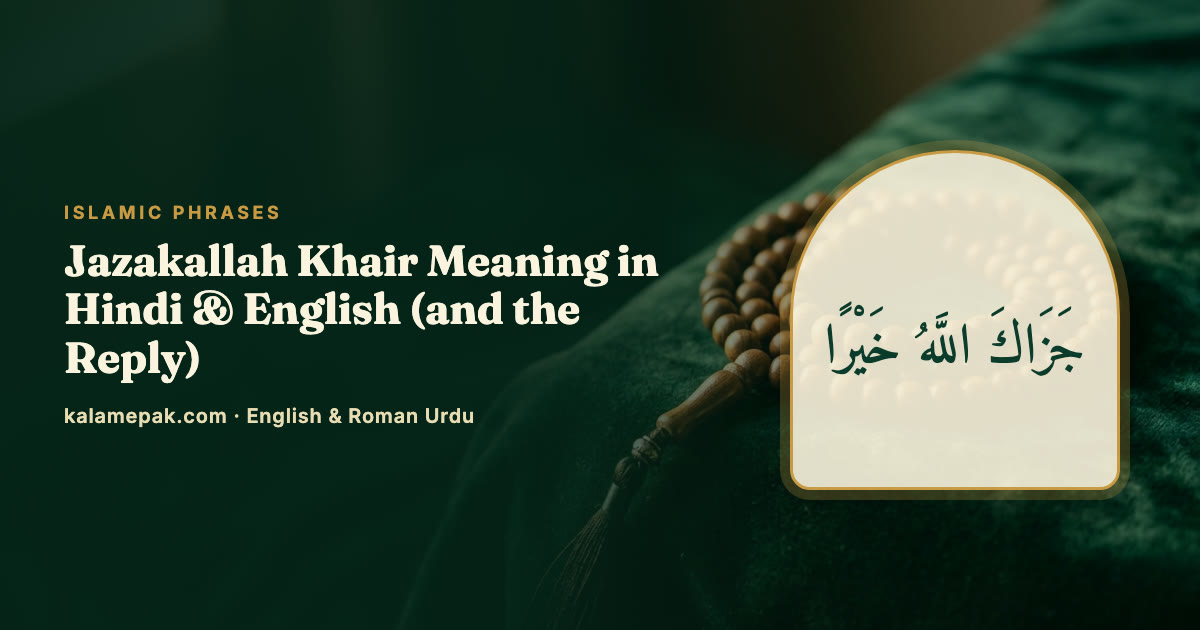
Someone helps you move house. A friend sends you notes before an exam. A stranger returns your lost wallet. "Thank you" feels too small. So Muslims say Jazakallah Khair — "May Allah reward you with good."
In Hindi and Urdu: "Allah aap ko behtar badla de."
May Allah reward you with good
Allah aap ko behtar badla de
Jazāka llāhu khayran · Jami' at-Tirmidhi 2035
The idea behind it is simple and beautiful: I can't repay you properly — so I'm asking Allah, who can, to repay you. It turns a thank-you into a dua.
Jazakallah Khair word by word
| Arabic | Say it | Meaning | In the book |
|---|---|---|---|
| جَزَاكَ | jazā-ka | (may He) reward you | jazā, word #93 · 73 times |
| اللَّهُ | Allāhu | Allah | word #2 · 2,699 times |
| خَيْرًا | khayran | with good, with the best | khayr, word #182 · 178 times |
- jazā means "he rewarded, he repaid". Urdu speakers know the noun from this root: jaza — as in jaza aur saza (reward and punishment).
- -ka at the end means "you" (speaking to one man).
- khayr is "good, better" — the same khair in khairiyat ("sab khairiyat?") and the same word the Quran uses when it says the Night of Qadr is khayrun min alfi shahr, "better than a thousand months".
So word for word: "rewarded-you Allah (with) good." In Arabic, a past-tense verb used like this carries the sense of a wish or prayer — "may Allah reward you".
Jazakallah Khair meaning in Hindi
"Jazakallah ka matlab kya hai?"
Jazakallah khair = Allah aap ko behtar badla de (अल्लाह आप को बेहतर बदला दे).
It's warmer than "shukriya" because you're not only thanking the person — you're making dua for them.
The source: Tirmidhi 2035
The phrase jazāka llāhu khayran is reported in Jami' at-Tirmidhi, hadith 2035, as a way of thanking someone who has done you a favour. That's why it has become the standard Muslim "thank you" all over the world — from Hyderabad to Lahore to London.
Jazakallah, Jazakillah, Jazakumullah — which one?
Arabic changes the "you" ending depending on who you're talking to. Only that little ending changes:
| Say it | To whom | Meaning |
|---|---|---|
| Jazāka-llāhu khayran | one man | May Allah reward you (m.) with good |
| Jazāki-llāhu khayran | one woman | May Allah reward you (f.) with good |
| Jazākumu-llāhu khayran | a group (or respectfully to anyone) | May Allah reward you all with good |
In India and Pakistan most people just say Jazakallah to everyone, and that's understood. But if you want to be precise: -ka for a man, -ki for a woman, -kum for many.
"Khair" or "Khairan"? The full phrase is jazākallāhu khayran. Many people shorten it to Jazakallah khair or just Jazakallah. The -an ending is the grammatically complete form, but the meaning is carried either way.
How to reply to Jazakallah Khair
This is one of the most-searched questions about the phrase. The most common replies are:
- Wa iyyākum — "and you too" (to anyone, or a group)
- Wa iyyāka — "and you too" (to one man)
- Wa iyyāki — "and you too" (to one woman)
These replies are a widespread custom — they return the same dua to the person — rather than a fixed wording you must use. Some people reply by simply saying Jazakallah khair back, or Āmīn. All are fine.
You already know the word iyyā from every rakʿah of your namaz:
Thee (alone) we worship; Thee (alone) we ask for help.
Hum sirf teri hi ibaadat karte hain aur sirf tujh hi se madad chaahte hain
Surah Al-Fatiha · 1:5
Iyyā-ka in Al-Fatiha is "You (alone)". In wa iyyāka as a reply, it's "and you (too)". Same word, #386 in the book (24 times in the Quran). So when you say wa iyyākum, you're using a word you've recited thousands of times without noticing.
"Reward" in the Quran: the root j-z-y
The root of jazā runs all through the Quran, especially in verses about how Allah repays good. Two words from this family are in the book:
| Arabic | Say it | Meaning | In the book |
|---|---|---|---|
| جَزَى | jazā | he rewarded, repaid | word #93 · 73 times |
| جَزاء | jazā' | reward, recompense (Urdu: jaza) | word #175 · 42 times |
And one of the most-loved verses of Surah Ar-Rahman sums up the spirit of Jazakallah khair perfectly:
Is the reward of goodness aught save goodness?
Ehsaan bhalaai ka badla ehsaan ke siwa kya hai
Surah Ar-Rahman · 55:60
Goodness deserves goodness in return. When someone does you iḥsān, Jazakallah khair is you asking Allah to return it to them — better than you ever could.
And a short verse repeated in Surah As-Saffat:
Thus do We reward the good.
Hum neko-kaaron nek logon ko isi tarah badla dete hain
Surah As-Saffat · 37:110
Najzī — "We reward" — is the same verb as jazāka.
When to say Jazakallah Khair
- When someone helps you, gives you something, or teaches you something.
- When someone shares useful knowledge — a common use in WhatsApp groups and comments.
- In reply to good advice, even if it's hard to hear.
It's not only for big favours. Saying it for small things — a glass of water, a held door — makes it a habit of dua.
Spelling variants people search
Jazakallah, JazakAllah, Jazak Allah, Jazakallahu khairan, Jazakallah khair, Jazak Allahu khayran, Jazakallah khayr — all the same phrase. In Hindi it's usually written जज़ाकल्लाह ख़ैर.
Learn the words inside the phrases you already use
Jazā, Allāh, khayr, iyyā — every word in this phrase and its reply is among the most frequent words in the Quran. That's the idea behind 600 Words of the Quran: learn the words you'll meet again and again, each with a real verse and Roman Urdu meaning. Other everyday phrases to learn next: Mashallah meaning, Inshallah meaning and Surah Fatiha meaning — where iyyāka comes from.
Frequently asked questions
What does Jazakallah Khair mean?
Jazākallāhu khayran means 'May Allah reward you with good'. In Hindi and Urdu: 'Allah aap ko behtar badla de'. Muslims say it instead of, or along with, 'thank you'.
How do you reply to Jazakallah Khair?
A common reply is 'Wa iyyākum' (and you too) or 'Wa iyyāka' when speaking to one man. It returns the dua to the person. This is a widespread custom rather than a fixed rule.
What is the difference between Jazakallah, Jazakillah and Jazakumullah?
Only the 'you' ending changes: -ka for one man (Jazakallah), -ki for one woman (Jazakillah), and -kum for a group (Jazakumullah). The meaning is the same: may Allah reward you.
Is Jazakallah Khair from a hadith?
Yes. The phrase jazāka llāhu khayran is reported in Jami' at-Tirmidhi (hadith 2035) as a way to thank someone who has done you a favour.