6 Kalma in Roman Urdu, Hindi & English (With Meaning)
Reviewed by Abrar Iqbal, Islamic scholar (PhD in Islamic research)
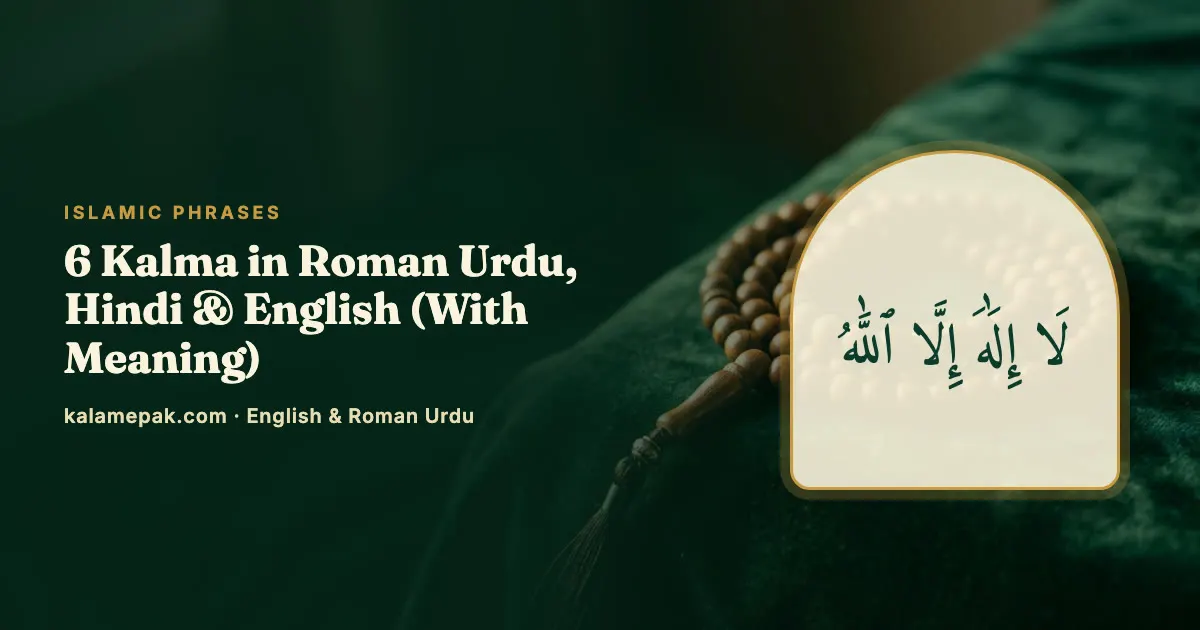
The 6 kalma are six short sentences that children in India, Pakistan and Bangladesh learn by heart, usually before anything else: Tayyab, Shahadat, Tamjeed, Tauheed, Astaghfar and Radd-e-Kufr. Together they say who Allah is, who the Prophet Muhammad ﷺ is, how we praise Allah, and how we ask Him for forgiveness.
Most of us can still recite them. Far fewer of us know what each line means. Below is every kalma in Arabic, then in Roman Urdu (so you can read it in English letters), its meaning in English, Roman Urdu, Urdu script and Hindi, how to read the Arabic in Hindi script, and where it comes from.
The 6 kalma at a glance
| # | Name | What the name means | What it says |
|---|---|---|---|
| 1 | Kalma Tayyab | the pure word | there is no god but Allah; Muhammad ﷺ is His Messenger |
| 2 | Kalma Shahadat | the testimony | I bear witness to the same |
| 3 | Kalma Tamjeed | glorifying | SubhanAllah, Alhamdulillah, La ilaha illallah, Allahu Akbar |
| 4 | Kalma Tauheed | oneness | Allah is One; life, death and all good are in His hand |
| 5 | Kalma Astaghfar | asking forgiveness | forgive every sin, known and unknown |
| 6 | Kalma Radd-e-Kufr | rejecting disbelief | I reject shirk and every sin, and I accept Islam |
Where do the 6 kalma come from?
This is worth knowing, because people often ask. The six kalma are not one list in the Quran or in one hadith. Mufti Abdurrahman ibn Yusuf explains that they "were compiled together for children to memorize and learn the basic fundamentals of a Muslim's beliefs", and that some of them are found individually in the narrations (his answer). The fatwa department of Darul Uloom Deoband lists a hadith source for each one (fatwa 344/236).
In short: most of the words of the first four are found in the Quran and hadith (we did not find abadan abadā, in the fourth, in a hadith). For the fifth and sixth, Deoband cites hadith sources, while other scholars describe them as drawn from hadith wordings (SeekersGuidance). Under each kalma below we show which part we found where.
1st Kalma (Pehla Kalma): Tayyab
Tayyib means pure, good. This is "the pure word", the sentence at the heart of Islam.
There is no god but Allah; Muhammad is the Messenger of Allah.
Allah ke siwa koi maabood nahin, Muhammad (sallallahu alaihi wa sallam) Allah ke Rasool hain.
Kalma Tayyab · both halves are Quran words: Quran 47:19 and Quran 48:29
In Roman Urdu: La ilaha illallahu Muhammadur Rasulullah
Exact sounds: Lā ilāha illallāhu Muḥammadur Rasūlullāh
اللہ کے سوا کوئی معبود نہیں، محمد (صلی اللہ علیہ وسلم) اللہ کے رسول ہیں
अल्लाह के सिवा कोई माबूद नहीं, मुहम्मद (सल्लल्लाहु अलैहि वसल्लम) अल्लाह के रसूल हैं
1st kalma ka tarjuma · Urdu and Hindi
Read the Arabic in Hindi script: ला इलाहा इल्लल्लाहु मुहम्मदुर रसूलुल्लाह
The first half, lā ilāha illā llāh, appears word for word in the Quran (for example 37:35 and 47:19), and the second half, Muḥammadun rasūlu llāh, is how Surah Al-Fath 48:29 begins. We explain every word in La ilaha illallah meaning.
2nd Kalma (Dusra Kalma): Shahadat
Shahādat means testimony. Here you don't only say it, you bear witness to it.
I bear witness that there is no god but Allah, He is One and has no partner, and I bear witness that Muhammad is His servant and His Messenger.
Main gawahi deta hoon ke Allah ke siwa koi maabood nahin, woh akela hai, us ka koi shareek nahin, aur main gawahi deta hoon ke Muhammad (sallallahu alaihi wa sallam) us ke bande aur us ke Rasool hain.
Kalma Shahadat · the same words are in Sahih Muslim 234b
In Roman Urdu: Ashhadu alla ilaha illallahu wahdahu la sharika lahu, wa ashhadu anna Muhammadan abduhu wa rasuluh
Exact sounds: Ashhadu allā ilāha illallāhu waḥdahū lā sharīka lahū, wa ashhadu anna Muḥammadan ʿabduhū wa rasūluh
میں گواہی دیتا ہوں کہ اللہ کے سوا کوئی معبود نہیں، وہ اکیلا ہے، اس کا کوئی شریک نہیں، اور میں گواہی دیتا ہوں کہ محمد (صلی اللہ علیہ وسلم) اس کے بندے اور اس کے رسول ہیں
मैं गवाही देता हूँ कि अल्लाह के सिवा कोई माबूद नहीं, वो अकेला है, उस का कोई शरीक नहीं, और मैं गवाही देता हूँ कि मुहम्मद (सल्लल्लाहु अलैहि वसल्लम) उस के बंदे और उस के रसूल हैं
2nd kalma ka tarjuma · Urdu and Hindi
Read the Arabic in Hindi script: अश्हदु अल्ला इलाहा इल्लल्लाहु वहदहू ला शरीका लहू, व अश्हदु अन्ना मुहम्मदन अब्दुहू व रसूलुह
These exact words are what the Prophet ﷺ taught to say after making wudu well (Sahih Muslim 234b). Full word by word: Kalma Shahadat meaning.
3rd Kalma (Teesra Kalma): Tamjeed
Tamjīd means glorifying. This kalma joins five of the most loved phrases of dhikr into one sentence.
Glory be to Allah, all praise is for Allah, there is no god but Allah, and Allah is the Greatest. There is no power and no strength except with Allah, the Most High, the Most Great.
Allah paak hai, sab taareef Allah hi ke liye hai, Allah ke siwa koi maabood nahin, aur Allah sab se bada hai. Koi taaqat aur koi quwwat nahin magar Allah ki madad se, jo buland aur azmat wala hai.
Kalma Tamjeed · words up to "illā billāh" taught in Abu Dawud 832 (al-Albani: hasan) and Nasa'i 924 (Darussalam: hasan)
In Roman Urdu: Subhanallahi walhamdu lillahi wa la ilaha illallahu wallahu akbar, wa la hawla wa la quwwata illa billahil aliyyil azeem
Exact sounds: Subḥānallāhi wal-ḥamdu lillāhi wa lā ilāha illallāhu wallāhu akbar, wa lā ḥawla wa lā quwwata illā billāhil ʿaliyyil ʿaẓīm
اللہ پاک ہے، سب تعریف اللہ ہی کے لیے ہے، اللہ کے سوا کوئی معبود نہیں، اور اللہ سب سے بڑا ہے۔ کوئی طاقت اور کوئی قوت نہیں مگر اللہ کی مدد سے، جو بلند اور عظمت والا ہے
अल्लाह पाक है, सब तारीफ़ अल्लाह ही के लिए है, अल्लाह के सिवा कोई माबूद नहीं, और अल्लाह सबसे बड़ा है। कोई ताक़त और कोई क़ुव्वत नहीं मगर अल्लाह की मदद से, जो बुलंद और अज़मत वाला है
3rd kalma ka tarjuma · Urdu and Hindi
Read the Arabic in Hindi script: सुब्हानल्लाहि वल्हम्दु लिल्लाहि व ला इलाहा इल्लल्लाहु वल्लाहु अक्बर, व ला हौला व ला क़ुव्वता इल्ला बिल्लाहिल अलिय्यिल अज़ीम
A man once told the Prophet ﷺ that he could not memorise anything from the Quran, and was taught to say these words: SubḥānAllāh, wal-ḥamdu lillāh, wa lā ilāha illallāh, wallāhu akbar, wa lā ḥawla wa lā quwwata illā billāh (Abu Dawud 832, graded hasan by al-Albani). The ending al-ʿaliyyil ʿaẓīm, "the Most High, the Most Great", is how the kalma is taught in South Asian books. Darul Uloom Deoband's fatwa gives it "in a narration", with the reference Muslim 2:345, but we did not find it in the Arabic of Sahih Muslim or Sahih al-Bukhari. The same phrases with this ending do come together in a dhikr for waking at night (Sunan Ibn Majah 3878; sunnah.com shows Darussalam's grade: sahih). More in Kalma Tamjeed meaning.
4th Kalma (Chautha Kalma): Tauheed
Tawḥīd means believing that Allah is One. This kalma is the longest description of Allah among the six.
There is no god but Allah, He is One and has no partner. His is the kingdom and His is the praise. He gives life and causes death, and He is Living and never dies, ever and ever. Owner of majesty and honour. In His hand is all good, and He has power over everything.
Allah ke siwa koi maabood nahin, woh akela hai, us ka koi shareek nahin. Usi ki baadshahi hai aur usi ke liye sab taareef hai. Wahi zinda karta hai aur wahi maut deta hai, aur woh khud zinda hai, kabhi nahin marega, hamesha hamesha. Woh azmat aur izzat wala hai. Usi ke haath mein har bhalaai hai, aur woh har cheez par qaadir hai.
Kalma Tauheed · opening in Sahih al-Bukhari 6403; see the sources below
In Roman Urdu: La ilaha illallahu wahdahu la sharika lah, lahul mulku wa lahul hamd, yuhyi wa yumit, wa huwa hayyun la yamutu abadan abada, zul jalali wal ikram, biyadihil khair, wa huwa ala kulli shai'in qadeer
Exact sounds: Lā ilāha illallāhu waḥdahū lā sharīka lah, lahul-mulku wa lahul-ḥamd, yuḥyī wa yumīt, wa huwa ḥayyun lā yamūtu abadan abadā, dhul-jalāli wal-ikrām, biyadihil-khayr, wa huwa ʿalā kulli shayʾin qadīr
اللہ کے سوا کوئی معبود نہیں، وہ اکیلا ہے، اس کا کوئی شریک نہیں۔ اسی کی بادشاہی ہے اور اسی کے لیے سب تعریف ہے۔ وہی زندہ کرتا ہے اور وہی موت دیتا ہے، اور وہ خود زندہ ہے، کبھی نہیں مرے گا، ہمیشہ ہمیشہ۔ وہ عظمت اور عزت والا ہے۔ اسی کے ہاتھ میں ہر بھلائی ہے، اور وہ ہر چیز پر قادر ہے
अल्लाह के सिवा कोई माबूद नहीं, वो अकेला है, उस का कोई शरीक नहीं। उसी की बादशाही है और उसी के लिए सब तारीफ़ है। वही ज़िंदा करता है और वही मौत देता है, और वो ख़ुद ज़िंदा है, कभी नहीं मरेगा, हमेशा हमेशा। वो अज़मत और इज़्ज़त वाला है। उसी के हाथ में हर भलाई है, और वो हर चीज़ पर क़ादिर है
4th kalma ka tarjuma · Urdu and Hindi
Read the Arabic in Hindi script: ला इलाहा इल्लल्लाहु वहदहू ला शरीका लहू, लहुल मुल्कु व लहुल हम्दु, युह्यी व युमीतु, व हुवा हय्युल ला यमूतु अबदन अबदा, ज़ुल जलालि वल इकराम, बियदिहिल ख़ैर, व हुवा अला कुल्लि शैइन क़दीर
Where it comes from: the opening, lā ilāha illallāhu waḥdahū lā sharīka lah, lahul-mulku wa lahul-ḥamd … wa huwa ʿalā kulli shayʾin qadīr, is a dhikr the Prophet ﷺ praised highly when said a hundred times a day (Sahih al-Bukhari 6403). The middle part is close to a dua for entering the market in Tirmidhi 3428 (scholars differ on its grading; sunnah.com shows Darussalam's grade: weak); Darul Uloom Deoband cites this hadith for the fourth kalma. Dhul-jalāli wal-ikrām is from the Quran (55:27). We did not find abadan abadā, "ever and ever", in a hadith. Full explanation: Kalma Tauheed meaning.
5th Kalma (Panchwan Kalma): Astaghfar
Istighfār means asking for forgiveness. This kalma asks for forgiveness of every kind of sin.
I ask forgiveness of Allah, my Lord, for every sin I have committed, on purpose or by mistake, in secret or in the open, and I turn to Him in repentance from the sin I know and from the sin I do not know. Surely You are the Knower of the unseen, the Concealer of faults and the Forgiver of sins. There is no power and no strength except with Allah, the Most High, the Most Great.
Main Allah se maafi maangta hoon jo mera Rabb hai, har us gunaah se jo main ne kiya, jaan boojh kar ya bhool kar, chhup kar ya khule aam, aur main us ki taraf tauba karta hoon us gunaah se jo main jaanta hoon aur us gunaah se jo main nahin jaanta. Beshak Tu ghaib ki baatein khoob jaanne wala, aibon ko chhupaane wala aur gunaahon ko bahut maaf karne wala hai. Koi taaqat aur koi quwwat nahin magar Allah ki madad se, jo buland aur azmat wala hai.
Kalma Astaghfar · a dua built from hadith wordings
In Roman Urdu: Astaghfirullaha rabbi min kulli zambin aznabtuhu amdan aw khata'an, sirran aw alaniyatan, wa atubu ilaihi minaz zambil lazi a'lamu wa minaz zambil lazi la a'lamu, innaka anta allamul ghuyubi wa sattarul uyubi wa ghaffaruz zunubi, wa la hawla wa la quwwata illa billahil aliyyil azeem
Exact sounds: Astaghfirullāha rabbī min kulli dhambin adhnabtuhū ʿamdan aw khaṭaʾan, sirran aw ʿalāniyatan, wa atūbu ilayhi minadh-dhambil-ladhī aʿlamu wa minadh-dhambil-ladhī lā aʿlam, innaka anta ʿallāmul-ghuyūbi wa sattārul-ʿuyūbi wa ghaffārudh-dhunūb, wa lā ḥawla wa lā quwwata illā billāhil ʿaliyyil ʿaẓīm
میں اللہ سے معافی مانگتا ہوں جو میرا رب ہے، ہر اس گناہ سے جو میں نے کیا، جان بوجھ کر یا بھول کر، چھپ کر یا کھلے عام، اور میں اس کی طرف توبہ کرتا ہوں اس گناہ سے جو میں جانتا ہوں اور اس گناہ سے جو میں نہیں جانتا۔ بیشک تو غیب کی باتیں خوب جاننے والا، عیبوں کو چھپانے والا اور گناہوں کو بہت معاف کرنے والا ہے۔ کوئی طاقت اور کوئی قوت نہیں مگر اللہ کی مدد سے، جو بلند اور عظمت والا ہے
मैं अल्लाह से माफ़ी माँगता हूँ जो मेरा रब है, हर उस गुनाह से जो मैं ने किया, जान बूझ कर या भूल कर, छुप कर या खुले आम, और मैं उस की तरफ़ तौबा करता हूँ उस गुनाह से जो मैं जानता हूँ और उस गुनाह से जो मैं नहीं जानता। बेशक तू ग़ैब की बातें ख़ूब जानने वाला, ऐबों को छुपाने वाला और गुनाहों को बहुत माफ़ करने वाला है। कोई ताक़त और कोई क़ुव्वत नहीं मगर अल्लाह की मदद से, जो बुलंद और अज़मत वाला है
5th kalma ka tarjuma · Urdu and Hindi
Read the Arabic in Hindi script: अस्तग़फ़िरुल्लाहा रब्बी मिन कुल्लि ज़म्बिन अज़्नब्तुहू अम्दन औ ख़ता-अन, सिर्रन औ अलानियतन, व अतूबु इलैहि मिनज़् ज़म्बिल्लज़ी अअ्लमु व मिनज़् ज़म्बिल्लज़ी ला अअ्लमु, इन्नका अन्ता अल्लामुल ग़ुयूबि व सत्तारुल उयूबि व ग़फ़्फ़ारुज़् ज़ुनूबि, व ला हौला व ला क़ुव्वता इल्ला बिल्लाहिल अलिय्यिल अज़ीम
We found no single hadith with this exact wording; Darul Uloom Deoband's fatwa points to Sahih al-Bukhari for istighfar. It gathers the meanings of istighfar found in the hadith. The Prophet ﷺ himself said he asked Allah's forgiveness more than seventy times a day (Sahih al-Bukhari 6307). For the short form, see Astaghfirullah meaning.
6th Kalma (Chhata Kalma): Radd-e-Kufr
Radd means rejecting, kufr disbelief. In this kalma you push away everything that spoils faith, then end with the first kalma again.
O Allah, I seek refuge in You from knowingly associating anything with You, and I ask Your forgiveness for what I do not know. I repent from it, and I free myself from disbelief, shirk, lying, backbiting, innovation in religion, tale-carrying, indecency, slander and all sins. I accept Islam, and I say: there is no god but Allah, Muhammad is the Messenger of Allah.
Aey Allah! Main Teri panaah maangta hoon is baat se ke jaan boojh kar kisi cheez ko Tera shareek banaaoon, aur Tujh se maafi maangta hoon us ki jo main nahin jaanta. Main ne us se tauba ki, aur main kufr, shirk, jhoot, gheebat, bid'at, chughli, behayaai ke kaamon, buhtaan aur har gunaah se bezaar hua. Main Islam laaya, aur main kehta hoon: Allah ke siwa koi maabood nahin, Muhammad (sallallahu alaihi wa sallam) Allah ke Rasool hain.
Kalma Radd-e-Kufr · opening close to Al-Adab Al-Mufrad 716
In Roman Urdu: Allahumma inni a'uzu bika min an ushrika bika shai'an wa ana a'lamu bihi, wa astaghfiruka lima la a'lamu bihi, tubtu anhu wa tabarra'tu minal kufri wash shirki wal kizbi wal ghibati wal bid'ati wan namimati wal fawahishi wal buhtani wal ma'asi kulliha, wa aslamtu wa aqulu la ilaha illallahu Muhammadur Rasulullah
Exact sounds: Allāhumma innī aʿūdhu bika min an ushrika bika shayʾan wa ana aʿlamu bih, wa astaghfiruka limā lā aʿlamu bih, tubtu ʿanhu wa tabarraʾtu minal-kufri wash-shirki wal-kidhbi wal-ghībati wal-bidʿati wan-namīmati wal-fawāḥishi wal-buhtāni wal-maʿāṣī kullihā, wa aslamtu wa aqūlu lā ilāha illallāhu Muḥammadur Rasūlullāh
اے اللہ! میں تیری پناہ مانگتا ہوں اس بات سے کہ جان بوجھ کر کسی چیز کو تیرا شریک بناؤں، اور تجھ سے معافی مانگتا ہوں اس کی جو میں نہیں جانتا۔ میں نے اس سے توبہ کی، اور میں کفر، شرک، جھوٹ، غیبت، بدعت، چغلی، بے حیائی کے کاموں، بہتان اور ہر گناہ سے بیزار ہوا۔ میں اسلام لایا، اور میں کہتا ہوں: اللہ کے سوا کوئی معبود نہیں، محمد (صلی اللہ علیہ وسلم) اللہ کے رسول ہیں
ऐ अल्लाह! मैं तेरी पनाह माँगता हूँ इस बात से कि जान बूझ कर किसी चीज़ को तेरा शरीक बनाऊँ, और तुझ से माफ़ी माँगता हूँ उस की जो मैं नहीं जानता। मैं ने उस से तौबा की, और मैं कुफ़्र, शिर्क, झूठ, ग़ीबत, बिदअत, चुग़ली, बेहयाई के कामों, बोहतान और हर गुनाह से बेज़ार हुआ। मैं इस्लाम लाया, और मैं कहता हूँ: अल्लाह के सिवा कोई माबूद नहीं, मुहम्मद (सल्लल्लाहु अलैहि वसल्लम) अल्लाह के रसूल हैं
6th kalma ka tarjuma · Urdu and Hindi
Read the Arabic in Hindi script: अल्लाहुम्मा इन्नी अऊज़ु बिका मिन अन उश्रिका बिका शैअन व अना अअ्लमु बिही, व अस्तग़फ़िरुका लिमा ला अअ्लमु बिही, तुब्तु अन्हु व तबर्रअ्तु मिनल कुफ़्रि वश्शिर्कि वल किज़्बि वल ग़ीबति वल बिदअति वन्नमीमति वल फ़वाहिशि वल बुह्तानि वल मआसी कुल्लिहा, व अस्लम्तु व अक़ूलु ला इलाहा इल्लल्लाहु मुहम्मदुर रसूलुल्लाह
The opening is close to a dua the Prophet ﷺ taught Abu Bakr about hidden shirk: "O Allah, I seek refuge in You from associating anything with You knowingly, and I ask Your forgiveness for what I do not know" (Al-Adab Al-Mufrad 716). We found no single hadith containing the list of sins that follows; Darul Uloom Deoband's fatwa cites Musnad Ahmad for this kalma. The list reads like a checklist for the heart.
How to learn the 6 kalma with meaning
- Learn one kalma a week. Say it after every namaz, then read its meaning once. By the end of the week the words and the meaning arrive together.
- Start with the short ones you already say. Kalma 3 is SubhanAllah, Alhamdulillah, La ilaha illallah and Allahu Akbar in a row. If you know SubhanAllah, Alhamdulillah and Allahu Akbar, you already know most of it.
- Notice the words that repeat. Lā ilāha illā llāh appears in five of the six. Lā ḥawla wa lā quwwata illā billāh in two. Allāh, ilāh, rabb, ghafara are all among the most common words of the Quran.
That last point is why the kalma are a good first step to understanding the Quran itself: their words come back on almost every page. The words ilāh, rasūl, ʿabd, shahida, ḥamd, ghafara and ʿaẓīm are all taught in 600 Words of the Quran, each with a real verse and its meaning in English and Roman Urdu.
A note on wording: the first three kalma read the same in every book. In the fourth, fifth and sixth, a word or two can differ between some books and regions. Learn the version your teacher or mosque uses.
Sources: Quran text from the Quranic Arabic Corpus and Tanzil · verse meanings in English from Marmaduke Pickthall and in Urdu from Maulana Muhammad Junagarhi · meanings of duas and phrases in Roman Urdu, Urdu and Hindi are our own plain renderings · hadith with collection and number, linked to sunnah.com. How we check every article →
Frequently asked questions
What are the 6 kalma?
Tayyab (la ilaha illallah Muhammadur Rasulullah), Shahadat (the testimony of faith), Tamjeed (glorifying Allah), Tauheed (Allah's oneness), Astaghfar (asking forgiveness) and Radd-e-Kufr (rejecting disbelief).
Are the 6 kalma in the Quran or hadith?
Not as one list. Mufti Abdurrahman ibn Yusuf explains that they were put together to teach children the basics of belief; Darul Uloom Deoband's fatwa department gives a hadith source for each. Most of the words of the first four are found in the Quran and hadith (we did not find 'abadan abada', in the fourth, in a hadith); for the fifth and sixth, scholars point to the hadith wordings they come from.
Which kalma do you say to become Muslim?
The testimony of faith: that there is no god but Allah and that Muhammad is His Messenger. This is the meaning of the first and second kalma.
Is the wording of the 6 kalma the same in every book?
Almost. The first three are the same everywhere. In the fourth, fifth and sixth a word or two differs between some books. Learn the version your teacher or local mosque uses.