Chautha Kalma (Kalma Tauheed) in Urdu, Hindi & English
Reviewed by Abrar Iqbal, Islamic scholar (PhD in Islamic research)
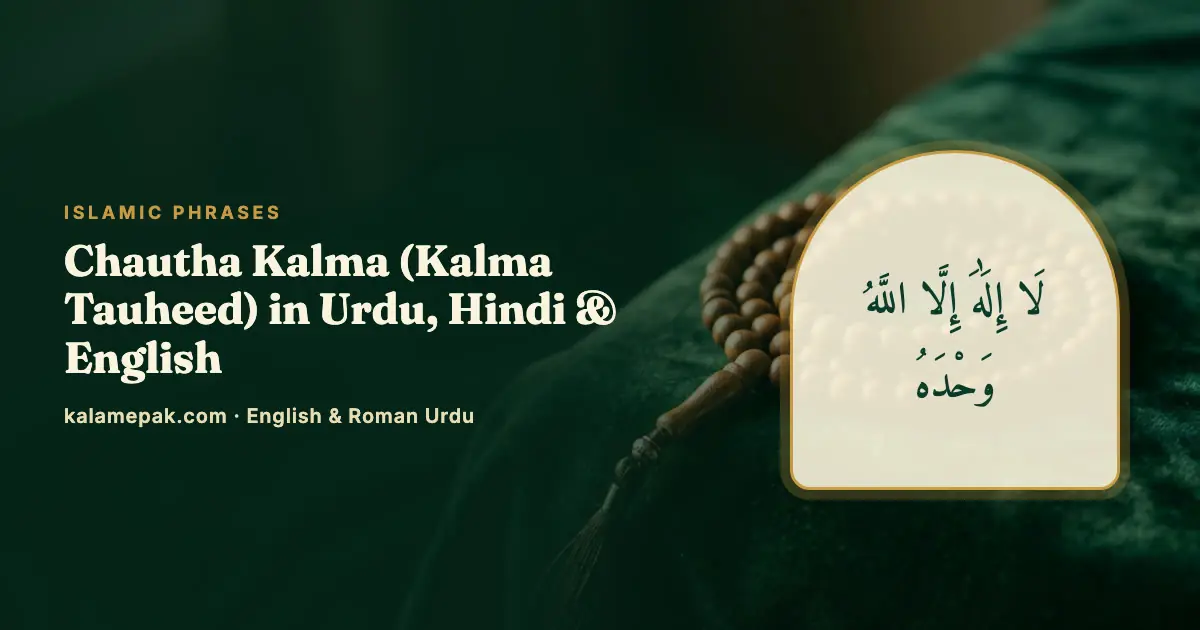
Kalma Tauheed, the fourth kalma (chautha kalma), means: "There is no god but Allah, He is One and has no partner. His is the kingdom and His is the praise. He gives life and causes death, and He is Living and never dies, ever and ever. Owner of majesty and honour. In His hand is all good, and He has power over everything."
Tawḥīd means oneness, believing that Allah is One. Of the six kalma, this one describes Allah in the most detail, and almost every phrase in it is also in the Quran. We'll go through them one by one.
There is no god but Allah, He is One and has no partner. His is the kingdom and His is the praise. He gives life and causes death, and He is Living and never dies, ever and ever. Owner of majesty and honour. In His hand is all good, and He has power over everything.
Allah ke siwa koi maabood nahin, woh akela hai, us ka koi shareek nahin. Usi ki baadshahi hai aur usi ke liye sab taareef hai. Wahi zinda karta hai aur wahi maut deta hai, aur woh khud zinda hai, kabhi nahin marega, hamesha hamesha. Woh azmat aur izzat wala hai. Usi ke haath mein har bhalaai hai, aur woh har cheez par qaadir hai.
Kalma Tauheed · as taught in South Asian books; sources below
Fourth kalma in Roman Urdu: Lā ilāha illallāhu waḥdahū lā sharīka lah, lahul-mulku wa lahul-ḥamd, yuḥyī wa yumīt, wa huwa ḥayyun lā yamūtu abadan abadā, dhul-jalāli wal-ikrām, biyadihil-khayr, wa huwa ʿalā kulli shayʾin qadīr.
Kalma Tauheed in Urdu and Hindi
اللہ کے سوا کوئی معبود نہیں، وہ اکیلا ہے، اس کا کوئی شریک نہیں۔ اسی کی بادشاہی ہے اور اسی کے لیے سب تعریف ہے۔ وہی زندہ کرتا ہے اور وہی موت دیتا ہے، اور وہ خود زندہ ہے، کبھی نہیں مرے گا، ہمیشہ ہمیشہ۔ وہ عظمت اور عزت والا ہے۔ اسی کے ہاتھ میں ہر بھلائی ہے، اور وہ ہر چیز پر قادر ہے
अल्लाह के सिवा कोई माबूद नहीं, वो अकेला है, उस का कोई शरीक नहीं। उसी की बादशाही है और उसी के लिए सब तारीफ़ है। वही ज़िंदा करता है और वही मौत देता है, और वो ख़ुद ज़िंदा है, कभी नहीं मरेगा, हमेशा हमेशा। वो अज़मत और इज़्ज़त वाला है। उसी के हाथ में हर भलाई है, और वो हर चीज़ पर क़ादिर है
Chautha kalma ka tarjuma · Urdu and Hindi
In Hindi script the Arabic is read: ला इलाहा इल्लल्लाहु वहदहू ला शरीका लहू, लहुल मुल्कु व लहुल हम्दु, युह्यी व युमीतु, व हुवा हय्युल ला यमूतु अबदन अबदा, ज़ुल जलालि वल इकराम, बियदिहिल ख़ैर, व हुवा अला कुल्लि शैइन क़दीर.
Phrase by phrase, with the Quran
1. Lā ilāha illallāhu waḥdahū lā sharīka lah
"There is no god but Allah, He is One, He has no partner." The first kalma said lā ilāha illallāh; this one adds waḥdahū (He alone) and lā sharīka lahū (no partner to Him), closing every door to shirk. The Quran says the same of Allah in Surah Al-An'am: "He hath no partner" (6:163).
2. Lahul-mulku wa lahul-ḥamd
"His is the kingdom and His is the praise." These words are in the Quran exactly:
…unto Him belongeth Sovereignty and unto Him belongeth praise, and He is Able to do all things.
…usi ki saltanat hai aur usi ki taareef hai, aur woh har har cheez par qaadir hai
Surah At-Taghabun · 64:1 (part)
3. Yuḥyī wa yumīt
"He gives life and He causes death."
He quickeneth and He giveth death; and He is Able to do all things.
Wahi zindagi deta hai aur maut bhi, aur woh har cheez par qaadir hai
Surah Al-Hadid · 57:2 (part)
4. Wa huwa ḥayyun lā yamūt
"And He is Living and never dies." Everyone we rely on will one day die. The Quran tells us whom to rely on instead:
And trust thou in the Living One Who dieth not…
Us hamesha zinda rehne wale Allah Ta'ala par tawakkul karein jise kabhi maut nahin…
Surah Al-Furqan · 25:58 (part)
The kalma then adds abadan abadā, "ever and ever", for emphasis. We did not find these two words in a hadith; they are how the kalma is taught in the books.
5. Dhul-jalāli wal-ikrām
"Owner of majesty and honour." When everything else has passed away, this is what remains:
There remaineth but the Countenance of thy Lord of Might and Glory.
Sirf tere Rabb ki zaat jo azmat aur izzat wali hai baaqi reh jaayegi
Surah Ar-Rahman · 55:27
6. Biyadihil-khayr
"In His hand is all good." In the Quran it is said to Allah directly:
In Thy hand is the good. Lo! Thou art Able to do all things.
Tere hi haath mein sab bhalaaiyaan hain, beshak Tu har cheez par qaadir hai
Surah Al Imran · 3:26 (part)
7. Wa huwa ʿalā kulli shayʾin qadīr
"And He has power over everything." You have now seen this ending three times above (64:1, 57:2, 3:26). It comes many times in the Quran, and the first verse of Surah Al-Mulk ends with it too (67:1).
Kalma Tauheed word by word: the key words
| Arabic | Say it | Meaning | In the book |
|---|---|---|---|
| لَا شَرِيكَ | lā sharīka | no partner | #141 sharīk · 40× |
| الْمُلْكُ | al-mulku | the kingdom | #291 mulk · 48× |
| الْحَمْدُ | al-ḥamdu | the praise | #218 ḥamd · 43× |
| يُحْيِي | yuḥyī | He gives life | #154 aḥyā · 51× |
| يَمُوتُ | yamūtu | (He) dies | #178 māta · 39× |
| حَيٌّ | ḥayyun | living | #299 ḥayy · 24× |
| بِيَدِهِ | biyadihi | in His hand | #145 yad · 120× |
| الْخَيْرُ | al-khayru | the good | #182 khayr · 178× |
| كُلِّ | kulli | every | #50 kull · 359× |
| قَدِيرٌ | qadīrun | all-powerful | #293 qadīr · 45× |
"In the book" is the word's number in 600 Words of the Quran and how many times it appears in the Quran.
Where Kalma Tauheed comes from
Like the other kalma, this one is taught as part of a list put together for children to learn. The fatwa department of Darul Uloom Deoband says all six are proved from hadith and cites the market dua in Tirmidhi for this one (fatwa 344/236). Here is where each part is found:
- The opening is a dhikr the Prophet ﷺ praised: whoever says lā ilāha illallāhu waḥdahū lā sharīka lah, lahul-mulku wa lahul-ḥamd, wa huwa ʿalā kulli shayʾin qadīr a hundred times in a day gets the reward of freeing ten slaves, a hundred good deeds are written for him, a hundred sins are wiped away, and it is a protection from Satan until evening (Sahih al-Bukhari 6403, Sahih Muslim 2691). The same words complete the hundred after the tasbeeh of namaz (Sahih Muslim 597).
- The middle, yuḥyī wa yumīt, wa huwa ḥayyun lā yamūt, biyadihil-khayr, is close to a dua for entering the market reported in Tirmidhi 3428. Scholars differ on the grading of that narration (sunnah.com shows Darussalam's grade: weak), so we don't quote its reward; the meaning of each of its phrases is in the Quran, as shown above.
- Dhul-jalāli wal-ikrām is from the Quran (55:27).
- Abadan abadā, "ever and ever": we did not find these two words in a hadith.
A one-minute reflection
Say the kalma slowly once, and at each phrase think of one thing:
- lā sharīka lah: nothing I fear or love shares His power.
- yuḥyī wa yumīt: my life and my death are both in His hand.
- ḥayyun lā yamūt: the One I rely on will never leave.
- biyadihil-khayr: whatever good I hope for is with Him.
For the other five kalma, see the 6 kalma in Roman Urdu; for the first, La ilaha illallah meaning. Words like mulk, ḥamd, ḥayy, yad, khayr and qadīr are taught in 600 Words of the Quran, each with a real verse, and you will meet them on page after page of the Quran.
Sources: Quran text from the Quranic Arabic Corpus and Tanzil · verse meanings in English from Marmaduke Pickthall and in Urdu from Maulana Muhammad Junagarhi · meanings of duas and phrases in Roman Urdu, Urdu and Hindi are our own plain renderings · hadith with collection and number, linked to sunnah.com. How we check every article →
Frequently asked questions
What is the meaning of Kalma Tauheed?
There is no god but Allah, He is One and has no partner. His is the kingdom and His is the praise. He gives life and causes death, and He is Living and never dies, ever and ever. Owner of majesty and honour. In His hand is all good, and He has power over everything.
What does Tauheed mean?
Tauheed (tawhid) means believing and declaring that Allah is One: one in His being, with no partner in His power and none who deserves worship besides Him.
Is Kalma Tauheed in the hadith?
Its opening is: the Prophet ﷺ praised saying 'La ilaha illallahu wahdahu la sharika lah, lahul mulku wa lahul hamd, wa huwa ala kulli shay'in qadir' a hundred times a day (Sahih al-Bukhari 6403). The middle part is close to a dua in Tirmidhi 3428, whose grading scholars differ on (sunnah.com shows Darussalam's grade: weak), and 'dhul jalali wal ikram' is from the Quran (55:27).
Which is the fourth kalma?
In the usual South Asian order: 1 Tayyab, 2 Shahadat, 3 Tamjeed, 4 Tauheed, 5 Astaghfar, 6 Radd-e-Kufr. Kalma Tauheed is the fourth.