Teesra Kalma (Kalma Tamjeed) in Urdu, Hindi & English
Reviewed by Abrar Iqbal, Islamic scholar (PhD in Islamic research)
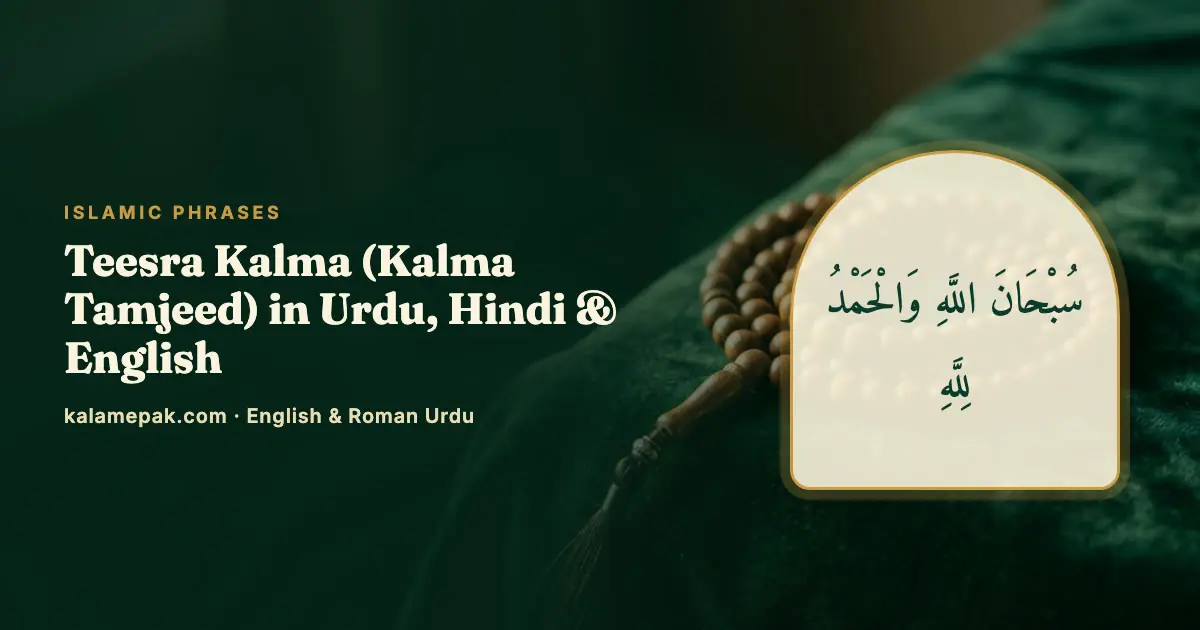
Kalma Tamjeed, the third kalma (teesra kalma), means: "Glory be to Allah, all praise is for Allah, there is no god but Allah, and Allah is the Greatest. There is no power and no strength except with Allah, the Most High, the Most Great."
It looks long, but it is really five short phrases joined together, and you almost certainly know all five already: SubhanAllah, Alhamdulillah, La ilaha illallah, Allahu Akbar, and La hawla wa la quwwata illa billah.
Glory be to Allah, all praise is for Allah, there is no god but Allah, and Allah is the Greatest. There is no power and no strength except with Allah, the Most High, the Most Great.
Allah paak hai, sab taareef Allah hi ke liye hai, Allah ke siwa koi maabood nahin, aur Allah sab se bada hai. Koi taaqat aur koi quwwat nahin magar Allah ki madad se, jo buland aur azmat wala hai.
Kalma Tamjeed · words up to "illā billāh" taught in Abu Dawud 832 (al-Albani: hasan) and Nasa'i 924 (Darussalam: hasan)
Third kalma in Roman Urdu: Subḥānallāhi wal-ḥamdu lillāhi wa lā ilāha illallāhu wallāhu akbar, wa lā ḥawla wa lā quwwata illā billāhil ʿaliyyil ʿaẓīm.
Kalma Tamjeed in Urdu and Hindi
اللہ پاک ہے، سب تعریف اللہ ہی کے لیے ہے، اللہ کے سوا کوئی معبود نہیں، اور اللہ سب سے بڑا ہے۔ کوئی طاقت اور کوئی قوت نہیں مگر اللہ کی مدد سے، جو بلند اور عظمت والا ہے
अल्लाह पाक है, सब तारीफ़ अल्लाह ही के लिए है, अल्लाह के सिवा कोई माबूद नहीं, और अल्लाह सबसे बड़ा है। कोई ताक़त और कोई क़ुव्वत नहीं मगर अल्लाह की मदद से, जो बुलंद और अज़मत वाला है
Teesra kalma ka tarjuma · Urdu and Hindi
In Hindi script the Arabic is read: सुब्हानल्लाहि वल्हम्दु लिल्लाहि व ला इलाहा इल्लल्लाहु वल्लाहु अक्बर, व ला हौला व ला क़ुव्वता इल्ला बिल्लाहिल अलिय्यिल अज़ीम.
Tamjīd means glorifying, declaring Allah's greatness and honour, and that is all this kalma does. It asks for nothing. It only praises.
Five phrases in one kalma
| Phrase | Meaning | Read more |
|---|---|---|
| Subḥānallāh | Glory be to Allah: He is free of every fault | SubhanAllah meaning |
| Wal-ḥamdu lillāh | and all praise is for Allah | Alhamdulillah meaning |
| Wa lā ilāha illallāh | and there is no god but Allah | La ilaha illallah meaning |
| Wallāhu akbar | and Allah is the Greatest | Allahu Akbar meaning |
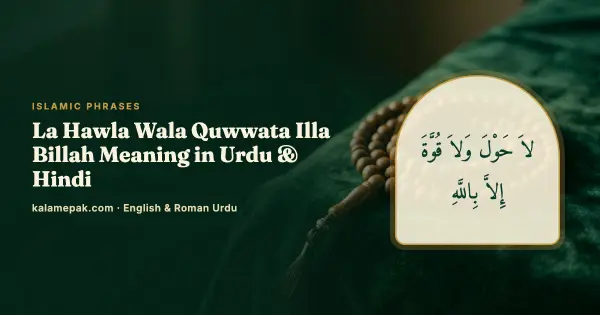
| Wa lā ḥawla wa lā quwwata illā billāh | and there is no power and no strength except with Allah | La hawla meaning |
The first two praise Allah for what He is (perfect) and what He gives (everything good). The third and fourth say that He alone is God and He is greater than all. The fifth turns to us: whatever we manage to do, we do only with His help.
Kalma Tamjeed word by word
| Arabic | Say it | Meaning | In the book |
|---|---|---|---|
| سُبْحَانَ | subḥāna | glory be to | #398 subḥān · 41× |
| اللَّهِ | Allāhi | Allah | #2 · 2,699× |
| وَالْحَمْدُ | wal-ḥamdu | and the praise | #218 ḥamd · 43× |
| لِلَّهِ | lillāhi | is for Allah | |
| وَلَا إِلَٰهَ إِلَّا اللَّهُ | wa lā ilāha illallāhu | and no god except Allah | #3 lā · #283 ilāh · #17 illā |
| وَاللَّهُ أَكْبَرُ | wallāhu akbaru | and Allah is the Greatest | #528 akbar · 24× |
| وَلَا حَوْلَ | wa lā ḥawla | and no might | ḥawl (see below) |
| وَلَا قُوَّةَ | wa lā quwwata | and no strength | #258 quwwah · 30× |
| إِلَّا بِاللَّهِ | illā billāhi | except with Allah | |
| الْعَلِيِّ | al-ʿaliyyi | the Most High | |
| الْعَظِيمِ | al-ʿaẓīmi | the Most Great | #244 ʿaẓīm · 107× |
"In the book" is the word's number in 600 Words of the Quran and how many times it appears in the Quran.
A small detail about ḥawl: in our word list, ḥawl (#395) is taught in its most common Quran meaning, "around" (as in "around the Throne"). In lā ḥawla, the same word is used in its other sense, which sunnah.com's translation of Sahih Muslim gives as "might": "There is neither might nor power but that of Allah."
Where the words of Kalma Tamjeed come from
The man who could not memorise the Quran. Abdullah ibn Abi Awfa narrated that a man came to the Prophet ﷺ and said he could not memorise anything from the Quran, and asked for something that would be enough for him. The Prophet ﷺ taught him: SubḥānAllāh, wal-ḥamdu lillāh, wa lā ilāha illallāh, wallāhu akbar, wa lā ḥawla wa lā quwwata illā billāh. When the man asked what was for himself, he was taught a short dua too (Abu Dawud 832, graded hasan by al-Albani; also Nasa'i 924, graded hasan by Darussalam).
So the third kalma is, almost word for word, what the Prophet ﷺ gave to someone who felt he could not learn much. If you have ever felt the same, this kalma was made for you.
The dearest words to Allah. The Prophet ﷺ said the dearest words to Allah are four: SubḥānAllāh, al-ḥamdu lillāh, lā ilāha illallāh, Allāhu akbar, and that it does not matter which one you begin with (Sahih Muslim 2137). Those are the first four phrases of this kalma.
A treasure of Paradise. Of the fifth phrase, the Prophet ﷺ told Abu Musa: "Shall I tell you a word which is one of the treasures of Paradise? It is: La hawla wa la quwwata illa billah" (Sahih al-Bukhari 6384, Sahih Muslim 2704).
The ending. The words al-ʿaliyyil ʿaẓīm, "the Most High, the Most Great", are how the kalma is taught in South Asian books. We did not find them in the Arabic of the two narrations above (sunnah.com's English of Nasa'i 924 adds them, but its Arabic ends at billāh). Darul Uloom Deoband's fatwa gives this ending "in a narration" (wa fī riwāyah), with the reference Muslim 2:345 at the end of the line, but we did not find these words in the Arabic of Sahih Muslim or Sahih al-Bukhari. The same phrases with this ending do come together in a dhikr for waking at night (Sunan Ibn Majah 3878; sunnah.com shows Darussalam's grade: sahih). The same two names end Ayatul Kursi: wa huwa l-ʿaliyyu l-ʿaẓīm, "He is the Sublime, the Tremendous."
How to use the third kalma every day
- After namaz. The Prophet ﷺ taught saying SubḥānAllāh 33 times, al-ḥamdu lillāh 33 times and Allāhu akbar 33 times after every prayer (Sahih Muslim 597). The third kalma contains all three. Our guide to SubhanAllah, Alhamdulillah, Allahu Akbar explains the counts.
- When something is too heavy. Stop at the last phrase, lā ḥawla wa lā quwwata illā billāh, and mean it: I can't do this alone.
- While walking or waiting. Five phrases, under ten seconds. It is the easiest dhikr to repeat without anyone noticing.
The words subḥān, ḥamd, ilāh, akbar, quwwah and ʿaẓīm are all taught in 600 Words of the Quran, each with a real verse in English and Roman Urdu. For all six kalma together, see the 6 kalma in Roman Urdu.
Sources: Quran text from the Quranic Arabic Corpus and Tanzil · verse meanings in English from Marmaduke Pickthall and in Urdu from Maulana Muhammad Junagarhi · meanings of duas and phrases in Roman Urdu, Urdu and Hindi are our own plain renderings · hadith with collection and number, linked to sunnah.com. How we check every article →
Frequently asked questions
What is the meaning of Kalma Tamjeed?
Glory be to Allah, all praise is for Allah, there is no god but Allah, and Allah is the Greatest. There is no power and no strength except with Allah, the Most High, the Most Great.
Why is it called Tamjeed?
Tamjeed means glorifying, declaring someone's greatness and honour. The whole kalma is praise of Allah.
Is Kalma Tamjeed in the hadith?
Its words are. The Prophet ﷺ taught a man who could not memorise the Quran to say 'SubhanAllah, walhamdulillah, wa la ilaha illallah, wallahu akbar, wa la hawla wa la quwwata illa billah' (Abu Dawud 832, Nasa'i 924). The ending 'al-aliyyil azim' is how South Asian books teach it; the same phrases with that ending come together in a dhikr in Ibn Majah 3878.
Can I read Kalma Tamjeed as tasbeeh after namaz?
Yes, its phrases are among the best dhikr. The Prophet ﷺ called the first four the dearest words to Allah (Sahih Muslim 2137).