Khane Ki Dua Before & After Eating: Arabic, Meaning in Urdu & Hindi
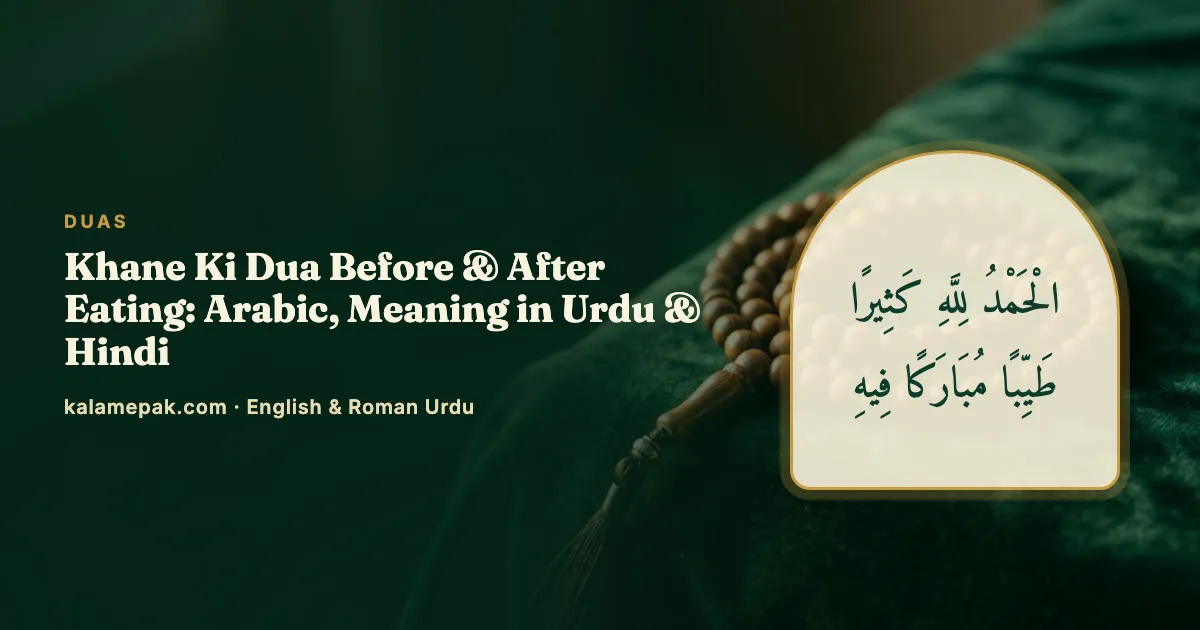
Khane ki dua has two halves. Before you eat: Bismillāh, and if you forgot and remembered midway, Bismillāhi awwalahu wa ākhirahu, "in the name of Allah at its beginning and its end" (Sunan Abi Dawud 3767). After you eat, the dua the Prophet ﷺ said when his dining cloth was lifted: Al-ḥamdu lillāhi kathīran ṭayyiban mubārakan fīhi… (Sahih al-Bukhari 5458). Many of us learnt a third one, Al-ḥamdu lillāhi l-ladhī aṭʿamanā wa saqānā wa jaʿalanā muslimīn; it is on this page too, with its grade stated plainly. Arabic, Roman English, meaning in English, Urdu, Roman Urdu and Hindi, and every word.
Khane se pehle ki dua (before eating)
In the name of Allah.
Allah ke naam se.
Sunan Abi Dawud 3767: "when one of you eats, let him mention the name of Allah" · Sahih (al-Albani)
اللہ کے نام سے
अल्लाह के नाम से।
Just Bismillāh: the hadith says to mention Allah's name, and that is the shortest way. The full line Bismillāhir Raḥmānir Raḥīm is also mentioning His name; both are fine. See Bismillah meaning for the words.
If you forgot Bismillah at the start
In the name of Allah, at its beginning and its end.
Allah ke naam se, is ke shuru mein bhi aur aakhir mein bhi.
Sunan Abi Dawud 3767 · narrated by Aisha · Sahih (al-Albani)
اللہ کے نام سے، اس کے شروع میں بھی اور آخر میں بھی
अल्लाह के नाम से, इसके शुरू में भी और आख़िर में भी।
Roman English: Bismillāhi awwalahu wa ākhirahu.
Khane ke baad ki dua (after eating)
Praise be to Allah, much, good and blessed praise; (a favour) not sufficed, not left off, and not dispensed with, our Lord.
Allah ke liye bahut zyada, paakeeza aur barkat wali taareef hai; (aisi naimat) jis ka haq ada nahin hota, jo chhodi nahin ja sakti aur jis se be-parwah nahin hua ja sakta, aey hamare Rabb.
Sahih al-Bukhari 5458 · narrated by Abu Umama
اللہ کے لیے بہت زیادہ، پاکیزہ اور برکت والی تعریف ہے؛ (ایسی نعمت) جس کا حق ادا نہیں ہوتا، جو چھوڑی نہیں جا سکتی اور جس سے بے پروا نہیں ہوا جا سکتا، اے ہمارے رب
अल्लाह के लिए बहुत ज़्यादा, पाकीज़ा और बरकत वाली तारीफ़ है; (ऐसी नेमत) जिसका हक़ अदा नहीं होता, जो छोड़ी नहीं जा सकती और जिससे बे-परवाह नहीं हुआ जा सकता, ऐ हमारे रब।
Roman English: Al-ḥamdu lillāhi kathīran ṭayyiban mubārakan fīhi, ghayra makfiyyin wa lā muwaddaʿin wa lā mustaghnan ʿanhu, Rabbanā.
The English here is a plain rendering of the Arabic (sunnah.com gives the hadith in transliteration); the Urdu, Roman Urdu and Hindi are our own plain rendering. The middle phrase is hard even for Arabs; the sense is: this food is a favour from Allah that we can never repay, never do without, and never stop needing.
The shorter one, with forgiveness
Muʿadh ibn Anas narrates that the Prophet ﷺ said: whoever eats food and then says this is forgiven his earlier sins (Sunan Abi Dawud 4023; al-Albani graded it hasan, except the added words "and later").
Praise be to Allah who fed me this food and provided it to me without any might or power on my part.
Tamaam taareef Allah ke liye hai jis ne mujhe yeh khana khilaya aur meri kisi taaqat aur quwwat ke baghair mujhe yeh ata kiya.
Sunan Abi Dawud 4023 · narrated by Muʿadh ibn Anas · Hasan (al-Albani)
तमाम तारीफ़ अल्लाह के लिए है जिसने मुझे यह खाना खिलाया और मेरी किसी ताक़त और क़ुव्वत के बग़ैर मुझे यह अता किया।
Roman English: Al-ḥamdu lillāhi l-ladhī aṭʿamanī hādha ṭ-ṭaʿāma wa razaqanīhi min ghayri ḥawlin minnī wa lā quwwah.
Word by word
The number in the last column is the word's place in 600 Words of the Quran.
| Arabic | Say it | Meaning | In the book |
|---|---|---|---|
| بِسْمِ اللَّهِ | bismillāh | in the name of Allah | ism #295, Allāh #2 |
| أَوَّلَهُ | awwalahu | its beginning | awwal #55 |
| وَآخِرَهُ | wa ākhirahu | and its end | ākhir #163 |
| الْحَمْدُ لِلَّهِ | al-ḥamdu lillāh | praise is for Allah | ḥamd #218 |
| كَثِيرًا | kathīran | much, abundant | kathīr #58 |
| طَيِّبًا | ṭayyiban | good, pure | ṭayyib #539 |
| مُبَارَكًا فِيهِ | mubārakan fīhi | blessed in it | |
| غَيْرَ مَكْفِيٍّ | ghayra makfiyy | not sufficed, never fully repaid | ghayr #37 |
| وَلاَ مُوَدَّعٍ | wa lā muwaddaʿ | and not left off, not bidden farewell | lā #3 |
| وَلاَ مُسْتَغْنًى عَنْهُ | wa lā mustaghnan ʿanhu | and not dispensed with | ghanī #300 |
| رَبَّنَا | Rabbanā | our Lord | rabb #12 |
| أَطْعَمَنِي | aṭʿamanī | He fed me | ṭaʿām #507 |
| الطَّعَامَ | aṭ-ṭaʿām | the food | ṭaʿām #507 |
| رَزَقَنِيهِ | razaqanīhi | He provided it to me | razaqa #96 |
| حَوْلٍ | ḥawl | might, power to change | |
| قُوَّةٍ | quwwah | strength | quwwah #258 |
Al-ḥamdu lillāh you know from Alhamdulillah meaning and from every rakat of namaz; kathīran and ṭayyiban are both common Quran words; ḥawl and quwwah are the pair from La hawla wala quwwata illa billah. The after-food dua is nearly all words you already have.
About "Alhamdulillahil lazi at'amana wa saqana wa ja'alana muslimin"
الْحَمْدُ لِلَّهِ الَّذِي أَطْعَمَنَا وَسَقَانَا وَجَعَلَنَا مُسْلِمِينَ
Al-ḥamdu lillāhi l-ladhī aṭʿamanā wa saqānā wa jaʿalanā muslimīn: "Praise be to Allah who fed us, gave us drink and made us Muslims." This is the wording printed in most dua books in India and Pakistan, so it is probably the one you learnt as a child. On sunnah.com it is Sunan Abi Dawud 3850 and Jami at-Tirmidhi 3457, both from Abu Saʿid al-Khudri, and both chains are graded daʿif (weak) by al-Albani and by the Darussalam edition. That does not make the words wrong: they are plain praise and thanks, and every word is true. It only means we cannot say with certainty that the Prophet ﷺ said exactly this. If you want to be sure your after-food dua is his, learn the Bukhari one above; if you keep saying this one, say it as praise, not as a reported sunnah wording.
How to make it a habit
- Bismillāh before the first bite, out loud, so children copy it. If you forget, Bismillāhi awwalahu wa ākhirahu whenever you remember.
- After the meal, at least Al-ḥamdu lillāh; then build up to kathīran ṭayyiban mubārakan fīhi, and later the whole line.
- Before you sleep that night there is sone ki dua, and when you step out in the morning, ghar se nikalne ki dua.
In Ramadan the meal has its own duas: iftar ki dua, with the grade of the popular Allahumma inni laka sumtu and what the hadith says about roza ki niyat.
Sources: Quran text from the Quranic Arabic Corpus and Tanzil · verse meanings in English from Marmaduke Pickthall and in Urdu from Maulana Muhammad Junagarhi · meanings of duas and phrases in Roman Urdu, Urdu and Hindi are our own plain renderings · hadith with collection and number, linked to sunnah.com. How we check every article →
Frequently asked questions
What is the dua before eating (khane se pehle ki dua)?
Bismillah, In the name of Allah. The Prophet ﷺ said: when one of you eats, let him mention Allah's name; if he forgets at the start, let him say Bismillahi awwalahu wa akhirahu, In the name of Allah at its beginning and its end (Sunan Abi Dawud 3767, sahih).
What is the dua after eating (khane ke baad ki dua)?
Alhamdulillahi kathiran tayyiban mubarakan fihi, ghaira makfiyyin wa la muwadda'in wa la mustaghnan 'anhu Rabbana: the dua the Prophet ﷺ said when his dining cloth was lifted (Sahih al-Bukhari 5458).
Is 'Alhamdulillahil lazi at'amana wa saqana wa ja'alana muslimin' authentic?
It is the version most Indian dua books teach. On sunnah.com it is Sunan Abi Dawud 3850 and Jami at-Tirmidhi 3457, and both chains are graded weak (da'if) by al-Albani and the Darussalam edition. The words are good praise, but if you want a wording with a sound chain, use the Bukhari 5458 dua above.
Khane ki dua in Hindi?
खाने से पहले: अल्लाह के नाम से। खाने के बाद: अल्लाह के लिए बहुत ज़्यादा, पाकीज़ा और बरकत वाली तारीफ़ है। Read the Arabic; this is its meaning.
Which dua after eating earns forgiveness?
Alhamdulillahil lazi at'amani hadhat ta'am wa razaqanihi min ghairi hawlin minni wa la quwwah: whoever eats and says it is forgiven his earlier sins (Sunan Abi Dawud 4023, graded hasan by al-Albani except the words 'and later').