Rabbi Inni Lima Anzalta Ilayya Min Khairin Faqir: Meaning in Urdu, Hindi & English
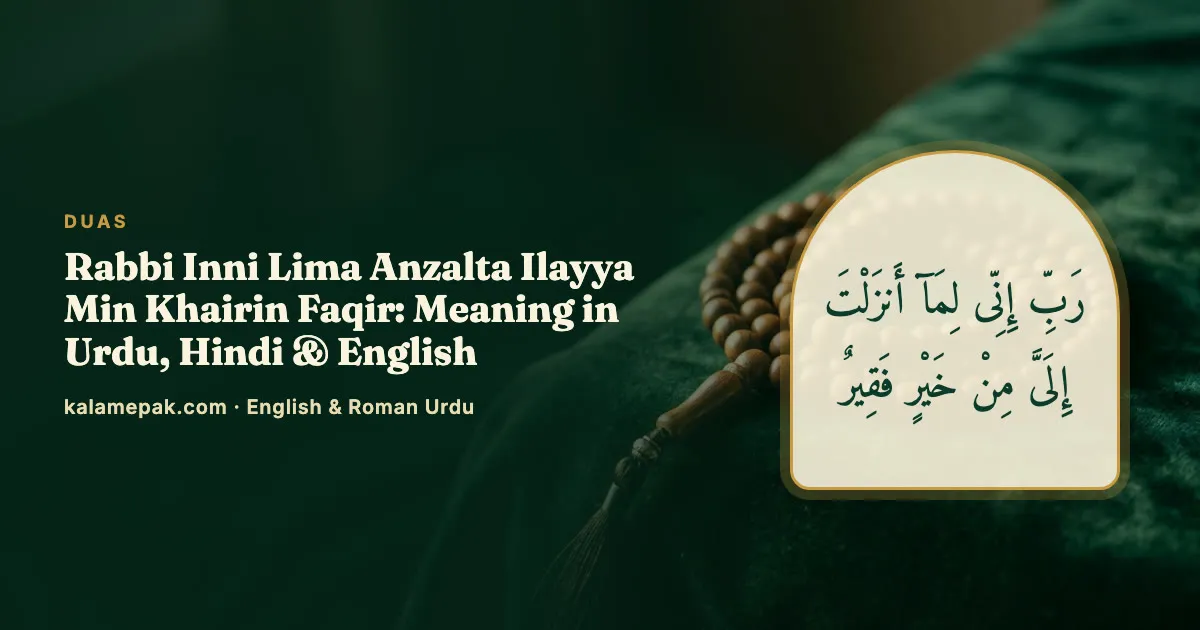
Rabbi inni lima anzalta ilayya min khairin faqir means: "My Lord! I am needy of whatever good Thou sendest down for me" (Quran 28:24, Pickthall). In Roman Urdu: Aey parwardigar! Tu jo kuch bhalaai meri taraf utaare main us ka mohtaaj hoon. It is the dua Musa (AS) said in the shade of a tree, with no money, no home and no country, after he had just done a kindness for two strangers. Here is the verse, its meaning in English, Urdu, Roman Urdu and Hindi, every word, and the story around it.
The verse in Arabic, English, Urdu and Roman Urdu
So he watered (their flock) for them. Then he turned aside into the shade, and said: My Lord! I am needy of whatever good Thou sendest down for me.
Pas aap ne khud un jaanwaron ko paani pila diya, phir saaye ki taraf hat aaye aur kehne lage: Aey parwardigar! Tu jo kuch bhalaai meri taraf utaare main us ka mohtaaj hoon.
Surah Al-Qasas · 28:24
پس آپ نے خود ان جانوروں کو پانی پلا دیا پھر سائے کی طرف ہٹ آئے اور کہنے لگے اے پروردگار! تو جو کچھ بھلائی میری طرف اتارے میں اس کا محتاج ہوں
पस आपने ख़ुद उन जानवरों को पानी पिला दिया, फिर साए की तरफ़ हट आए और कहने लगे: ऐ परवरदिगार! तू जो कुछ भलाई मेरी तरफ़ उतारे मैं उसका मोहताज हूँ।
The English is Pickthall's translation, the Urdu is Maulana Muhammad Junagarhi's, and the Roman Urdu and Hindi are the same Urdu line written in English and Devanagari letters.
Word by word
| Arabic | Say it | Meaning | In the book |
|---|---|---|---|
| رَبِّ | rabbi | my Lord | rabb #12 |
| إِنِّي | innī | indeed I | inna #5 |
| لِمَا | li-mā | for whatever | mā #7 |
| أَنزَلْتَ | anzalta | You sent down | anzala #66 |
| إِلَيَّ | ilayya | to me | ilā #15 |
| مِنْ خَيْرٍ | min khayrin | of good | min #1, khayr #182 |
| فَقِيرٌ | faqīr | needy, poor |
Seven words, and six of them are in the first 200 words of 600 Words of the Quran. Faqīr is the one word you may not know; it is the same word as fakir in Urdu and Hindi, someone who has nothing and asks.
Notice the order. Musa (AS) does not say "give me". He says I am faqīr, in need, of whatever good You send. He does not name what he wants. He leaves the choice of the "good" to Allah, and the story shows what that good turned out to be.
The story around the dua (Surah Al-Qasas 28:22–28)
Musa (AS) has fled Egypt. He arrives at the water of Madyan and finds a crowd of shepherds watering their animals, and two women standing apart, holding their flock back. He asks what is wrong. They say: "We cannot give (our flocks) to drink till the shepherds return from the water; and our father is a very old man" (28:23). So he waters their flock for them, turns to the shade, and says this dua (28:24).
Then one of the two women comes back, walking shyly, and says her father wants to reward him for the watering. Musa (AS) goes with her, tells the old man his story, and hears: "Fear not! Thou hast escaped from the wrongdoing folk" (28:25). The verses that follow tell how he was offered work and marriage into that family.
So the "good" that came down after this dua was not money in the shade. It was safety, work, a wife and a home, and it came through the very kindness he had just done without expecting anything.
When people read this dua
- When in need of rizq (provision) or work. The verse is the words of a man with nothing, asking for whatever Allah sends.
- When you have done good and feel you have nothing to show for it. Musa (AS) said it right after helping strangers.
- When you do not know what to ask for. The dua names no amount and no thing; it leaves the "good" to Allah.
Earlier in his life, before facing Firaun, Musa (AS) made another short dua that people read before speaking: Rabbish rahli sadri (20:25–28).
There is no fixed number of times in the Quran or the hadith for this verse; read it with its meaning in mind. Two other short Quranic duas that people read beside it are Ayat e Karima, the dua of Yunus (AS), and Hasbunallahu wa niʿmal wakeel.
For your parents, the Quran gives its own Rabbi dua: Rabbir hamhuma kama rabbayani sagheera (17:24), have mercy on them both as they raised me when I was small.
Sources: Quran text from the Quranic Arabic Corpus and Tanzil · verse meanings in English from Marmaduke Pickthall and in Urdu from Maulana Muhammad Junagarhi · meanings of duas and phrases in Roman Urdu, Urdu and Hindi are our own plain renderings · hadith with collection and number, linked to sunnah.com. How we check every article →
Frequently asked questions
What does Rabbi inni lima anzalta ilayya min khairin faqir mean?
My Lord! I am needy of whatever good You send down for me (Quran 28:24, Pickthall). In Urdu: Aey parwardigar! Tu jo kuch bhalaai meri taraf utaare main us ka mohtaaj hoon.
Who said this dua and when?
Musa (AS), after he fled Egypt and reached the water of Madyan, watered the flock of two women, and sat down in the shade with nothing. The story is in Surah Al-Qasas, 28:22 to 28.
Is this a dua for rizq (provision)?
The verse itself is a statement of need to Allah, and the story shows that provision, safety and a family came after it. Many people read it when asking Allah for rizq or help, which is in the spirit of the verse. The Quran and hadith do not fix a number of times.
Which surah and ayat is it?
Surah Al-Qasas (28), verse 24. It is the last part of the verse; the verse begins with Musa watering the flock for the two women.