Surah Baqarah Last 2 Ayat: Urdu, Hindi, English & Benefits
Reviewed by Abrar Iqbal, Islamic scholar (PhD in Islamic research) · 14 Nov 2026
Surah Baqarah last 2 ayat (سورہ بقرہ کی آخری دو آیات · सूरह बक़रह की आख़िरी 2 आयतें) are verses 285 and 286 of the Quran's second surah, the two that begin Āmanar-rasūl (often written Amana Rasool). They say what the believers believe in, and then teach a dua that begins: "Our Lord! Condemn us not if we forget, or miss the mark!"
The Prophet Muhammad ﷺ said: "If somebody recited the last two Verses of Surat Al-Baqara at night, that will be sufficient for him" (Sahih al-Bukhari 5009).
Surah Baqarah last 2 ayat in Arabic with translation
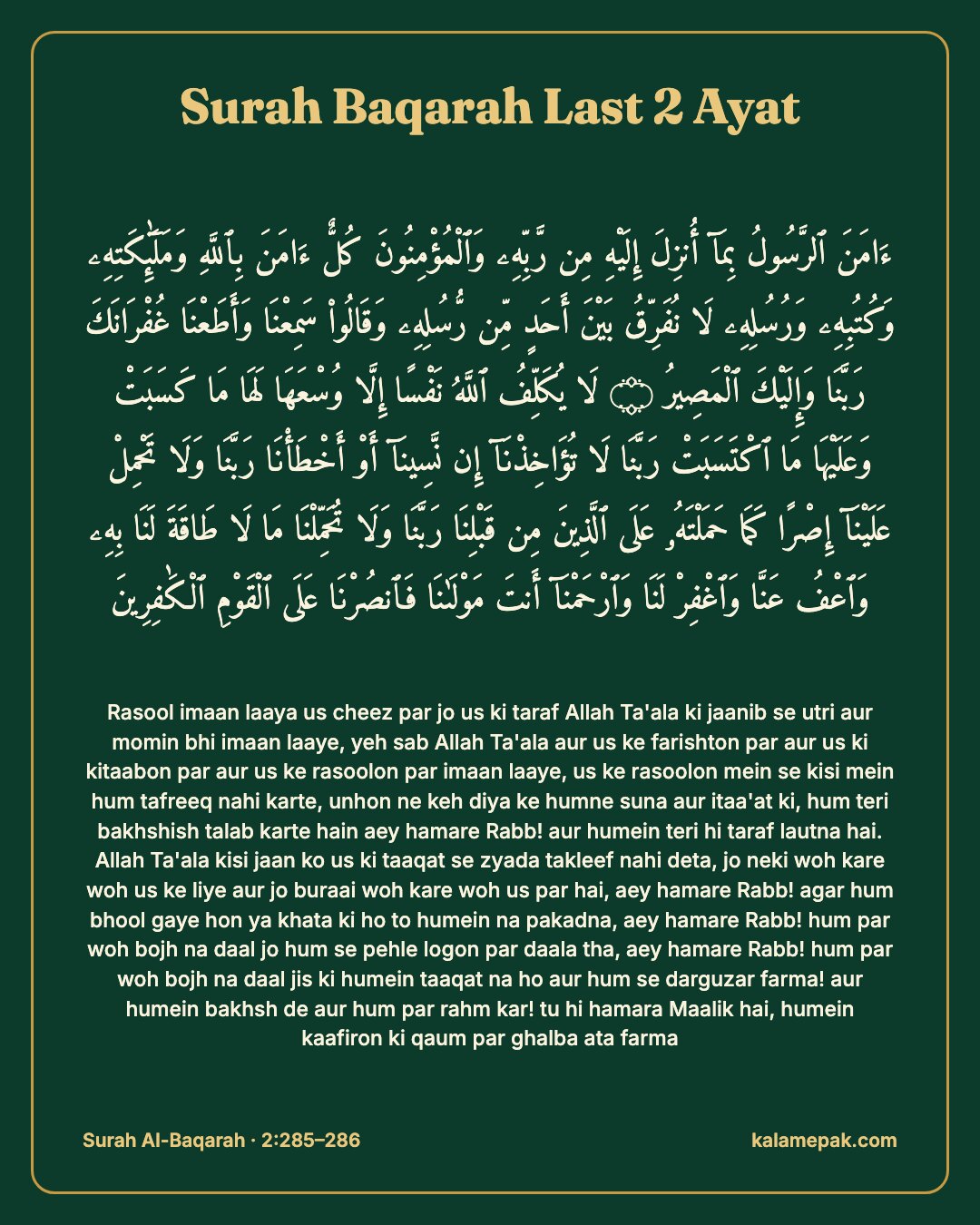
The messenger believeth in that which hath been revealed unto him from his Lord and (so do) the believers. Each one believeth in Allah and His angels and His scriptures and His messengers - We make no distinction between any of His messengers - and they say: We hear, and we obey. (Grant us) Thy forgiveness, our Lord. Unto Thee is the journeying.
Rasool imaan laaya us cheez par jo us ki taraf Allah Ta'ala ki jaanib se utri aur momin bhi imaan laaye, yeh sab Allah Ta'ala aur us ke farishton par aur us ki kitaabon par aur us ke rasoolon par imaan laaye, us ke rasoolon mein se kisi mein hum tafreeq farq nahi karte, unhon ne keh diya ke humne suna aur itaa'at ki, hum teri bakhshish maafi talab karte hain aey hamare Rabb! aur humein teri hi taraf lautna hai
Surah Al-Baqarah · 2:285
Allah tasketh not a soul beyond its scope. For it (is only) that which it hath earned, and against it (only) that which it hath deserved. Our Lord! Condemn us not if we forget, or miss the mark! Our Lord! Lay not on us such a burden as thou didst lay on those before us! Our Lord! Impose not on us that which we have not the strength to bear! Pardon us, absolve us and have mercy on us, Thou, our Protector, and give us victory over the disbelieving folk.
Allah Ta'ala kisi jaan ko us ki taaqat se zyada takleef nahi deta, jo neki woh kare woh us ke liye aur jo buraai woh kare woh us par hai, aey hamare Rabb! agar hum bhool gaye hon ya khata galti ki ho to humein na pakadna, aey hamare Rabb! hum par woh bojh na daal jo hum se pehle logon par daala tha, aey hamare Rabb! hum par woh bojh na daal jis ki humein taaqat na ho aur hum se darguzar maaf karna farma! aur humein bakhsh de aur hum par rahm kar! tu hi hamara Maalik hai, humein kaafiron ki qaum par ghalba jeet ata farma
Surah Al-Baqarah · 2:286
Listen to these two verses on Quran.com.
Surah Baqarah last 2 ayat in Roman English
Amanar rasulu bima unzila ilaihi mir rabbihi wal mu'minun, kullun amana billahi wa mala'ikatihi wa kutubihi wa rusulih, la nufarriqu baina ahadim mir rusulih, wa qalu sami'na wa ata'na, ghufranaka rabbana wa ilaikal masir.
La yukallifullahu nafsan illa wus'aha, laha ma kasabat wa alaiha maktasabat, rabbana la tu'akhizna in nasina au akhta'na, rabbana wa la tahmil alaina isran kama hamaltahu alallazina min qablina, rabbana wa la tuhammilna ma la taqata lana bihi, wa'fu anna, waghfir lana, warhamna, anta maulana fansurna alal qaumil kafirin.
People also write it as last 2 ayats of Surah Baqarah, Surah Baqarah ki aakhri 2 ayat or Surah Bakra ki akhri do ayat.
सूरह बक़रह की आख़िरी 2 आयतें हिंदी में
सूरह बक़रह की आख़िरी 2 आयतें, आयत 285 और 286 हैं। नबी ﷺ ने फ़रमाया कि जो इन्हें रात में पढ़े, ये उस के लिए काफ़ी हैं (सहीह बुख़ारी 5009)।
तर्जुमा: रसूल ईमान लाया उस चीज़ पर जो उस की तरफ़ अल्लाह तआला की जानिब से उतरी और मोमिन भी ईमान लाए, ये सब अल्लाह तआला और उस के फ़रिश्तों पर और उस की किताबों पर और उस के रसूलों पर ईमान लाए, उस के रसूलों में से किसी में हम तफ़रीक़ नहीं करते, उन्हों ने कह दिया कि हम ने सुना और इताअत की, हम तेरी बख़्शिश तलब करते हैं ऐ हमारे रब! और हमें तेरी ही तरफ़ लौटना है
तर्जुमा: अल्लाह तआला किसी जान को उस की ताक़त से ज़्यादा तकलीफ़ नहीं देता, जो नेकी वो करे वो उस के लिए और जो बुराई वो करे वो उस पर है, ऐ हमारे रब! अगर हम भूल गए हों या ख़ता की हो तो हमें न पकड़ना, ऐ हमारे रब! हम पर वो बोझ न डाल जो हम से पहले लोगों पर डाला था, ऐ हमारे रब! हम पर वो बोझ न डाल जिस की हमें ताक़त न हो और हम से दरगुज़र फ़रमा! और हमें बख़्श दे और हम पर रहम कर! तू ही हमारा मालिक है, हमें काफ़िरों की क़ौम पर ग़लबा अता फ़रमा
2:285–286 · Hindi: Junagarhi in Hindi script
अरबी आयतें हिंदी में ऐसे पढ़ें:
आमनर्रसूलु बिमा उन्ज़िला इलैहि मिर्रब्बिही वल मुअमिनून, कुल्लुन आमना बिल्लाहि व मलाइकतिही व कुतुबिही व रुसुलिही, ला नुफ़र्रिक़ु बैना अहदिम मिर्रुसुलिही, व क़ालू समिअना व अतअना, ग़ुफ़रानका रब्बना व इलैकल मसीर।
ला युकल्लिफ़ुल्लाहु नफ़्सन इल्ला वुसअहा, लहा मा कसबत व अलैहा मक्तसबत, रब्बना ला तुआख़िज़ना इन नसीना औ अख़्तअना, रब्बना व ला तहमिल अलैना इसरन कमा हमल्तहू अलल्लज़ीना मिन क़ब्लिना, रब्बना व ला तुहम्मिलना मा ला ताक़ता लना बिही, वअफ़ु अन्ना, वग़फ़िर लना, वरहमना, अन्ता मौलाना फ़न्सुरना अलल क़ौमिल काफ़िरीन।
سورہ بقرہ کی آخری دو آیات اردو میں
سورہ بقرہ کی آخری دو آیات، آیت 285 اور 286 ہیں۔ نبی ﷺ نے فرمایا کہ جو انہیں رات میں پڑھے، یہ اس کے لیے کافی ہیں (صحیح بخاری 5009)۔
ترجمہ: رسول ایمان لایا اس چیز پر جو اس کی طرف اللہ تعالیٰ کی جانب سے اتری اور مومن بھی ایمان لائے، یہ سب اللہ تعالیٰ اور اس کے فرشتوں پر اور اس کی کتابوں پر اور اس کے رسولوں پر ایمان لائے، اس کے رسولوں میں سے کسی میں ہم تفریق نہیں کرتے، انہوں نے کہہ دیا کہ ہم نے سنا اور اطاعت کی، ہم تیری بخشش طلب کرتے ہیں اے ہمارے رب! اور ہمیں تیری ہی طرف لوٹنا ہے
ترجمہ: اللہ تعالیٰ کسی جان کو اس کی طاقت سے زیادہ تکلیف نہیں دیتا، جو نیکی وہ کرے وہ اس کے لئے اور جو برائی وہ کرے وہ اس پر ہے، اے ہمارے رب! اگر ہم بھول گئے ہوں یا خطا کی ہو تو ہمیں نہ پکڑنا، اے ہمارے رب! ہم پر وہ بوجھ نہ ڈال جو ہم سے پہلے لوگوں پر ڈالا تھا، اے ہمارے رب! ہم پر وہ بوجھ نہ ڈال جس کی ہمیں طاقت نہ ہو اور ہم سے درگزر فرما! اور ہمیں بخش دے اور ہم پر رحم کر! تو ہی ہمارا مالک ہے، ہمیں کافروں کی قوم پر غلبہ عطا فرما
2:285–286 · Urdu: Junagarhi
Surah Baqarah last 2 ayat benefits: what the hadith say
They are "sufficient" at night. The Prophet ﷺ said: "If somebody recited the last two Verses of Surat Al-Baqara at night, that will be sufficient for him" (Sahih al-Bukhari 5009, and Sahih Muslim 807a with almost the same words). The hadith doesn't spell out sufficient for what. Imam an-Nawawi's commentary on Sahih Muslim gives more than one explanation: that they suffice for the night prayer, or protect the reader from Shaytan and from harm, and the wording may cover all of these.
They are one of "two lights". An angel greeted the Prophet ﷺ with these words: "Rejoice in two lights given to you which have not been given to any prophet before you: Fatihat al-Kitab and the concluding verses of Surah al-Baqara. You will never recite a letter from them for which you will not be given (a reward)" (Sahih Muslim 806). The other light is the surah you read in every rak'ah: see Surah Fatiha meaning.
They were given on the Night Journey. Abdullah narrated that the Prophet ﷺ was given three things on that night: the five prayers, the concluding verses of Surah al-Baqara, and forgiveness of serious sins for those of his ummah who do not associate anything with Allah (Sahih Muslim 173).
"I indeed did it": how verse 286 was answered
The story behind these verses is one of the most comforting in the Quran. Verse 284 says that Allah will call us to account for what is in our hearts, whether we show it or hide it. Ibn Abbas narrated that this worried the Companions as nothing had before. The Prophet ﷺ told them: "Say: We have heard and obeyed and submitted ourselves."
Then verse 286 came down, and with each request, Allah replied. "Our Lord, call us not to account if we forget or make a mistake." He said: قَدْ فَعَلْتُ, "I indeed did it." "Our Lord! do not lay on us a burden as Thou didst lay on those before us." He said: "I indeed did it." "And pardon us, have mercy on us. Thou art our Protector." He said: "I indeed did it" (Sahih Muslim 126).
So when you read this dua, you are asking for something the hadith says Allah has already answered.
Surah Baqarah last 3 ayat
If you are looking for the last 3 ayat, they begin one verse earlier, with the verse that worried the Companions:
Unto Allah (belongeth) whatsoever is in the heavens and whatsoever is in the earth; and whether ye make known what is in your minds or hide it, Allah will bring you to account for it. He will forgive whom He will and He will punish whom He will. Allah is Able to do all things.
Aasmaanon aur zameen ki har cheez Allah Ta'ala hi ki milkiyat hai. Tumhaare dilon mein jo kuch hai use tum zaahir karo ya chhupaao, Allah Ta'ala us ka hisaab tum se lega. Phir jise chaahe bakhshe aur jise chaahe saza de aur Allah Ta'ala har cheez par qaadir hai
Surah Al-Baqarah · 2:284
What each verse says
Verse 285 is a statement of belief. The Messenger and the believers believe in what was sent down, and in four things by name: Allah, His angels, His books and His messengers. They make no difference between any of the messengers. Then come the believers' own words: samiʿnā wa aṭaʿnā, "we heard and we obeyed", and they ask for forgiveness.
Verse 286 begins with a promise. Lā yukallifullāhu nafsan illā wusʿahā: Allah does not burden a soul beyond what it can bear. Many Muslims know this line by heart for hard days. Then the verse turns into a dua, calling Rabbanā, "our Lord", three times:
- Don't take us to task if we forget or make a mistake.
- Don't lay on us a burden like the one laid on those before us.
- Don't make us carry what we have no strength for.
- Pardon us, forgive us, have mercy on us. You are our Protector, so help us.
When to read them
The hadith says at night and names no hour. Many people read them before going to sleep, and that is an easy habit to keep. Two other bedtime readings have their own hadith: Ayatul Kursi (Sahih al-Bukhari 2311), and Surah Ikhlas, Falaq and Nas (Sahih al-Bukhari 5017).
Try this tonight. Read the two verses once with the meaning open. Stop at samiʿnā wa aṭaʿnā and at each Rabbanā. The second night, try saying rabbanā lā tuʾākhidhnā in nasīnā aw akhṭaʾnā from memory: seven words that ask Allah to forgive what we forget and get wrong.
Word by word: verse 285
| Arabic | Say it | Meaning | In the book |
|---|---|---|---|
| ءَامَنَ | āmana | believed | #19 āmana · 537× |
| ٱلرَّسُولُ | ar-rasūlu | the Messenger | #64 rasūl · 332× |
| بِمَآ | bimā | in what | #7 mā · 1,592× |
| أُنزِلَ | unzila | was sent down | #66 anzala · 183× |
| إِلَيْهِ | ilayhi | to him | #15 ilā · 742× |
| مِن | min | from | #1 min · 3,226× |
| رَّبِّهِۦ | rabbihī | his Lord | #12 rabb · 975× |
| وَٱلْمُؤْمِنُونَ | wal-muʾminūna | and the believers | #122 muʾmin · 202× |
| كُلٌّ | kullun | each one | #50 kull · 359× |
| ءَامَنَ | āmana | believed | #19 āmana · 537× |
| بِٱللَّهِ | billāhi | in Allah | #2 Allah · 2,699× |
| وَمَلَٰٓئِكَتِهِۦ | wa malāʾikatihī | and His angels | #127 malak · 88× |
| وَكُتُبِهِۦ | wa kutubihī | and His books | #65 kitāb · 260× |
| وَرُسُلِهِۦ | wa rusulihī | and His messengers | #64 rasūl · 332× |
| لَا | lā | not | #3 lā · 1,742× |
| نُفَرِّقُ | nufarriqu | we make a difference | |
| بَيْنَ | bayna | between | #31 bayn · 266× |
| أَحَدٍ | aḥadin | any one | #288 aḥad · 74× |
| مِّن | min | of | #1 min · 3,226× |
| رُّسُلِهِۦ | rusulihī | His messengers | #64 rasūl · 332× |
| وَقَالُوا۟ | wa qālū | and they said | #6 qāla · 1,618× |
| سَمِعْنَا | samiʿnā | we heard | #308 samiʿa · 78× |
| وَأَطَعْنَا | wa aṭaʿnā | and we obeyed | #210 aṭāʿa · 72× |
| غُفْرَانَكَ | ghufrānaka | Your forgiveness (we ask) | |
| رَبَّنَا | rabbanā | our Lord | #12 rabb · 975× |
| وَإِلَيْكَ | wa ilayka | and to You | #15 ilā · 742× |
| ٱلْمَصِيرُ | al-maṣīru | is the return | #487 maṣīr · 28× |
Word by word: verse 286
| Arabic | Say it | Meaning | In the book |
|---|---|---|---|
| لَا | lā | not | #3 lā · 1,742× |
| يُكَلِّفُ | yukallifu | burdens | |
| ٱللَّهُ | Allāhu | Allah | #2 Allah · 2,699× |
| نَفْسًا | nafsan | a soul | #219 nafs · 295× |
| إِلَّا | illā | except | #17 illā · 659× |
| وُسْعَهَا | wusʿahā | (within) its capacity | |
| لَهَا | lahā | for it | |
| مَا | mā | what | #7 mā · 1,592× |
| كَسَبَتْ | kasabat | it earned | #95 kasaba · 62× |
| وَعَلَيْهَا | wa ʿalayhā | and against it | #9 ʿalā · 1,444× |
| مَا | mā | what | #7 mā · 1,592× |
| ٱكْتَسَبَتْ | iktasabat | it earned (of wrong) | |
| رَبَّنَا | rabbanā | our Lord | #12 rabb · 975× |
| لَا | lā | do not | #3 lā · 1,742× |
| تُؤَاخِذْنَآ | tuʾākhidhnā | take us to task | |
| إِن | in | if | #16 in · 703× |
| نَّسِينَآ | nasīnā | we forget | #117 nasiya · 35× |
| أَوْ | aw | or | #30 aw · 280× |
| أَخْطَأْنَا | akhṭaʾnā | we make a mistake | |
| رَبَّنَا | rabbanā | our Lord | #12 rabb · 975× |
| وَلَا | wa lā | and do not | #3 lā · 1,742× |
| تَحْمِلْ | taḥmil | lay | #335 ḥamala · 41× |
| عَلَيْنَآ | ʿalaynā | on us | #9 ʿalā · 1,444× |
| إِصْرًا | iṣran | a heavy burden | |
| كَمَا | kamā | as | |
| حَمَلْتَهُۥ | ḥamaltahū | You laid it | #335 ḥamala · 41× |
| عَلَى | ʿalā | on | #9 ʿalā · 1,444× |
| ٱلَّذِينَ | alladhīna | those | #8 alladhī · 1,468× |
| مِن | min | from | #1 min · 3,226× |
| قَبْلِنَا | qablinā | before us | #51 qabl · 242× |
| رَبَّنَا | rabbanā | our Lord | #12 rabb · 975× |
| وَلَا | wa lā | and do not | #3 lā · 1,742× |
| تُحَمِّلْنَا | tuḥammilnā | make us carry | |
| مَا | mā | what | #7 mā · 1,592× |
| لَا | lā | no | #3 lā · 1,742× |
| طَاقَةَ | ṭāqata | strength | |
| لَنَا | lanā | we have | |
| بِهِۦ | bihī | for it | |
| وَٱعْفُ | waʿfu | and pardon | #367 ʿafā · 27× |
| عَنَّا | ʿannā | us | #21 ʿan · 465× |
| وَٱغْفِرْ | waghfir | and forgive | #130 ghafara · 65× |
| لَنَا | lanā | us | |
| وَٱرْحَمْنَآ | warḥamnā | and have mercy on us | #298 raḥima · 28× |
| أَنتَ | anta | You are | |
| مَوْلَىٰنَا | mawlānā | our Protector | #461 mawlā · 18× |
| فَٱنصُرْنَا | fanṣurnā | so help us | #97 naṣara · 59× |
| عَلَى | ʿalā | against | #9 ʿalā · 1,444× |
| ٱلْقَوْمِ | al-qawmi | the people | #25 qawm · 383× |
| ٱلْكَٰفِرِينَ | al-kāfirīna | who disbelieve | #125 kāfir · 156× |
"In the book" is the word's number in 600 Words of the Quran and how many times it appears in the whole Quran. Of the 76 words in these two verses, 60 are built on a word from that list. Learn them once and you will meet them again all through the Quran.
87 duas from the Quran, including the duas in these two verses word by word, are collected in Quran ki Duaein. And if you want to recognise words like āmana, rasūl, nafs and ghafara wherever you meet them, they are taught in 600 Words of the Quran, each with a real verse in English and Roman Urdu.
The duas in these two verses are among the Rabbana duas of the Quran; ten of them are collected with meaning in Rabbana duas from the Quran.
Sources: Quran text from the Quranic Arabic Corpus and Tanzil · verse meanings in English from Marmaduke Pickthall and in Urdu from Maulana Muhammad Junagarhi · meanings of duas and phrases in Roman Urdu, Urdu and Hindi are our own plain renderings · hadith with collection and number, linked to sunnah.com. How we check every article →
Frequently asked questions
Which are the last 2 ayat of Surah Baqarah?
Verses 285 and 286 of Surah Al-Baqarah, the Quran's second surah. They begin 'Amanar-rasul', which is why many people call them Amana Rasool.
What is the benefit of reading the last 2 ayat of Surah Baqarah?
The Prophet ﷺ said that whoever recites them at night, they will be sufficient for him (Sahih al-Bukhari 5009, Sahih Muslim 807a). An angel also called them, with Surah Fatiha, one of two lights given to him (Sahih Muslim 806).
When should I read the last 2 ayat of Surah Baqarah?
The hadith says at night and names no exact time. Many people read them before going to sleep.
What does 'Allah does not burden a soul' mean?
It is the opening of verse 286: 'Allah tasketh not a soul beyond its scope.' In Urdu: Allah Ta'ala kisi jaan ko us ki taaqat se zyada takleef nahi deta.
Is Amana Rasool the same as the last 2 ayat of Surah Baqarah?
Yes. Amana Rasool is a popular name taken from the first words of verse 285. Some people use it for verse 285 alone, but usually it means both verses.