Ayat e Karima: Meaning & Benefits in Urdu, Hindi & English
Reviewed by Abrar Iqbal, Islamic scholar (PhD in Islamic research) · 14 Nov 2026

Ayat e Karima (آیت کریمہ · आयते करीमा) is the popular name for the words Prophet Yunus (AS) called out from the darkness, inside the fish: La ilaha illa anta subhanaka inni kuntu minaz zalimin. It means: "There is no God save Thee. Be Thou Glorified! Lo! I have been a wrong-doer." In Urdu: Tere siwa koi maabood nahi, tu paak hai, beshak main zaalimon mein ho gaya.
The words are in the Quran at 21:87. The Prophet Muhammad ﷺ said that no Muslim asks Allah for anything with this dua except that Allah responds to him (Tirmidhi 3505).
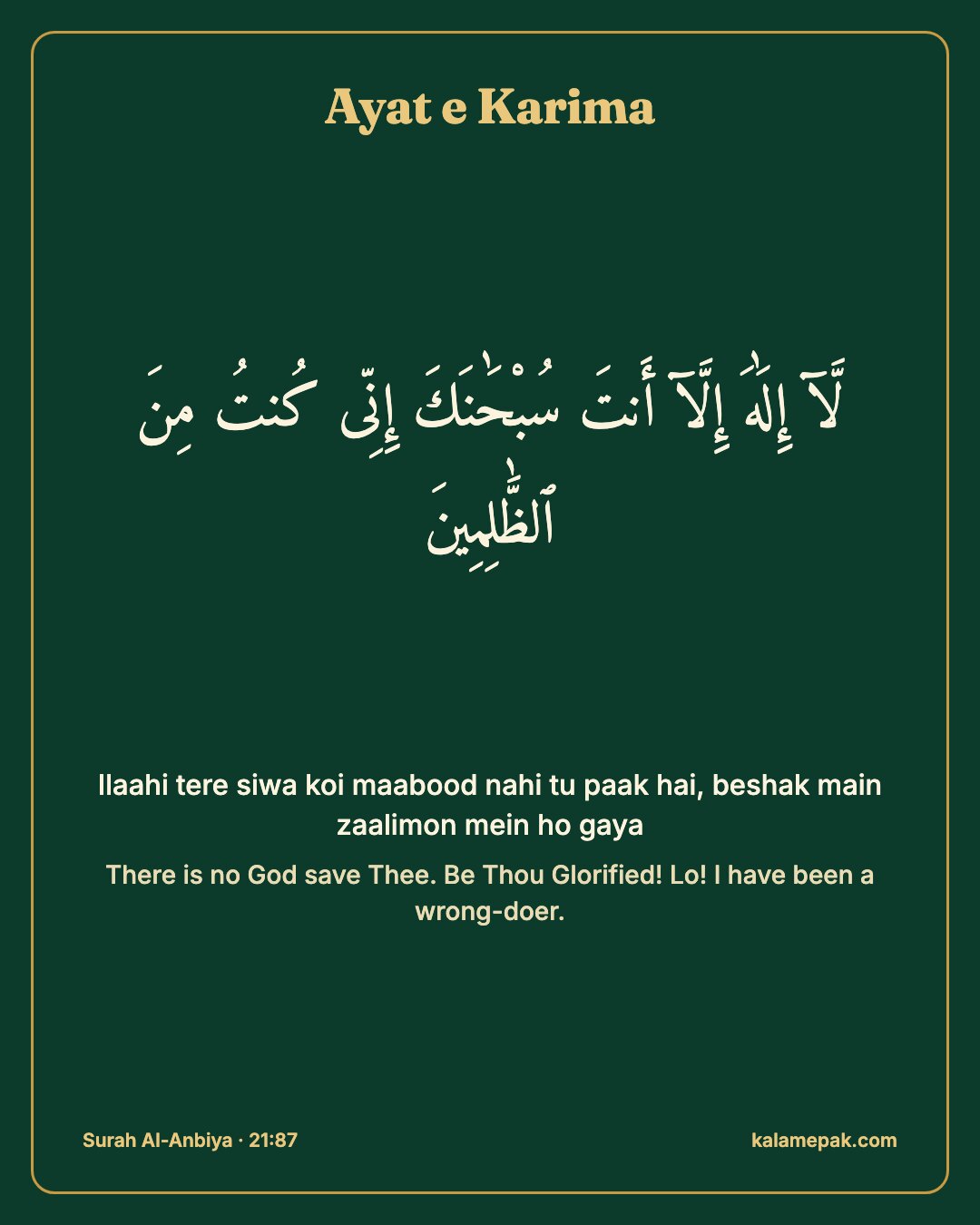
Ayat e Karima in Arabic with translation
There is no God save Thee. Be Thou Glorified! Lo! I have been a wrong-doer.
Ilaahi aey mere Allah tere siwa koi maabood jis ki ibaadat ki jaaye nahi tu paak hai, beshak main zaalimon mein ho gaya
Surah Al-Anbiya · 21:87 (part)
Listen to this verse on Quran.com.
Ayat e Karima in Roman English
La ilaha illa anta subhanaka inni kuntu minaz zalimin.
People spell the name many ways: Ayat e Karima, Ayat e Kareema, Ayat Karima, Ayat al Karima, Ayat Kareema. Karīmah means noble, honoured.
Ayat e Karima benefits: what the hadith says
Sa'd narrated that the Prophet ﷺ said:
"The supplication of Dhun-Nun (Prophet Yunus) when he supplicated, while in the belly of the whale was: 'There is none worthy of worship except You, Glory to You, Indeed, I have been of the transgressors.' So indeed, no Muslim man supplicates with it for anything, ever, except Allah responds to him." (Tirmidhi 3505, graded Sahih by Darussalam on sunnah.com)
So it isn't only for one kind of trouble. The hadith says for anything.
आयते करीमा हिंदी में
आयते करीमा हज़रत यूनुस (अलैहिस्सलाम) की वो दुआ है जो उन्हों ने मछली के पेट में पढ़ी (क़ुरआन 21:87)। नबी ﷺ ने फ़रमाया कि जो मुसलमान किसी भी चीज़ के लिए इस से दुआ करे, अल्लाह उस की दुआ क़बूल करता है (तिर्मिज़ी 3505)।
तर्जुमा: इलाही तेरे सिवा कोई माबूद नहीं तू पाक है, बेशक मैं ज़ालिमों में हो गया
21:87 (part) · Hindi: Junagarhi in Hindi script
अरबी दुआ हिंदी में ऐसे पढ़ें:
ला इलाहा इल्ला अन्ता सुब्हानका इन्नी कुन्तु मिनज़्ज़ालिमीन।
آیت کریمہ اردو میں
آیت کریمہ حضرت یونس علیہ السلام کی وہ دعا ہے جو انہوں نے مچھلی کے پیٹ میں پڑھی (قرآن 21:87)۔ نبی ﷺ نے فرمایا کہ جو مسلمان کسی بھی چیز کے لیے اس سے دعا کرے، اللہ اس کی دعا قبول کرتا ہے (ترمذی 3505)۔
ترجمہ: الٰہی تیرے سوا کوئی معبود نہیں تو پاک ہے، بیشک میں ظالموں میں ہو گیا
21:87 (part) · Urdu: Junagarhi
Word by word
| Arabic | Say it | Meaning | In the book |
|---|---|---|---|
| لَّآ | lā | (there is) no | #3 lā · 1,742× |
| إِلَٰهَ | ilāha | god | #283 ilāh · 147× |
| إِلَّآ | illā | except | #17 illā · 659× |
| أَنتَ | anta | You | |
| سُبْحَٰنَكَ | subḥānaka | glory be to You | #398 subḥān · 41× |
| إِنِّى | innī | indeed I | #5 inna · 1,682× |
| كُنتُ | kuntu | have been | #10 kāna · 1,358× |
| مِنَ | mina | among | #1 min · 3,226× |
| ٱلظَّٰلِمِينَ | aẓ-ẓālimīn | the wrongdoers | #186 ẓālim · 129× |
"In the book" is the word's number in 600 Words of the Quran and how many times it appears in the whole Quran. All but one of these nine words are from that list.
Three things in one sentence
Short as it is, the dua says three separate things:
- لَّآ إِلَٰهَ إِلَّآ أَنتَ: You alone are God. It opens with the same words as the kalma, but says anta, "You", speaking to Allah directly. See La ilaha illallah meaning.
- سُبْحَٰنَكَ: Glory be to You. He declares Allah free of all fault. See SubhanAllah meaning.
- إِنِّى كُنتُ مِنَ ٱلظَّٰلِمِينَ: I am the one who did wrong. He blames nobody else.
Notice what is missing. He asks for nothing in words: not "save me" or "get me out". He praises Allah and admits his own fault. And in the next verse, Allah answers.
The story of Yunus (AS) in the Quran
The Quran calls him Dhu'n-Nūn, "the man of the fish", and tells the story in short pieces.
And (mention) Dhu'n-Nun, when he went off in anger and deemed that We had no power over him, but he cried out in the darkness, saying: There is no God save Thee. Be Thou Glorified! Lo! I have been a wrong-doer.
Machhli wale (Hazrat Yunus alaihis salaam) ko yaad karo! jabke woh gusse se chal diya aur khayaal kiya ke hum use na pakad sakenge. Bil-aakhir woh andheron ke andar se pukaar utha ke Ilaahi tere siwa koi maabood nahi tu paak hai, beshak main zaalimon mein ho gaya
Surah Al-Anbiya · 21:87
Then we heard his prayer and saved him from the anguish. Thus we save believers.
To humne us ki pukaar sun li aur use gham se najaat de di aur hum imaan walon ko isi tarah bacha liya karte hain
Surah Al-Anbiya · 21:88
Those last words are why this dua means so much to Muslims. Allah did not end with Yunus. He added: "Thus we save believers."
Surah As-Saffat adds more: Yunus (AS) "fled unto the laden ship", the lots were drawn and he lost, "the fish swallowed him", and "had he not been one of those who glorify (Allah), he would have tarried in its belly till the day when they are raised" (37:140–144). So it was his glorifying of Allah that the Quran names here. Surah Al-Qalam uses him as a lesson in patience: "be not like him of the fish, who cried out in despair" (68:48).
Is there a fixed count, like 125000 or 313 times?
Many families gather to recite Ayat e Karima a set number of times, and you may have heard of a count like 313 or 1.25 lakh (125000), or seen it called a wazifa. The verses and the hadith on this page mention no number. If you are following a count taught by your elders, you can ask them where it comes from. What these sources do teach is simpler: say the words, mean them, and ask Allah.
How to use it today
- In a hard moment: a bad phone call, a worry at night, a problem with no way out. Yunus (AS) was in darkness inside a fish, and he still had this to say.
- Before you ask for something: say it first, then ask in your own language.
- When you have done wrong: the last three words are a confession. They sit well with Astaghfirullah and with the dua read at the end of namaz, which also begins with admitting wrong: Allāhumma innī ẓalamtu nafsī.
Another one-line dua of a prophet in hardship is Rabbi inni lima anzalta ilayya min khairin faqir, said by Musa (AS) at the well of Madyan (28:24).
Two other short phrases from the Quran sit beside Ayat e Karima in times of trouble: Hasbunallahu wa niʿmal wakeel (3:173) and Inna lillahi wa inna ilayhi rajiun (2:156).
A one-minute exercise. Say it slowly three times. The first time, think of anta: you are speaking to Allah directly. The second, think of subḥānaka: He has done nothing wrong to you. The third, think of minaẓ-ẓālimīn: what is one thing I need to own up to?
The words ilāh, subḥān, ẓālim, nādā ("he called out", #314 · 44×) and istajāba ("he answered", #318 · 28×) are all taught in 600 Words of the Quran, each with a real verse in English and Roman Urdu. This dua, with 86 more from the Quran, is in Quran ki Duaein.
Sources: Quran text from the Quranic Arabic Corpus and Tanzil · verse meanings in English from Marmaduke Pickthall and in Urdu from Maulana Muhammad Junagarhi · meanings of duas and phrases in Roman Urdu, Urdu and Hindi are our own plain renderings · hadith with collection and number, linked to sunnah.com. How we check every article →
Frequently asked questions
What is Ayat e Karima?
It is the popular name for the words of Prophet Yunus (AS) in Quran 21:87: 'La ilaha illa anta subhanaka inni kuntu minaz-zalimin'. Meaning: There is no God save Thee. Be Thou Glorified! Lo! I have been a wrong-doer.
What is the benefit of Ayat e Karima?
The Prophet ﷺ said of this dua: 'no Muslim man supplicates with it for anything, ever, except Allah responds to him' (Tirmidhi 3505, graded Sahih by Darussalam on sunnah.com). In the Quran, Allah says He answered Yunus and saved him from anguish, and 'Thus we save believers' (21:88).
How many times should Ayat e Karima be read?
The verses and the hadith on this page mention no number. Some families recite it a set number of times together as a custom.
When should I read Ayat e Karima?
Yunus (AS) said it in distress, so many Muslims say it when in trouble or grief and when turning to Allah in repentance. The hadith says it can be used to ask for anything.